Quality medical transcription services contribute towards safeguarding a healthcare practice from legal hazards. Certain things may be beyond the practice’s control such as an unexpected death despite the best medical intervention. Yet, some other things such as mistakes in healthcare documentation can be curbed and prevented to avoid minor or serious legal action.
Maintaining Consistent Accuracy – The medical transcriptionists in a reliable company would be experts in medical terminology, the structure and process of the human body, different styles and formats, and English language spelling, punctuation and grammar. If you require voice transcription services for a particular medical specialty, a team of transcriptionists that have experience in transcribing notes for that particular specialty would be entrusted with your project. It is thus possible to achieve a transcription accuracy of 98 percent and above. If the prepared medical records are of such precision, you have less cause to worry if a malpractice litigation issue should arise.
HIPAA Compliance – A HIPAA compliant service provider would ensure that patient information is protected. Measures they would have in place include:
Ensuring that no floppy disks or laptops are brought into the company quarters and that no information or CDs from the office are taken out
Providing password and anti-virus protection for computers
Keeping a fire extinguisher and smoke alarm
Maintaining computer system back-ups
HIPAA compliance can help to avoid complaints from patients pertaining to a breach of patient privacy.
Timely Completion – Timely completion of projects is something that can’t be compromised in medical transcription services. Timely completion ensures that physicians have whatever particulars they require to design a strategy for the patient’s care and treatment, on time. This again can help to prevent litigation.
The U.S. is still feeling the negative effects of the recession along with problems such as strict compliance regulations, packed deadlines and difficult budgets. So, medical transcription outsourcing is something which your healthcare practice shouldn’t have to think twice about. This blog gives you some good, valid reasons to outsource.
Better Quality – Your back office team may not as familiar with medical terminology and English language use as you would want them to be. There are chances of errors creeping in. Medical transcriptionists at a reliable transcription company would have received exhaustive training in comprehending medical terms and jargon and foreign dialects and accents and in English language use and style. These transcriptionists would have also acquired experience in preparing different medical records for a wide range of medical specialties. You can thus expect fewer errors.
Offshore Resources – Very often, medical transcription outsourcing companies use the services of offshore manpower. This is good because wages are lower in countries such as India and the Philippines. What’s more, the difference in time zones gives you the assurance that there are people working dedicatedly on your project even as you sleep, to complete and deliver it to you by the time you wake up. Backlog can also be cut down.
Lower Costs – Managing an in-house transcription team is a costly affair. You have to worry about matters such as hiring and training suitable staff, installing costly infrastructure, ensuring its upkeep and also upgrading to more modern equipment. Outsource and you don’t have to worry about all these things. You’ll also notice that your operating costs get considerably reduced.
Convenient Output – A first-class service provider would usually deliver documents that are both comprehensible and multipurpose at all interfaces.
Transferable Across the Globe – With the internet revolution, service providers can now transfer your files to wherever you are, in whichever part of the globe.
HIPAA Compliance – If you are outsourcing to an HIPAA compliant company, you can rest assured that their infrastructure would be secured against data theft.
Anytime Access – A leading medical transcription service provider would keep backups of patient records. If you want to access them at a later date, chances are that the files would still be there with the company. In addition, once you’ve outsourced a transcription project to the company, you can view the files to see the work that has been/is being done and to make any necessary corrections.
Some of the other benefits of medical transcription outsourcing are flexibility in dictation modalities and file transfer, efficient customer support, custom turnaround and EHR or EPM feeds.
Medical transcription services performed by an outsourcing solution provider can help a medical practice ensure it is always up-to date with respect to medical records. It would also ensure among other things, superior quality and HIPAA compliance. So would be the case when you send ER dictations and notes to outsourcing companies for transcription.
Medical Transcription Service for a Good Price
Medical transcription outsourcing companies would have transcription specialists in a variety of medical specialties including emergency room. As such, healthcare centers, hospitals, individual practitioners, medical emergency centers, trauma care centers and other medical practices don’t have to worry about training their own back office staff to be experts in medical terminology, lab values, diseases, anatomy, the English language, and so on. These companies, provided they are established and reliable ones, would know it all and perform the transcription for a very good price. They would also adhere to the specific ER transcription formatting requirements provided by the client.
A stringent quality control process would ensure that the ER medical reports with their different sections such as chief complaint, past medical history, history of present illness, physical examination and disposition are free of spelling, language, medical terminology related and other errors.
HIPAA Compliance Is Important
HIPAA compliance is something which cannot be avoided. When you outsource emergency room medical transcription to an HIPAA compliant service provider, you can be ensured of the following:
Confidentiality of all data that you share with the company
Superior measures for secure transfer of files
Password and virus protection for computers
Monthly data backups
When seeking reliable emergency room medical transcription services, make sure you look for a company that is flexible in the modes of dictation it accepts and the methods of file transfer it supports, offers digital or electronic signature capabilities, uses advanced technology, enables you to do online review and editing, and can meet your specific turnaround requirements. The company should also be able to give you a free trial and should keep itself up-to-date.
Comprehensive and accurate electronic health records (EHRs) provide the critical information needed for ongoing care decisions. That’s why accuracy rates are one of the most important considerations when choosing a medical transcription company. Skilled transcriptionists will accurately document diagnoses, treatment plans, and medical history, which is critical for patient care and safety.
EHRs serve several purposes all through the patient’s treatment. They chronicle the reasons leading up to the patient’s admission, diagnosis, and treatment plan. In addition to the patient’s current hospitalization, medications, and prevailing medical condition, they also provide information on the previous medical and surgical events, treatments, social and family history, allergies, and so on.
Let’s look into how medical transcription impacts patient care, medical practitioners, and the overall healthcare system.
Save time and improve EHR documentation accuracy with our medical transcription services!
Precise and timely medical documentation is necessary for patient safety and provision of quality of care. Medical transcription services provide detailed and precise documentation of physician dictation, so that clinicians can make informed clinical decisions. When transcribing dictations, reliable medical transcriptionists take care prevent errors, misinterpretations, and omissions in medical records. Even minor mistakes and typos can have grave consequences. For example, if the physician clearly states the patient is to take “10 milligrams of Lisinopril once daily”, and the medical transcriptionist incorrectly transcribes this as “100 milligrams of Lisinopril once daily”, it can lead to potentially dangerous side effects. Attention and quality control in the transcription process are essential to mitigate these risks.
Effective Communication
Medical transcription services also contribute to efficient healthcare delivery by ensuring that healthcare providers have access to up-to-date patient information when needed. Since accurately transcribed medical records represent a permanent record of patient history, treatments, and outcomes, they facilitate continuity of care. When all healthcare providers have access to accurate patient records, it prevents misunderstandings or miscommunications, and promotes seamless communication, enabling faster decision-making and efficient care.
Consider a patient who was hospitalized for a cardiac problem. On discharge, he has to continue his care with his primary care physician (PCP) and a cardiologist. A medical transcriptionist can provide accurate and detailed discharge summaries, including recommended follow-up tests and appointments. This allows the PCP and cardiologist to understand the hospital course and make informed decisions about ongoing care.
Reducing Legal Risks
Inaccurate or incomplete medical records can pose legal risks for healthcare providers and organizations, especially in cases where patient care is compromised. Accuracy in medical transcription is vital in the event of litigation or a malpractice lawsuit. In legal proceedings or medical malpractice cases, detailed and accurate medical documentation serves as evidence to support healthcare providers’ decisions and actions. EHR-integrated medical transcription ensures real-time documentation of patient care, mitigating risk of delays and inaccuracies that can undermine credibility lead to legal issues.
Medical Transcription: Best Practices for Accuracy
Reliable companies implement best practices to improve transcription accuracy and prevent errors that could impact patient safety.
Skilled team: Companies providing medical transcription services have skilled professionals on the job. Their transcriptionists have in-depth knowledge about medical terminology, anatomy, pharmacology, and healthcare workflows. They also have good typing speed and superior listening skills to provide accurate medical transcripts.
Continuous training: They also make sure their transcriptionists stay updated with industry regulations and documentation standards with continuous learning and quality improvement. This enables them to meet the highest standards of accuracy and professionalism.
Stringent QA: Reliable outsourcing companies have stringent quality assurance (QA) processes in place to guarantee that the transcribed reports are 99 percent accurate or better, provide an exact description of the original dictation, and comply with legal and regulatory requirements.
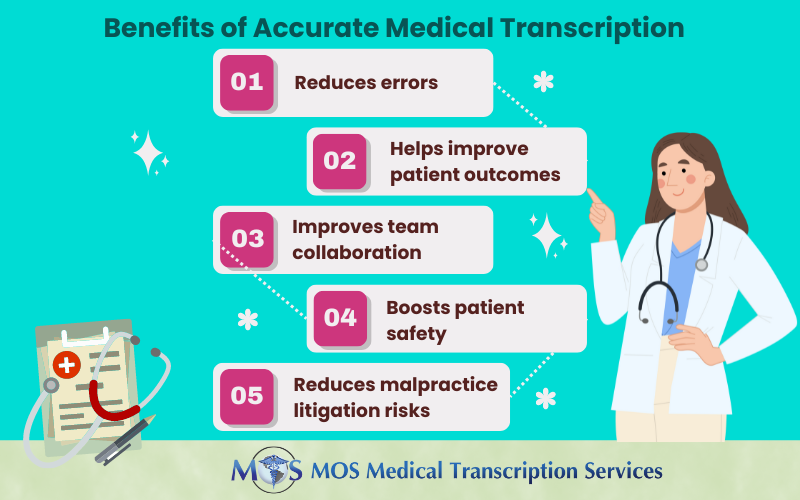
Reduce risk of miscommunication and medical errors.
Improve patient outcomes by ensuring timely and accurate information for making better clinical decisions, leading to improved patient outcomes.
Clear and detailed documentation facilitates better coordination among different healthcare providers, ensuring a collaborative approach to patient care.
Ensures the patient receives consistent care across different settings, enhancing overall safety and quality of care.
By helping healthcare providers maintaining accurate patient records, medical transcription services improve care, support more efficient communication, enhance patient outcomes, and improve overall healthcare delivery. Experts can provide custom documentation solutions for almost all specialties.
Optimize your practice with expert medical transcription services!
The dynamic nature of healthcare and digital documentation has contributed to the rapid growth of the medical transcription outsourcing industry, underscoring how outsourcing addresses a wide range of challenges. Beyond the technical benefits—such as improved accuracy, faster turnaround times, and seamless EHR integration—outsourcing medical transcription also comes with significant cost savings. Maintaining an in-house transcription infrastructure is expensive, requiring dedicated staff, software, and ongoing training. Today, many healthcare organizations are partnering with a professional medical transcription company not only to reduce costs but also to leverage AI-assisted workflows, ensure compliance with HIPAA and other regulations, and scale their transcription services efficiently in response to fluctuating patient volumes.
This post discusses the key drivers of medical transcription growth, top transcription challenges faced by healthcare providers, and how outsourcing addresses them.
Why the Demand for Medical Transcription is Growing
The medical transcription market is forecast to expand by USD 28.63 billion at a CAGR of 6.55% between 2023 and 2028, according to Technavio. This growth highlights the increasing challenges healthcare organizations face as they adopt electronic health records (EHRs) and manage rising data complexity.
Two key hurdles – ADT normalization and audio identification—are areas where medical transcription plays a vital role.
ADT Normalization
Admission, discharge, and transfer (ADT) data must be consistent and precise to ensure seamless integration into the patient’s official EHR. Transcription addresses this by:
Standardizing patient demographics and identifiers across records.
Formatting admission and discharge dates, times, and provider names accurately.
Maintaining consistency in documenting locations such as wards, ICUs, and clinics.
Aligning with EHR system requirements so records are linked to the correct patient and encounter.
By normalizing ADT data, medical transcription eliminates inconsistencies, prevents duplicate records, and ensures that clinical and administrative information remains reliable for both care and billing purposes.
Audio Identification
With multiple clinicians dictating simultaneously, associating each recording with the correct provider and patient is a significant challenge. Modern transcription technologies overcome this through audio identification, which:
Correctly attributes dictations to the right speaker.
Links each recording to the correct patient chart and encounter.
Prevents mismatched or duplicate records in the EHR.
Enhances billing and coding accuracy.
Improves patient safety by ensuring that every note is tied to the right medical record.
Evolving Demands: Telehealth and AI
The rapid adoption of telehealth and AI-powered tools adds further complexity, from managing virtual visit documentation to automating parts of transcription. Advanced transcription services leverage machine learning and natural language processing to streamline patient forms, discharge summaries, and treatment notes—helping reduce staff burden while supporting evidence-based care.
So, medical transcription is no longer just about typing notes. It actively resolves key challenges in healthcare documentation, making records more accurate, interoperable, and usable in a digital-first environment.
Top Medical Transcription Workflow Challenges in Healthcare Organizations
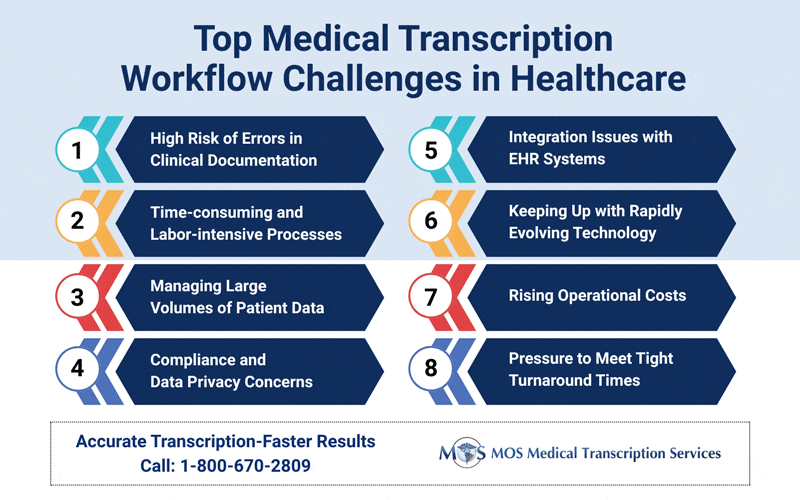
High Risk of Errors in Clinical Documentation: Manual transcription is prone to errors, including misspellings, omissions, or misinterpretation of medical terms. Inaccurate records can compromise patient safety, lead to incorrect treatment decisions, and increase liability risks.
Time-Consuming and Labor-Intensive: Transcribing medical notes in-house requires significant staff time, often diverting clinicians and administrative teams from patient care and other critical tasks.
Managing Large Volumes of Data: Healthcare providers generate vast amounts of documentation daily. Each patient generates approximately 80 megabytes of data annually, encompassing electronic medical records (EMRs), imaging, and other health-related information, according to Harmony Healthcare IT. Handling, organizing, and storing these records manually can be overwhelming and inefficient.
Compliance and Privacy Concerns: Healthcare transcription involves sensitive patient information. Healthcare is a prime target for hackers; 2023 saw thousands of reported breaches affecting millions of patient records. Ensuring HIPAA compliance and maintaining data security is challenging, especially for practices with limited IT infrastructure.
Integration with EHR Systems: Accurately entering transcribed data into Electronic Health Records (EHR) can be complex, particularly when EHR systems have compatibility or formatting issues, which may slow workflows.
Rapidly Evolving Technology: Advanced audio-to-text converters can quickly and accurately transcribe speech. But keeping up with AI-assisted transcription tools, speech recognition software, and other digital solutions can be difficult. Adopting these technologies requires training, system upgrades, and budget considerations.
High Costs: Maintaining internal transcription staff, software licenses, and quality control processes can be expensive, making it a financial burden for smaller practices or those with fluctuating patient volumes.
Turnaround Time Pressures: Delays in completing medical record documentation process can impact patient care decisions, insurance claim submissions, and overall workflow efficiency.
Regardless of the specialty, skilled transcriptionists can ensure accurate and timely speech-to-text conversion. They are well-versed in medical terminology and jargon and work with the latest tools and technologies to ensure precision. By ensuring error-free medical records, these services support timely and informed patient care decisions.
Clinical Documentation Improvement
Professional transcription services ensure that clinical notes are precise, standardized, and free from errors or ambiguities, supporting better care decisions and reducing misinterpretations. Improving clinical documentation through outsourcing improves the way documentation aligns with medical codes, reducing claim denials, audits, and reimbursement delays.
Quick Access to Patient History
EHR-integrated transcription services allow healthcare providers to retrieve patient histories rapidly, supporting timely and informed care decisions.
Modern Tools for Enhanced Accuracy
Advanced technologies, including speech recognition and AI-assisted workflows, reduce manual errors and improve medical record documentation quality.
Smooth Claims Processing
Accurate and timely documentation supports clean claims, minimizing denials and speeding up reimbursements.
Supports Evidence-Based Decision Making
Well-organized and error-free medical records enable providers to make informed, evidence-based clinical decisions.
Saving Time and Reducing Costs
By eliminating the need for in-house transcription infrastructure and staff, practices can reduce operational costs while increasing productivity. Outsourcing helps healthcare teams maintain up-to-date charts efficiently, freeing up time for patient care.
HIPAA Compliance
Reliable transcription companies follow strict HIPAA guidelines. HIPAA-compliant transcription outsourcing safeguards patient information and maintaining confidentiality.
If your practice or hospital is planning to outsource transcription, it’s important to evaluate vendors carefully. Key factors to consider include cost, response time, service quality, turnaround time, accuracy, and overall return on investment.
Choose a provider with proven experience in providing outsourced transcription solutions for hospitals and clinics and a solid track record in handling specialty-specific requirements. It’s also critical to ensure that the company is HIPAA-compliant and follows strict data security protocols to protect sensitive patient information.
The right partner will not only guarantee secure, high-quality documentation but also deliver significant cost savings—often in the range of 30% to 40% compared to in-house transcription. By selecting a reliable and compliant vendor, your organization can streamline workflows, reduce administrative burden, and enhance the efficiency of patient care delivery.
Streamline Your Documentation with Custom Medical Transcription Services!
A professional medical transcription company utilizes various kinds of technology to ensure that the transcription output is accurate and conforms to the client’s formatting and other guidelines. The application of technology can be seen right from the time the physician sends his dictations to the transcriptionist to the time when the transcription is complete and is delivered. Some of the technology applications of a medical transcription company are discussed below.
The Importance of Technology for Medical Transcription Service
Methods of Dictation – Consider the popular modes of dictation. Two commonly provided options are digital dictation machines and toll free number. In the former method, the medical information is dictated and recorded by the digital recorder. The data is downloaded to a local computer for use by the transcriptionists. In the second method, the physician would dictate through the telephone. The numbers provided facilitate direct dictation to the protected servers. After the physician has transferred his dictations, the transcriptionists use their own IT tools such as the computer and the internet to download the dictations and start the transcription process.
Software – Providers of medical transcription services in the US make use of different kinds of advanced software for benefits such as the following:
Voice capture
Word processing
Speech recognition
Speech processing
Quick editing
Document formatting
Audio playback
Document distribution
Electronic signature
Medical dictionary/spell check
Merging with other healthcare systems
Quick editing
Facility for insertion and exports
Convenient printing capability
File Transfer – The transfer of the transcription output is also technology based. It can be done using one of two methods – browser based transfer using the client’s internet browser or by way of secure FTP (File Transfer Protocol).
Indispensable
Technology is thus an indispensable aspect when it comes to quality transcription. A reliable medical transcription service provider can guarantee state-of-the-art solutions only with the support of the latest advanced technology. Ask your MT company about the technology utilized, and also make sure that the firm is HIPAA compliant before you outsource to it.
Medical transcription services have made things easy for time-strapped physicians. All they have to do is either dial a toll-free number to dictate the medical information to be transcribed, or use a battery operated digital recorder for the purpose. The medical transcription company retrieves the recordings made to the phone. Files dictated to a recorder can be converted to the MP3 format and sent via the Internet using FTP (File Transfer Protocol).
Highly Knowledgeable Professionals
The medical transcriptionists employed by the service provider firm are competent and knowledgeable about medical terminology and can accurately transcribe the dictations without errors. They would also be well-versed in comprehending and transcribing foreign accents. You just have to specify a turnaround time and they complete your project by the given deadline.
HIPAA Compliance – An Important Factor
The security and confidentiality of patient information is of utmost importance. Thus, if you have found yourself an HIPAA compliant company, you need have no worries. The important security measures that such companies take are:
• Passwords required to use computers and even to start Windows
• Password protection of storage lockers
• Employees at the company are searched as they enter and before they leave the company premises
• Monthly back-ups
• Training provided to staff on HIPAA privacy, confidentiality and security.
You Can Edit Transcribed Files
Your medical transcription company would give you the facility to view files that are in the process of being transcribed and to edit them if you feel the need. You can benefit from flexibility in the format of your transcription and in the mode of delivery of the completed project. A free trial would help you to analyze the medical transcription services of an MT company before you decide to outsource your requirements to them.
The decision to outsource medical transcription to the right service provider is a value solution that helps to effectively meet the documentation requirements of healthcare facilities. Here are some tips to help you make the right choice.
Specialty Specific – A medical transcription service company may specialize in transcriptions for a specific group of medical specialties. Find out if your service provider is an expert in the particular specialty for which you require the service.
Experience – You should outsource to a company that has sufficient years of experience and not to a new company.
Testimonials and Reviews – Go through testimonials posted on the company website and reviews published online. Try to verify these testimonials and reviews.
Privacy and Confidentiality – Enquire with the company to make sure that they take all necessary measures to ensure data security and confidentiality. One such important security measure is 256 bit AES encryption. In short, if the company is HIPAA compliant, it is to be preferred.
Pricing – Find out about pricing and billing and see if it is suitable for you. A reliable pricing calculation is 65 character line billing.
Free Trial – If the company offers a free trial, it is an added advantage. You would be able to assess the accuracy and format of medical transcription provided by the company.
Other factors to consider when you want to outsource medical transcription are the company’s quality control measures, whether it is flexible with respect to accepted methods of dictation and modes of delivery of the transcribed output, and ability to meet different turnaround requirements.
Medical transcription involves the creation of patient medical records from the audio narration provided by healthcare professionals. These transcripts are extremely important with regard to ongoing patient care and treatment. Therefore these have to be ideally organized for easy access. Most medical companies and healthcare professionals take the help of medical transcription companies to successfully carry out the transcription work. Services are available for multi-specialty clinics, hospital-based clinics, and group practices. All your medical transcription needs, ranging from dictation capture to document distribution – are efficiently met by utilizing state-of-the-art hardware and user-friendly software.
A recognized and experienced medical transcription company provides services for almost all major medical specialties. You can request for the transcription of your:
Progress and chart notes
Different kinds of necessary reports including the diagnostic reports
Discharge summaries
Emergency room reports
Clinic/office consultation notes
Physical/operative reports
Lab/X-ray reports, and more
All these reports are customized and formatted to meet specific client requirements. You can expect quality services because the professional transcriptionists in a transcription company have in-depth knowledge in relevant medical terminologies. Clients can view and check the reports online during the processing.
Medical Specialties Served
Some of the specialties for which these companies offer medical transcription services include:
Cardiology
Dermatology
Internal medicine
Nuclear medicine
Orthopedics
Behavioral medicine
Allergy and sleep medicine, and much more.
Benefit from Error Free Services
The main reason why healthcare professionals look for medical transcription service is because of the high level of accuracy guaranteed for the transcripts. Once the data is transcribed, reliable transcription companies carry out stringent quality checks with the support of efficient editors and proofreaders. The transcribed documents are also scanned with the help of electronic medical dictionaries.
Transcription Service Providers Reduce Your Workload
In medical transcription companies, the professional transcriptionists can easily cope with the high volumes of work involved. At the same time, there will also be no compromise in the quality. Service providers offer additional benefits such as customized turnaround time, HIPAA compliance, maximum accuracy, cost-effective pricing, round-the-clock technical support and more. The pricing usually depends on factors such as volume, turnaround time, types of dictation chosen, specialty requirements, and document management flow system requirements.
There is no doubt that a dependable transcription service provider will reduce your workload. As the client of a reputable medical transcription company, your transcription work is streamlined, with the transcripts readily accessible whenever you need them. With the time saved, you can concentrate more on patient care and other important processes.
Specialty specific medical transcription services are fine tuned to meet the requirements of each medical specialty. What is significant about these services is that a separate pool of transcriptionists is assigned to the management of each specialty to ensure dedicated transcription services. Transcription service is provided for cardiology, chiropractic, anesthesiology, family practice, gastroenterology, pain management, pediatrics and all other specialties and sub specialties.
Medical Transcription with Focus on Your Particular Specialty
When considering outsourcing your transcription requirements, look for a company that provides customized services. A medical transcription company that offers specialty-specific transcription would have staff trained in specialty specific terminology, medical reports, document formatting and abbreviations. E-dictionaries and online resources catering to each medical specialty would be readily put at the disposal of the transcriptionists to look up doubtful terminology. Moreover, reputable companies also provide regular training programs for their staff to keep them up-to-date in all relevant details. So, with such a reliable company as your partner, you gain access to qualified and experienced professionals as well as the latest technology without heavy investment on your part.
Medical Transcription Outsourcing – Advantages
Outsourcing your medical transcription can bring many advantages, apart from the benefits of time and cost savings. When the transcription is regularly done by your partnering company, you get more time to devote to patient care and thereby enhance patient satisfaction. Many established companies offer affordable rates, often up to 30 to 40% lesser than existing market rates. Here are some of the other benefits you can expect.
Maximum security for patient data
Medical transcription using the latest equipment and software
Three levels of quality assurance
Convenient dictation options – digital recorder and toll free telephone number
Customizable TAT
Web based electronic signature and secure web based document transfer
24X7 access to your information over secure server from anywhere in the world
Strict compliance with HIPAA rules and regulations
Complete audit trail of all processes is readily available
EMR integration with popular EMR applications clients subscribe to
How to Select a Reliable Company to Partner with
The company you choose should be one that will work as a virtual extension to your practice. It should provide medical transcription services fine tuned to meet your specific specialty requirements. You can test drive the services of the medical transcription company by checking out the free trial offer provided. Carefully go through client testimonials and find who the company’s clients are. Learn everything about the company from the information provided on the website, or by calling one of their customer care representatives and talking to them. If you are able to identify the right company for your needs, you stand to enjoy the many benefits of outsourcing medical transcription.
 Quality medical transcription services contribute towards safeguarding a healthcare practice from legal hazards. Certain things may be beyond the practice’s control such as an unexpected death despite the best medical intervention. Yet, some other things such as mistakes in healthcare documentation can be curbed and prevented to avoid minor or serious legal action.
 The U.S. is still feeling the negative effects of the recession along with problems such as strict compliance regulations, packed deadlines and difficult budgets. So, medical transcription outsourcing is something which your healthcare practice shouldn’t have to think twice about. This blog gives you some good, valid reasons to outsource.


 Medical transcription services have made things easy for time-strapped physicians. All they have to do is either dial a toll-free number to dictate the medical information to be transcribed, or use a battery operated digital recorder for the purpose. The
  The decision to outsource medical transcription to the right service provider is a value solution that helps to effectively meet the documentation requirements of healthcare facilities. Here are some tips to help you make the right choice.
 Specialty specific medical transcription services are fine tuned to meet the requirements of each medical specialty. What is significant about these services is that a separate pool of transcriptionists is assigned to the management of each specialty to ensure dedicated transcription services. Transcription service is provided for cardiology, chiropractic, anesthesiology, family practice, gastroenterology, pain management, pediatrics and all other specialties and sub specialties.