With the CDIA (Clinical Documentation Industry Association) having announced last month that it was closing, many would have wondered about the AHDI’s (Association for Healthcare Documentation Integrity’s) stability. Though the AHDI has assured the public of its continuing position as an energetic and workable organization, anything is possible.
More Worries
The CDIA had noted that the reason for their closing was the very strongly unhealthy economic situation that it just could not handle. Then what would be the condition of healthcare practices and individual physicians who are struggling in this financial crisis? Added to those financial worries are these worries:
The administration has directed that all Americans should possess electronic health records (EHRs) by 2014
The federal government has advised the health industry to change the format of patient files from paper-based to digital
Medical Transcription Outsourcing could be your Miracle
However, all is not lost. Outsourcing can help to save costs and free up more time and energy for not just patient care but also for business furthering and profit generating endeavors. Quality medical transcription services can decrease operating costs by up to 40 percent while also improving patient care and enabling better risk management. Good service providers wouldn’t charge any service fees and would offer a discount for volume projects. In addition to financial gains, other advantages would include:
99 percent accuracy
No long-term contracts
Flexibility
HIPAA compliance
HL7 interface
EMR interface
Service offered for almost all medical records and specialties
Neurology is a classification of medical science pertaining to the structure, role and organic ailments of the nerves and nervous system. It is a highly complex branch for which transcription would require expert comprehension of some really difficult words and procedures. There is a chance of errors creeping in when the medical transcription is performed in-house. So it is always better to get this task performed by a medical transcription specialist.
Extensive Transcription Experience
An expert and reputable medical transcription service provider would be fluent in the English language and basic medical terminology. When you request neurology transcription, you would get a team of skilled professionals to work exclusively for you. In the course of their documentation experience, some of the many disorders the team may have covered are:
Epilepsy
Bradykinetic disorders
Cognitive disorders
Cervical spine disorders
Multiple Sclerosis
Patient education
Lumbosacral spine disorders
Visual-cranial nerve symptoms
Peripheral nerve disorders
Facial pain
Cranial nerve disorders
Headache
This ensures that they provide accurate and reliable neurology transcription.
Other Benefits
The other benefits of outsourcing this specialized task to a reliable company are:
HIPAA compliance
Freedom from a tedious, boring and monotonous task
You can choose from different dictation options
More time available for core healthcare tasks
HL7 interface
Electronic signature and online editing enabled
Favorable turnaround
Choice of transcription by a local or international team
A common goal of professional healthcare practices is to deliver excellent care and ensure patient satisfaction. Other goals include research, developing an outstanding reputation, and growth and expansion. One of the processes that help in ensuring quality care is timely and accurate medical transcription. This back office task involves the conversion of physician dictations in audio format into text format. The resulting format is in the form of an orderly medical record that helps ensure correct and quick treatment to the patient. Unfortunately, in-house transcription is often associated with backlog and heavy expenditure.
Outsourced Medical Transcription – the Benefits
Three of the important ways in which these outsourcing solutions can benefit your healthcare practice are described below:
Helps to Concentrate on Core Tasks – You won’t have to worry about employing and training staff to perform transcription. You also won’t have to worry about the expenses involved in this. Instead, you would have more time to devote to your core business duties.
Speeds up coding and billing – Medical transcription is the first step in the receivables management cycle. Outsourcing ensures timely creation of patient records which in turn ensures faster reimbursements.
Limits transcription expenditure to “per line” costs – By outsourcing, your healthcare practice can do away with costs associated with administration overhead, information technology, capital equipment, and space. You would thus be able to better manage your limited overhead.
If you want to reap these benefits to the full, you should find yourself a reputable medical transcription service provider. Try to find testimonials or reviews posted about the companies you are considering. Look for HIPAA compliance, a 99 percent accuracy rate, convenience and security of file transfer, and a flexible turnaround.
Busy healthcare practices that undertake medical transcription tasks in-house often find it difficult to deliver results within the specified time limit. The reasons for this include shortage of staff, the hectic pace of activity and necessity of attention to core tasks, as well as transcription challenges caused by missing details or blanks that need review, poor dictation quality, and the lack of new technology. As such, more and more medical facilities are outsourcing their healthcare documentation processes. Outsourcing is one of the most viable options to improve turnaround.
Get Solutions in Custom Turnaround Time
Medical transcription outsourcing companies are able to comply with individualized turnaround times, the only exception being immediate requirements. You can expect your work to be completed and sent to you in 24 hours. Regardless of the volume of work or the medical specialty for which you seek transcription, a reliable medical transcription service provider would be able to handle it. With turnaround moving the way you want it to, you can expect benefits in the following areas:
Risk management
Clinical decision making
Standards of patient healthcare
Reimbursement procedures
How They Do It
Established medical transcription companies are well-equipped to assure solutions to keep turnaround deadlines. This includes:
Expert medical transcriptionists
HIPAA compliance
Multilevel QA process
Use of advanced technology
Besides prompt documentation, outsourcing your medical transcription tasks to the right company also ensures considerable cost savings.
Using the emergency room transcription services offered by a competent medical transcription service provider is a wise decision. This helps to ease a challenging task. What’s more, you can save time by outsourcing as in-house transcription takes up valuable time that should have gone into patient care.
Efficient Medical Transcription addresses Many Issues
Reduces Monotony – Transcription does get monotonous and boring after a while. The medical transcription company you outsource to has employees who can do this monotonous work for you – efficiently and affordably.
Resolves Unintelligibility Issues – Each doctor has his own dictation methods. The transcriptionists of a company providing professional emergency room transcription services would have had a lot of experience in comprehending different styles and accents. So they would be able to transcribe across style and accent differences and in the format you specify.
Minimizes Errors – The tensions associated with everyday healthcare management can cause errors to creep into your staff’s transcription without their even being aware of it. Your service provider, on the other hand, doesn’t have to manage healthcare and so would be able to complete this task efficiently. Accuracy is very important for follow-up care when records can get passed between multiple medical professionals.
Ensures HIPAA Compliance – Your service provider can help you ensure that your transcription adheres to current HIPAA norms.
Maintains Deadlines – Deadlines cannot be compromised on and your service provider will ensure that they aren’t. You can even specify your deadlines and gain from customized TAT.
Get Maximum Benefit
So take full advantage of emergency room transcription services from a reliable outsourcing company. Ask for a free trial to assess the services so that you can be sure you’re goals are met.
One of the factors that have to be considered when choosing a provider of medical transcription services is the pricing plan. A comparison of different pricing plans would help you make the right choice. In addition you would:
Learn the difference in ways service providers define a line
Find a vendor that can provide certain services free of cost
Judge whether outsourcing to a particular company would really save costs
Individualized Pricing Schemes
Prices differ according to factors such as medical specialty, quality, upload frequency and quantity of audio files. Providers have different rates for digital audio, telephone dictation, and cassette medical transcription.
Professional medical transcription outsourcing companies offer their customers tailored pricing plans. They wouldn’t charge any set-up fees. A common method of pricing is that based on the AHDI (The Association for Healthcare Document Integrity) model of 65 character line billing. Pricing can also be done on a per-character basis. Some companies would charge for underlining, bolding, headers or footers while some wouldn’t. The pricing for a particular project would vary with volume, expected turnaround, dictation quality, medium through which dictation was submitted, Document Management System Flow requisites and specialty requirements. Some providers offer discounted rates when you request volume medical transcription services.
You Have to Make the Right Choice
To make the right choice of service provider, consider three important factors: enhanced productivity, quick turnaround and cost. The right provider can save you up to 30%-40% on the cost of medical transcription services.
Delivering the “Best Quality” has become one of the greatest challenges in the new millennium. The healthcare industry needs to meet the desired standards of quality and accuracy in documentation and therefore there is an increasing demand for medical transcription day by day. The HMOs, accreditation boards and government offices now call for maximum quality at minimum cost. In the case of transcription, excellence and quality play a more significant role than quantity. Therefore, professional medical transcription services have skilled experts that ensure accuracy in data and quality of documents. Medical transcription quality assurance has emerged as a key component in ensuring that transcribed medical records meet the highest standards of accuracy and reliability.
Quality assurance (QA) is an important element in the medical transcription process. Dependable service providers are focused on maintaining accuracy levels of up to 98% or more in the medical transcripts for hospitals, clinics and individual physicians. Expert proofreaders and editors in the QA department review the transcribed files at three levels. The quality of a transcribed page can be measured in terms of the percentage of accuracy of the transcribed documents. Industry standards require that up to 99% accuracy should be maintained in the transcripts. The audio provided for transcription should be of good quality.
Different Levels in the Medical Transcription Quality Assurance Process
The first level is the process of medical transcription done by medical transcriptionists.
At the second level, the files are checked by a proofreader (PR). The proofreader examines the working document for integrity of content.
At the third level, the files are checked by a quality controller (QC)
The final level of checking is done by the quality auditor (QA). He will analyze the quality of the delivered product and check the overall quality of the files done at all the previous levels. This layered process is central to QA in healthcare transcription, ensuring accuracy at every stage.
Guidelines for Quality Assurance
It is the responsibility of the service providers to maintain and follow a quality assurance policy based on the following guidelines:
The quality process should be made available to all the workers involved in the transcription process including the transcriptionists, proofreaders, editors and quality assurance team.
The quality assurance program should not affect the outcome of the documentation process including the progression of work, turnaround time and technology.
It is important to make necessary modifications in the QA policy according to requirements and specifications.
Proper training should be given to the QA staff.
Create and plan a budget for implementing the quality assurance program.
Follow all the guidelines and rules for good quality assessment
By understanding how QA improves accuracy in medical transcription, medical transcription companies can develop solid procedures and invest in quality personnel and tools. Adhering to these principles ensures consistent and precise healthcare documentation.
What Medical Transcription Companies Regularly Do
Reliable medical transcription companies implement diverse quality control measures and follow state-of-the-art documentation procedures to accomplish their goal. For more accurate transcription, all the transcribed document reports are processed ensuring the following:
Three levels of checking by editors, medical editors and proofreaders for 99% accuracy.
All transcriptions are performed using software such as:
American Drug Index
Stedman’s Electronic Medical Dictionary along with the complete range of Stedman’s books
Utilizes Microsoft Word 97/98 and 2000, WordPerfect 9, sound / media players and converters such as Windows Media Player, GoldWave, DVIPS, MSV, WinAmp, DVF, ICS, DSS and PC Dart PlayAll for the adjustment of pitch and speed.
These providers have a QA team that has an excellent eye for detail and is adept in all aspects of medical transcription. Team members have knowledge about chief body systems and diseases, and can detect errors in
Medical abbreviations, foreign terms, jargon, word differentiation, slang and plurals in medical language
Layout of fundamental hospital reports
Roots, prefixes, suffixes and combinations associated with medical word building
English spelling, grammar, punctuation and style
This extensive transcription error detection process allows for corrections before delivery, which is essential for protecting patient care outcomes and minimizing liability.
Quality Assessment Personnel
The quality assessment personnel required in a medical transcription company are:
Medical Transcriptionists
Quality Editors
Quality Manager
In its Statement on Quality Assessment for Medical Transcription, the AAMT (American Association for Medical Transcription) has classified transcription errors in the following manner.
Critical Errors: Those errors which impact patient safety such as medical term misuse, incorrect drug or drug dosage, wrong lab values and test names, omitted dictation, patient identification error.
Major Errors: Errors which impact document integrity, which include medical word misspelling, English word misspelling, failure to flag a document, abuse of flagging documents, protocol failures.
Minor Errors: These include grammar, punctuation, typographical errors, and various formatting errors.
Dictation Flaws: These have been classified into critical, major, and minor as defined by patient safety and document integrity impact. In medical transcription, it is very important to understand the impact of the voice quality of dictation on the transcript.
To ensure quality across all documentation, many organizations follow a structured medical transcription QA checklist for healthcare providers, which outlines best practices for minimizing errors and streamlining workflows
Quality Is What Really Matters!
Quality can be achieved through a well-planned set of actions designed to meet the expectations of the end-user. The quality control program for healthcare documentation aims at ensuring clear, accurate, timely, and consistent patient care documentation that satisfies all documentation requirements. These documents will be a model for the implementation of the quality assurance program compatible with hybrid EHR record systems, paper-based medical records, and electronic health record systems. Properly executed proofing and editing in transcription, and state-of-the-art quality control in medical transcription services helps avoid wrong treatment and malpractice lawsuits, thereby safeguarding the healthcare provider’s integrity and reputation.
Ensure Accuracy with Every Word!
Partner with a reliable medical transcription company that prioritizes medical transcription quality assurance.
Physician practices need precise and timely documentation for the delivery of quality care, treatment planning, billing, regulatory compliance, and reduced risk of liability claims. Outsourced digital medical transcription services have become an increasingly valuable strategy to achieve these goals. Delegating the task of transcribing medical recordings to an external service provider that utilizes digital tools and technology can ensure efficiency, timeliness, and accuracy.
Outsource medical transcription, optimize your documentation, and focus on patient care!
How Outsourcing Digital Transcription Benefits Physician Practices
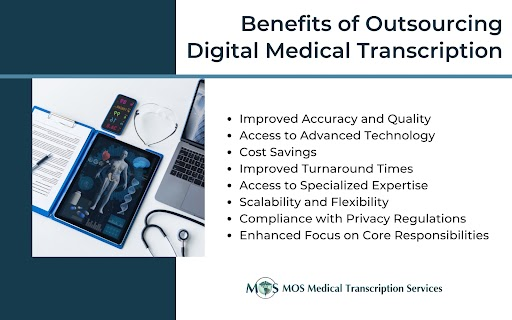
By outsourcing digital medical transcription, practices can expect the following benefits:
Improved Accuracy and Quality
Professional medical transcription companies employ highly skilled transcriptionists with expertise in medical terminology. They can convert audio recordings of physicians’ dictations-such as patient histories, consultations, diagnoses, and treatment plans—into precise, formatted text files. Timely, error-free documentation upholds patient safety, meets compliance standards, and supports coding and billing processes.
Access to Advanced Technology
These services use advanced tools like automated transcription software powered by artificial intelligence (AI), speech recognition (SR), natural language processing (NLP), secure cloud platforms, and electronic health record (EHR) systems to streamline transcription workflows. EHR-integrated medical transcription services ensure data is securely stored and readily accessible, improving overall productivity.
Cost Savings
Outsourcing eliminates the overhead costs associated with hiring and maintaining in-house transcription teams, such as salaries, training, software, and office space. Physicians only pay for the services they use, making it a cost-effective solution for healthcare facilities of all sizes.
Improved Turnaround Times
By leveraging digital tools, voice recognition software, and skilled professionals, expert teams deliver transcriptions quickly without compromising quality. Fast documentation enhances workflow efficiency, supporting timely patient care and claim submissions.
Access to Specialized Expertise
Many transcription service providers offer specialists who understand niche fields such as radiology, cardiology, or orthopedics, ensuring accurate documentation of complex medical terms and procedures.
Scalability and Flexibility
Services are customizable to meet the specific needs of healthcare providers. As your practice grows or experiences seasonal variations, an outsourced transcription partner can easily scale up or down to meet practices’ changing needs. This flexibility allows you to focus on patient care without worrying about staffing or capacity issues.
Compliance with Privacy Regulations
Outsourced transcription providers are well-versed in regulations such as HIPAA and ensure that all patient data is securely handled and stored. They use encryption, secure data transfer protocols, and stringent confidentiality agreements to protect sensitive information.
Focus on Core Responsibilities
Outsourcing transcription reduces the administrative burden on in-house staff, allowing them to focus on their core responsibilities like patient care, scheduling, and billing. This streamlined workflow improves overall efficiency and patient satisfaction.
Navigating Challenges in Digital Medical Transcription: Ensuring Accurate Documentation
While digital transcription has significantly advanced with AI and machine learning, it is not without its limitations. Despite its efficiency, certain challenges persist, particularly when dealing with complex medical terminology, poor audio quality, or nuanced language. These factors can hinder a machine’s ability to accurately interpret context, resulting in potential misinterpretations or errors in the transcribed text.
Challenges in Digital Transcription
Complex medical terminology: Machines often struggle with recognizing intricate or less commonly used medical terms, especially if they have not been adequately trained on the specific terminology.
Audio quality issues: Background noise, overlapping voices, or unclear speech can significantly impact the transcription accuracy of even the most sophisticated software.
Language nuances: Regional accents, idiomatic expressions, or subtle differences in phrasing can confuse automated systems, leading to errors in capturing the intended meaning.
Ensuring Accuracy Through Rigorous Quality Checks
A reliable medical transcription company will have a robust quality assurance process in place to address these challenges. After the initial transcription—whether done by automated software or human transcriptionists—dedicated professionals review the files to identify and correct any errors.
These quality checks involve:
Contextual analysis: Ensuring the transcribed content aligns with the intended meaning, particularly for nuanced medical terms.
Term validation: Cross-checking medical jargon against industry standards and references to confirm accuracy.
Audio cross-referencing: Re-listening to unclear portions of the audio to ensure fidelity in transcription.
Proofreading: Ensuring grammar, spelling, and formatting meet the required standards for medical documentation.
By combining advanced technology with human expertise, trusted medical transcription providers achieve accuracy rates of up to 99%, ensuring the highest standards of quality. This meticulous approach not only minimizes the risk of errors but also enhances the reliability of medical records, supporting better patient care and compliance with healthcare regulations.
Enhance documentation accuracy and save time with our medical transcription services!
Medical transcription outsourcing companies carry out a highly specialized service. They transcribe whatever important details a doctor conveys in a dictation about interactions with various patients. This includes details about the patient’s history, medical condition, physical diagnoses, laboratory tests and procedures. They also perform the transcription process using specialized equipment such as a computer, headphones, medical spellchecker software, word processing software, medical specialty books, converters and sound/media players, foot pedals and medical dictionaries.
Medical Transcription Services – Application of Knowledge and Research
Medical transcriptionists undergo extensive training in medical terminology, English language, grammar, punctuation and style, physiology, laboratory test values and other aspects. Additionally, transcription services are offered for quite a wide range of medical specialties. So the medical transcriptionist engaged in transcription for a particular medical specialty would have got training in terms associated with that specialty. If medical transcriptionists find a particular dictation to be incomprehensible, they would use their own knowledge coupled with research using reliable resources to understand what the doctor said. If they are still left with words that they are not sure about, they can flag the incomprehensible portions for the doctor to fill in.
Error Spotting and Background Noise Filtering
The medical transcriptionists at medical transcription outsourcing companies are also capable of identifying errors in dictations and ensuring that the correct terms are used in the transcript. The doctor may have made an error owing to his fast-paced lifestyle and work-related stress which often cannot be avoided. Another specialized task medical transcriptionists perform is the filtering of background sounds from the dictation to make the dictation clearer to hear and therefore, easier to transcribe. Medical transcription service providers can also assist in the adoption of EHR or EMR utilizing the HL7 interface.
The process of turning spoken medical reports narrated by healthcare professional into written text requires specific skills. Hospitals and medical practices are increasingly relying on outsourced medical transcription services to ensure that the patient’s medical history is appropriately recorded for continuity of care, compliance, and insurance purposes. However, as third-party vendors are often a target of data breaches, it’s important that healthcare entities partner with a HIPAA-compliant medical transcription company for their EHR-related documentation requirements.
The Significance of Medical Transcription
Transcription of medical dictations involves more than just translating speech to text; it also involves obtaining vital health data that has an immediate bearing on patient treatment. For the purposes of making treatment plans, making diagnoses, and monitoring patient progress, accurate medical records are crucial. In order to make sure that these records are correct, current, and in compliance with healthcare laws, medical transcriptionists are essential.
Improve Patient Care: Its immediate effect on patient treatment is one of the main reasons medical transcribing is so important. Whether it’s a surgical summary, discharge report, or consultation note that a doctor dictates, the transcriptionist has the duty to make sure that every detail is precisely captured. This degree of accuracy guarantees continuity of care, reduces the risk of medical errors, and gives other healthcare professionals access to the data they need to decide how best to treat a patient.
Assisting with Healthcare Functions: Additionally, medical transcribing aids in the general operations of healthcare facilities. Medical records that are accurate and well-organized are necessary for insurance claims, coding, and billing. They guarantee that patients receive accurate bills and that healthcare practitioners are paid for the services they render. Furthermore, these records must be accurate and comprehensive because they are frequently needed for legal purposes, like as audits or malpractice cases.
Compliance with Laws and Regulations: Medical records are not only treatment records; they are also legally binding documentation that may be needed for insurance claims or legal actions. Strict laws, such as the Health Insurance Portability and Accountability Act (HIPAA) in the United States, which requires the appropriate handling and preservation of patient information, regulate the healthcare sector. Healthcare practitioners are guaranteed to adhere to these rules through precise and thorough transcribing. If these guidelines are not followed, the healthcare practitioner may face fines, legal action, or reputational harm.
Ensuring Security of Medical Transcripts
Managing sensitive medical data presents security risks that must also be taken into consideration. Patient data is being stored and transferred digitally more often in the modern era, leaving it open to cyberattacks and data breaches. Proper precautions are therefore essential to prevent unauthorized access to sensitive data.
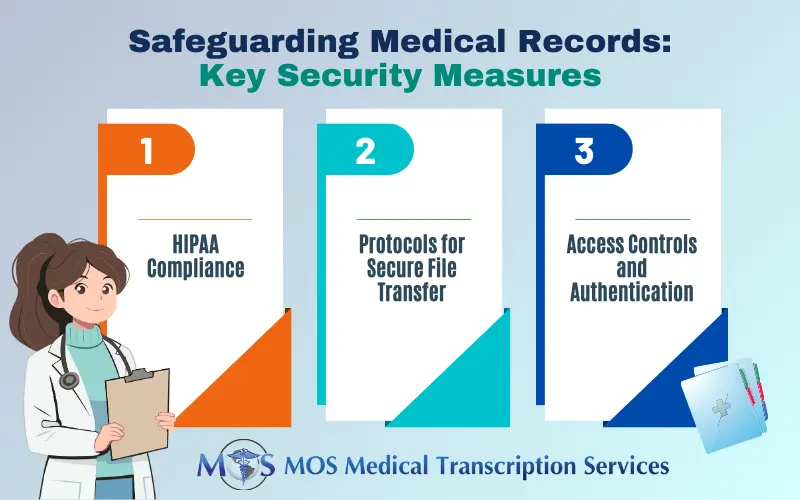
HIPAA Compliance: To secure patient data, healthcare practitioners in the United States and their partners, including transcription service providers, must abide by HIPAA standards. HIPAA establishes requirements for the security of electronic medical records (EMRs), making sure that all organizations that handle patient data follow stringent security and privacy guidelines. Medical transcription providers need to make sure they are completely compliant with HIPAA, which entails setting up secure networks, encrypting data, and limiting access to patient information. To make sure that these standards are being followed consistently, regular audits and evaluations are also essential.
Protocols for Secure File Transfer: Using secure file transfer protocols (SFTP) is essential to preventing unauthorized access or data interception since transcribing entails the transfer of audio files and documents between healthcare practitioners and transcriptionists. By ensuring file transfers are done so securely over the internet, SFTP provides an additional line of defense against cyberattacks. High security criteria are met by the secure file-sharing systems offered by several medical transcription providers.
Access Controls and Authentication: Patient data shouldn’t be accessible to every employee of a hospital or transcription service. To restrict who has access to sensitive data, multi-factor authentication and access controls are crucial. It makes sure that only individuals with the proper authorization can access or change patient records. Strong authentication techniques, like password protection or biometric verification, can also aid in preventing unwanted access to private medical data.
Accurate and timely medical transcription services support efficient electronic health record (EHR) management, workflow efficiency, and legal compliance. Partnering with a HIPAA compliant service provider is essential for upholding the security and confidentiality of patient information.
Trust our medical transcription services to ensure precise documentation while safeguarding your patients’ data.
 With the CDIA (Clinical Documentation Industry Association) having announced last month that it was closing, many would have wondered about the AHDI’s (Association for Healthcare Documentation Integrity’s) stability. Though the AHDI has assured the public of its continuing position as an energetic and workable organization, anything is possible.
 Neurology is a classification of medical science pertaining to the structure, role and organic ailments of the nerves and nervous system. It is a highly complex branch for which transcription would require expert comprehension of some really difficult words and procedures. There is a chance of errors creeping in when the
 Busy healthcare practices that undertake medical transcription tasks in-house often find it difficult to deliver results within the specified time limit. The reasons for this include shortage of staff, the hectic pace of activity and necessity of attention to core tasks, as well as transcription challenges caused by missing details or blanks that need review, poor dictation quality, and the lack of new technology. As such, more and more medical facilities are outsourcing their healthcare documentation processes. Outsourcing is one of the most viable options to improve turnaround.
 Using the emergency room transcription services offered by a competent medical transcription service provider is a wise decision. This helps to ease a challenging task. What’s more, you can save time by outsourcing as in-house transcription takes up valuable time that should have gone into patient care.


 Medical transcription outsourcing companies carry out a highly specialized service. They transcribe whatever important details a doctor conveys in a dictation about interactions with various patients. This includes details about the patient’s history, medical condition, physical diagnoses, laboratory tests and procedures. They also perform the transcription process using specialized equipment such as a computer, headphones, medical spellchecker software, word processing software, medical specialty books, converters and sound/media players, foot pedals and medical dictionaries.