Reduce Complications with Accurate Transcripts of Cataract Surgery Reports

Even though the risk with cataract surgery is low, it does involve the risk of partial or total vision loss if there are complications associated with the surgery. It is estimated that less than 5 out of 100 people experience complications from this surgery that can threaten their sight or demand further surgery. The rate of complications is high in people with eye diseases other than cataract. An ophthalmologist can understand these complications only with accurate transcripts of cataract surgery reports and follow-up examinations so that they can take appropriate steps to treat them.

Need for Complete Operative Report

There are several complications that may occur with the surgery such as infection in the eye (endophthalmitis), rupture of the capsule and loss of fluid in the eye, swelling and fluid in the center of the nerve layer (cystoid macular edema), bleeding in front of the eye (hyphema) and detachment of the nerve layer at the back of the eye (retinal detachment). But it is estimated that in many cases surgical complications are unfortunately overlooked by clinicians. This is because operative reports are often left incomplete. In some cases, it may occur inadvertently. In other cases, the surgeons may not wait to prepare the reports until the complications are found. It is because certain complications may occur sometime after the surgery — such as dislocated intraocular lens (IOL), glaucoma, astigmatism, sagging of the upper eyelid etc. The surgeons must thoroughly review the symptoms of possible complications post surgery and include their assessment in the operative reports. This will help the patients to follow correct eye protection practices, take appropriate medicines and visit specialists. So, the surgeons must ensure that they scrupulously document operative reports including all details regarding the complications.

Documentation of Follow-up Examinations

If there are any complications associated with the surgery, quick and more frequent follow-up examinations are necessary. Other healthcare professionals including optometrist or community health nurse can perform the follow-up examinations. The check-ups may include ophthalmoscopy for evaluating the inside of the eye, measurement of visual acuity and eye pressure (tonometry) and slit lamp exam to check lens clarity. It is required to transcribe reports of all the interventions during the follow-up visits in order to track the progress of treatment for complications. With these details, it is possible to understand the severity of complications and determine whether further surgery is required.

Effective Documentation Tips

  • Prepare a complete operative report following surgery that includes recognition of any complications intraoperatively, surgeon’s response to recognized complications and steps taken to prevent infection.
  • If a different IOL is implanted than expected, then the operative reports should include the reason for choosing that IOL and how its size was determined.
  • Complaints such as flashes, floaters, and pain should be investigated thoroughly during the follow-up examination and documented properly.
  • Document all the findings carefully in respective charts with plan.
Effective Ebola Screening – Improving Clinical Decision Support with EMR Transcription

Ebola ScreeningIn order to enhance clinical decision support (CDS) tools within electronic medical records or EMR and ensure effective Ebola screening, representatives from the Centers for Disease Control (CDC) and the Office of the National Coordinator for Health IT (ONC) co-hosted a special webinar this October. The webinar explored the ways in which electronic clinical documentation could help healthcare professionals evaluate and identify individuals with suspected Ebola Virus Disease (EVD) in a timely manner. The main focus of this webinar was regarding the inclusion of travel history within the clinical workflow.
Here are the key ideas put forward by experts at the webinar for effective screening as reported by Healthcare Informatics.

  • ONC representative Jon White, M.D. presented the idea of standardizing the CDC guidelines into a CDS tool for EMRs. He also added the simplest way to accomplish this is a human readable document. You can get a lot more specific using tools developed for Health eDecisions (ONC’s CDS standards framework) and other standards for decision support.
  • CDC’s Ebola Medical Care Task Force representatives shared the algorithm used by the agency for evaluating and identifying an individual with Ebola. The important elements in that algorithm that the CDC wants to see as a decisional tool in the EMR are to identify people with a fever of 100.4 degrees Fahrenheit or compatible symptoms to Ebola, and people who have traveled to a country with an Ebola outbreak in the last 21 days. The representatives added that they are hoping that these elements are translated into an electronic question prompted in emergency rooms or care facilities around the country.
  • CDC is seeking a mechanism in the EMR to alert healthcare providers that a particular patient has been identified with Ebola and should be isolated immediately. They are also interested in an electronic record system that alerts the hospital’s infection control program and the local state health department as well while evaluating risk for exposure. However, one of the CDC representatives expressed concern that the evaluation of exposure is too complicated to capture using a structured CDS tool. The representatives from Texas Health Resources and Allscripts claimed that they have developed a screening tool that can determine if a patient has had low or high-risk exposure.

Challenges with EMR and the Need for EMR Transcription

Though all the ideas shared in the webinar seems viable, there exists several challenges with EMR itself now such as:

  • As the physicians are not very familiar with the EMRs (logins and logouts, browsing between screens etc.), it takes a lot of time for them to complete documentation.
  • The point-and-click templates within EMRs limit the narrative style while physicians want to include clinical narrative as a part of their notes as this is where they document their medical decision making.
  • Physicians often copy and paste data within EMR fields to save their time and the surging number of cases force them to copy-paste data without checking the content thoroughly, which may result in serious errors and affect the system entirely as the errors spread easily within the system.

It is imperative to fix all these issues if all the ideas presented by representatives of prominent healthcare organizations are to be put into practice. During the medical transcription process, transcriptionists used to flag potential errors such as wrong drug names, inconsistent findings and more for physicians to review so that it was possible to ensure the accuracy of transcribed notes at the end of the process. By integrating transcription with EMR and utilizing the service of medical transcriptionists providers can ensure that the records in their electronic record system are accurate.

You can retain the quality of narrative reports by transcribing notes with the help of transcriptionists and populating the EMR fields with relevant data. EMRs have the ability to interface directly with the transcription platforms in order to parse data and therefore there would be data fields in the place of flat files or static information snapshots. With dictation software, advanced speech recognition systems and natural language processing, transcriptionists can perform their job more easily and ensure great efficiency in data transfer.

EHR Dissatisfies Many Providers Amidst Huge Investments in Such Systems

Electronic health record (EHR) debates can be contentious. While some praise EHR systems for enhancing the medical documentation process, others find the system burdensome. Contradictory findings are found in even studies on EHR’s impact on physician burnout rates and patient care. Medical transcription services can be helpful since they relieve healthcare practitioners of the stress of data entry during the patient visit, freeing them up to concentrate on providing high-quality care. These services can assist in resolving challenges with EHR use by ensure precise and prompt documentation of patient encounters.

Boost practice’s efficiency with accurate and timely medical transcription services.

Contact us today!

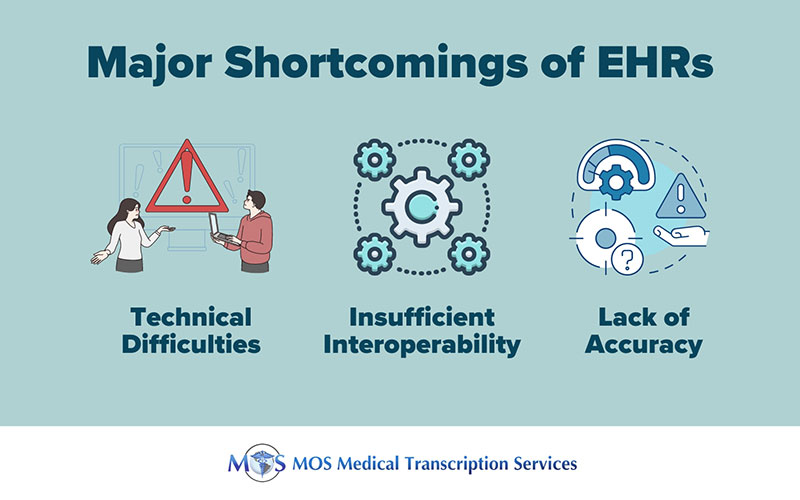
Shortcomings of EHRs

  • Technical Difficulties: A medical facility’s reliance on EHRs could prove disastrous in the event of a technological issue. In order to diagnose a patient correctly, healthcare professionals consult their medical history. But their capacity to deliver optimal care may be compromised if the digital storage system breaks down. Furthermore, rather than accessing the files from the cloud, the attending physician will need to question the patient about their medical history. If technical glitch lasts several hours, it can result in delays and mistakes, compromising care.
  • Insufficient Interoperability: Interoperability enables communication and collaboration, enhancing care. However, the majority of EHR systems prohibit the exchange of data. Absence of data exchange can improve system security, but it also reduces access to information needed to provide proper medical care.
  • Lack of Accuracy: Many physicians copy and paste data within EHR system in order to save time. However, most of them may not have enough time to check every word or data point while copy-pasting lots of data, which can potentially result in proliferation of errors in the chart.

Shortcomings
A study titled “A Qualitative Analysis of the Impact of Electronic Health Records (EHR) on Healthcare Quality and Safety” published on Sage Journals noted that EHRs had several disadvantages. The researchers surveyed physicians, hospitalists, nurse practitioners, nurses, and patient safety officers and listed their opinions on EHR implementation and use:

  • While some nurses thought that using an EHR would increase efficiency, others thought that it would take a lot of time.
  • Physicians, nurse practitioners, and patient safety officials emphasized how crucial EHRs are for preventing medical errors by making patient data more easily accessible and readable. Nurses, however, had reservations about the data’s accuracy.
  • Given the lack of system integration, interoperability seemed to be a concern for medical professionals and patient safety officials.

Are you facing interoperability issues?

Read more: EHR Interoperability: Importance, Challenges and Solutions

Combining EHR and Transcription – A Practical Solution

As of 2021, nearly 9 in 10 (88%) of U.S. office-based physicians adopted any EHR and nearly 4 in 5 (78%) had adopted a certified EHR, according to HealthIT.gov. An approach that blends EHR and medical transcription is a practical solution to optimize EHR documentation.

In this system, physician dictations are transcribed with the help of transcriptionists and discrete reportable transcription (DRT) technology is used to populate the transcribed data within the EHR system. This helps them to take advantage of both structured templates and narrative description depending on the care settings and practice patterns. For example, structured history and physical templates populated by a physician assistant may be useful in the case of one care setting while transcribed narrative report may be the best for findings and assessments. If providers partner with a medical transcription company with a good quality assurance processes, they can ensure that data within the EHR is accurate and avoid errors associated with copy-pasted data. It can also help eliminate the need for stressful data entry by physicians and allow them to focus on what they do best – care for patients.

Navigate the complexities of EHR documentation effortlessly and ensure quality patient records.

Call (800) 670 2809

Why Documentation of Vital Signs in Emergency Departments Should Be Consistent

Though the monitoring of vital signs (heart rate, respiratory rate, temperature, blood pressure, peripheral oxygenation and pain) is a commonly performed task in emergency departments (EDs), there are no published standards of care that provide appropriate guidelines for the frequency of obtaining vital signs. It depends upon hospital and unit level policies, physician orders according to the patient’s chief complaint and acuity level and nursing judgment on the priorities for patient care. However, there should be a consistent process in the documentation of vital signs. Otherwise, it may reduce the critical care team’s ability to record early warning signs of physiological instability or deterioration.

A study published in the 2014 issue of Journal of Nursing Scholarship explored the frequency of documentation of blood pressure (BP) recorded during ED visits across Veterans Health Administration (VHA) facilities and found inconsistent documentation of vital signs of patients in the designated fields within the electronic health record (EHR). More than 43,232 unique patient visits to 94 VHA EDs with a median length of stay of 173.3 min were included in the dataset for the study. The mean number of times BP was recorded per visit was 1.23 and the median time between BP documentation in the ED was every 2.3 hr for all patients. Most facilities (84.1%) documented BP for greater than 75% of patient visits while eight facilities (9.1%) documented BP for less than 50% of patient visits.

The study says nurses anecdotally report that vital signs are noted down on a paper chart and scanned later as an image into the EHR. This may be the reason why there are inconsistent fields of vital signs in EHR. In most of the cases, the nurses may not get time to check whether the vital sign monitoring and frequency of obtaining vital signs are reported correctly and those documents are entered into the EHR as well. The more effective method to document vital signs is to transcribe nurses’ dictations with the help of experienced transcriptionists and populate them into the corresponding EHR fields through discrete reportable transcription (DRT) technology.

As there are no published standards for vital sign monitoring in ED patients, policies must be established at the local level as well. Creating a multidisciplinary team and implementing a quality improvement project is also essential for consistent documentation.

Treating Infectious Diseases – Accurate Documentation Vital

Medical transcription of doctors’ recorded observations and treatment details is of great significance from the point of view of appropriate diagnosis and treatment. The transcripts have to be accurate, and there is no room at all for error. Physicians cannot afford to order medically unnecessary procedures, diagnostics and hospitalization with a view to mitigate risk and second-guessing, because this is very likely to invite penalty for malpractice and wastefulness.

In the present scenario where more cases of infectious diseases are being reported today in the US than in previous years, accurate documentation has become all the more vital. Infectious diseases are a grave threat to patients as well as those who come in contact with them. In addition, they also pose new malpractice risks.

Rise in Infectious Diseases Increase Stress on Staff

The CDC reports that the first half of this year saw more than 288 measles cases being reported, which is alarming considering the fact that measles was eradicated in 2000. And now, Ebola has made its way to the country too. With these infectious diseases, any negligence or mismanagement in hospitals could end up with serious malpractice consequences for patients and staff as the flawed diagnosis of Thomas Eric Duncan, the first Ebola victim in the United States, proved. Malpractice could invite legal action and bring with it a host of issues that could tarnish the reputation of the healthcare practice.

The risk of malpractice is greater when a healthcare team, consisting of a physician who leads nurses and physician assistants, handles treatment. A mistake by any of them will affect the physician leader of the team who will be held responsible for the actions of others as part of “vicarious liability.” The responsibility is assigned to the professional with a legal relationship to the damage causing member of the team.

Preventing Malpractice

  • Efficient and consistent communication between various members of the care team is essential, right from the front-office staff to the physician. The late diagnosis of Thomas Duncan was the result of failure of communication between the nursing staff and the physician at the Dallas hospital.
  • Consistent patient flow protocols are vital to minimize the risk of oversight. The procedures must also be reviewed from time to time and the staff made fully aware of the changes.
  • To prevent malpractice, the discussions about such infectious diseases must be documented as should discussions on serologic evaluations.
  • Hospitals must allow only staff members having immunity to work with infectious disease patients. Immunization tracking and accurate documentation must be made up to date.
  • The staff should also be trained in isolation techniques and using protective equipment. Individuals exposed to the disease should be notified.

Ensuring Accurate Medical Transcription of Physicians’ Notes and Interactions

Any reports relevant to treating patients must be transcribed and the transcripts maintained scrupulously. Discussions between the members of the care team, diagnoses made, tests ordered, treatments administered – every detail should be clearly recorded to avoid ambiguity at a later stage. Apart from reducing the risk for malpractice, efficient and reliable documentation will also facilitate providing the right treatment for the patient and improve patient outcomes.

Asthma Associated with Decrease in Bone Mineral Density, Says South Korean Researchers

AsthmaAccording to a study conducted by a group of researchers in Seoul, South Korea, there appears to be an association between asthma and BMD (Bone Mineral Density) decrease. This study was published in the May issue of Annals of Allergy, Asthma & Immunology, the official journal of the American College of Allergy, Asthma and Immunology (ACAAI). In the opinion of the lead study author, prolonged use of corticosteroids for asthma treatment is a risk factor of osteoporosis (a condition which makes the bones weak, fragile and more likely to break) though the researchers lack definite data that shows the relationship between asthma and bone loss. The study also revealed a meaningful association between these conditions even in the absence of earlier use of oral corticosteroid.


The researchers studied 7,034 patients, out of which 433 patients had airway hyperresponsiveness (AHR) or asthma. The density of lumbar spine and femur bone was considerably lower in those 433 patients compared to those who did not have these conditions. The associate editor of ACAAI journal opined it is quite difficult to locate the real cause of bone loss in this group of patients and it can be corticosteroid use, low levels of vitamin D or even race. The facts revealed in the research need to be studied further.

CDC statistics shows that 18.7 million non-institutionalized adults in the U.S. currently have asthma while 6.8 million children suffer from this disease. The data also reveals asthma mortality rate is 1.1 deaths per 100,000 population. As per the ACAAI, though high oral corticosteroids can be associated with adverse effects, it is the most effective medication for asthma treatment. It recommends using the lowest effective dose of oral corticosteroid when required, and inhaling it rather than taking orally whenever it is possible. Healthcare experts say it is very important for asthma patients to continue their prescribed treatment as this disease can be life-threatening. But, at the same time, doctors need to discuss about the disease prospects and consequences of therapy in asthma patients.

It is very important to document the details of asthma patients such as their health conditions, their treatment, how the treatment affects them and improvements in health conditions in each visit accurately. Based on that, doctors can understand whether a particular drug is effective and provide quality care. If the doctors cannot find time for systematic clinical documentation amidst their busy schedule, they can seek the support of a professional medical transcription company that offers the service of experienced and trained medical transcriptionists.

Google’s Patient-Doctor Video Chat Service to Facilitate Virtual Office Visits

Patient-Doctor Video ChatGoogle is reportedly testing a service that connects patients with doctors over a video chat, across a limited number of users. As per the Verge report, when people search for basic health information (for example, knee pain), a blue icon appears in the search results offering the option of chatting with the doctor. Though more details regarding this service are not available yet, it seems that the new feature opens a new way for virtual office visits. With the aging baby-boomer population and rising medical costs, virtual office visits and electronic clinical documentation are really beneficial for patients and physicians.

According to the Verge report, the service ties into Helpouts. This is a marketplace, which can be used by experts to give lessons and advice over video chat and charge for their services. With this, the service currently on test implies a more vivid picture of virtual office visits and we can’t rule out the probability that virtual office visits will become more common if the testing proved successful. As per a study from Deloitte, around 75 million of 600 million appointments with general practitioners will involve virtual office visits or electronic visits (e-Visits) in 2014. Why are e-Visits so important in the current healthcare scenario?

Benefits of E-Visits

  • E-visits are convenient and a less costly alternative to the traditional visit to the physician’s office. Video conferencing gives patients easy access to a primary care physician so that they need not visit a costly emergency room when they get sick.
  • With the huge influx of newly insured patients in the backdrop of ACA, doctors’ offices find it difficult to give appointment to all patients quickly and it adds to the documentation challenges (delay, accidental errors) as well. Electronic visits comprising electronic document exchanges and videoconferencing between physicians and patients really relieves physicians’ offices from the strain associated with patients’ office visits.
  • E-visits also enhance the communication between patients and doctors. Patients can discuss their symptoms (in some cases for example, wounds, skin allergies) and concerns conveniently from their own homes and the physician can make a diagnosis, provide treatment instructions, and formulate a specific treatment protocol.

Electronic documentation or the use of electronic medical records (EMRs) is more effective in the case of e-Visits rather than paper charting. Physicians can interact with their patients through video conferencing in one window and enter the details into or retrieve them from the electronic records via another window. This will help physicians to diagnose and provide treatment very quickly. They can enter the data through keyboards/mouse/touch screens (for data that include diagnosis, patient history and findings), camera (for video signal transfer), speech recognition systems, and transcription. With experienced and trained transcriptionists, more accurate data can be sent to the EMR compared to the speech recognition system.

Importance of a Proofreading Checklist for Medical Transcripts

The information in patient medical records is crucial for clinical decision-making, quality management and clinical reporting. However, errors can creep into medical transcripts and endanger patient safety, even resulting in serious consequences. Proofreading the transcripts is crucial to eliminate errors and correct oversights. Using a checklist during the proofreading process is the key to avoiding common errors.

https://youtu.be/og24s_EzhPA

Noting Errors to Avoid in the Checklist

Physicians are really busy people and sometimes cognitive biases, stress, and distractions can lead to outright errors. That’s why in professional medical transcription companies, the QA department uses checklists to ensure error-free clinical documentation. Here are some of the things that proofreaders should check for:
Proofreading Checklist

  • Errors in Terminology – Errors in medical terminology can lead to inaccurate diagnosis, incorrect medical decisions, and inaccurate medical billing.
  • Omitted or Added words – These can compromise patient safety.
  • Wrong Patient Demographics – Patient encounter information such as date of service, date of consultation, medical record number, date of operation, and author identification number must be checked for mistakes.
  • Misspellings – Such errors may not directly affect patient care and safety but can affect the integrity of the document. All spellings need to be verified using a proper resource such as Stedman’s Electronic Medical Dictionary.
  • Typographical Errors – These are caused by striking the wrong key or by striking two or more wrong keys because of finger misalignment with respect to the keyboard.
  • Grammatical Mistakes – These are hard to identify while transcribing and must be identified through careful proofreading.
  • Punctuation Mistakes – Errors in punctuation can actually change the medical meaning of a sentence.
  • Incorrect Verbiage – These are errors caused by inappropriate or excessive editing that do not have significant impact on the meaning of the document, but affect the quality of documentation.

Reports that need clarification should be flagged. It is also necessary to review the account specifics against the final report to see if the physician’s requirements have been met. Reading the report without listening to the audio to check for medical and logistical sense is also a helpful proofreading technique.

Associating with a HIPAA compliant medical transcription company with a team of trained and experienced transcriptionists can ensure accuracy in medical notes and reports. They have experienced quality assurance professionals consisting of editors and proofreaders who perform stringent three-level quality checks, ensuring accuracy rates of 99% within prescribed turnaround time. Moreover, these superior medical transcription solutions come at highly competitive rates.

Using BI-RADS Terminology in Mammogram Report

The correct use of BI-ARDS terminology in a mammogram report is very important for an effective diagnosis of breast cancer. The American College of Radiology (ACR) has come up with the Breast Imaging Reporting and Data System (BI-RADS) to describe mammogram findings and results in a standard way. This system involves final assessment category which provides clear communication of the overall results to both primary care physicians and radiologists so that appropriate follow-up is performed for suspicious findings. With this, breast cancer can be correctly diagnosed at an early stage and appropriate treatment and care provided.

While Medicaid and Medicare offer coverage for mammogram screening, the accuracy of mammogram report is important and so is the use of appropriate BI-RADS categories. Here are the BI-RADS categories and what they refer to.

BI-RADS Categories (X-ray Assessment Is Not Complete)

Category 0: Additional imaging evaluation and/or comparison to prior mammograms are needed.

This actually means that a possible abnormality may not be found or defined, and more tests (for example, spot compressions) are required. This category also suggests that the mammogram results should be compared with older results to check whether there have been any changes in the area over time.

BI-RADS Categories (X-ray Assessment Is Complete)

Category 1: Negative

This indicates the breast look the same with no masses, distorted structures or suspicious calcifications and thereby suggests that no significant abnormality was found.

Category 2: Benign (non-cancerous) finding

Though this is also a negative mammogram result, the reporting doctor chooses to describe benign finding as benign calcifications, lymph nodes in the breast, or calcified fibroadenomas so that others looking at the report won’t misinterpret the finding as suspicious. This is recorded in order to help when comparing with future mammograms.

Category 3: Probably benign finding

This means a very high chance (more than 98%) for the findings being benign or not cancer. Though the findings are not expected to change over time, it is helpful to check whether the area in question does change over time. Follow-up in a short time frame is suggested for this finding. Typically, follow-up with repeat imaging is done in 6 months and regularly after that till the finding is known to be stable (at least 2 years), which helps to avoid unnecessary biopsies and still allows for early diagnosis if the area does change over time.

Category 4: Suspicious abnormality

The findings in this category do not definitely appear as cancer, but could be a cancer. A biopsy may be recommended in this case. Since the findings can have a wide variety of suspicion levels, some doctors further divide this category into the following.

•    4A: finding with a low suspicion of being cancer
•    4B: finding with an intermediate suspicion of being cancer
•    4C: finding of moderate concern of being cancer, but not as high as Category 5

Category 5: Highly suggestive of malignancy

The findings in this category look like cancer and there is at least 95% chance of it being cancer. Biopsy is required in this case and appropriate action must be taken.

Category 6: Known biopsy-proven malignancy

This is used for the findings that have already been shown to be a cancer in a previous biopsy. This category is used to see how well the cancer is responding to treatment.

BI-RADS Classification of Breast Density

An assessment of breast density will also be included in mammogram reports. The fifth edition of BI-RADS Atlas issued by the ACR in 2014 included changes in breast density reporting categories which are:

•    BI-RADS 1: The breast is almost entirely fat
•    BI-RADS 2: There are scattered areas of fibroglandular density
•    BI-RADS 3: The breasts are heterogeneously dense, which can obscure small masses
•    BI-RADS 4: The breasts are extremely dense, which lowers the sensitivity of mammography

This will improve breast density assessment which is crucial to identify women who may benefit from supplemental imaging to improve the early diagnosis of cancer.

Mammograms can also find cancers and cases of ductal carcinoma in situ or DCIS (a noninvasive tumor in which abnormal cells that may transform into cancer build up in the lining of the breast ducts) that will never cause any symptoms or are fatal. If they are not correctly reported in the mammogram report using appropriate BI-RADS category, it may lead to over-diagnosis of breast cancer and overtreatment which may prove hazardous to women. So, whether the physicians themselves prepare the report or seek help from a transcription service to save time, it is vital to make sure that the mammogram findings are reported with the most appropriate BI-RADS category.

Tele-nursing in Critical Care, The Importance of Documentation

Tele-nursing in Critical CareTele-nursing or providing medical advice via telephone is widely used in critical care as it provides an efficient, responsive and cost-effective way to access health care services. With the use of technology, tele-intensive care unit nursing can enhance available resources and transform how critical care nursing is practiced. However, the documentation of telenursing interventions and its quantification actually help to clarify how telenurses’ role affects critical nursing practice, improvement of patient care, patient safety, and outcomes. In this way, accurate documentation is critical for the effective practice of tele-intensive care unit nursing.

Accurate documentation plays a significant role in establishing the following critical standards for the sustainability of the Tele-ICU nursing practice.

Effective Communication – Since patient assessment is done remotely in the case of tele-ICU, effective communication, true collaboration and proper decision making is essential for timely patient intervention and improved outcomes. There should be clear and complete communication with in-room staff, physicians, patient and family members. Tele-ICUs should be able to communicate in an opportune manner with minimum disruption in patient care. If they remain hesitant to act, it can disrupt the provision of timely care and result in unfortunate patient outcomes. One of the major barriers to effective communication is poor medical documentation. With thorough and accurate documentation, tele-ICU nurses can communicate to ICU staffs and physicians their assessments about the status of clients, nursing interventions they performed, and their results. This will reduce the potential for misinterpretation and errors and the patients will receive consistent care / service.

Standardization – In order to establish true collaboration between tele-ICU nursing staffs and between the staffs and care providers, it is very important to develop policies to standardize tele-ICU procedures. In addition to virtual rounding, patient and family education, standardized clinical documentation is essential to implement this. Through such kind of documentation, both the ICU and tele-ICU team will find it easy to access the information that they need.

Transparency – Though the tele-ICU team provides the resource and knowledge of the intensivist to immediately diagnose and treat the health issue, actual diagnosis depends upon the information from the ICU. So, there should be transparency of information between the tele-ICU and the ICU for the development of an appropriate plan of care. This can be accomplished through accurate and real-time documentation of critical care events as well as direct verbal communication between the tele-ICU and the ICU regarding the patients’ conditions.

Essential Elements of Tele-nursing Documentation

  • Date and time of incoming calls including the voice mails
  • Date and time of returning the call
  • Name, telephone number and age of the caller, if necessary
  • Reason for the call, assessment of the client’s needs, signs and symptoms explained, any specific protocol or decision tree used for call management, advice or information provided, referrals made (if any), agreement on next steps for the client and the follow-up required

Nurses who provide telephone care should document the entire telephone interaction and they can use either paper chart or electronic health records (EHR) for that purpose. The advantage of electronic documentation is that it ensures standardized documentation with quick access to patient records. Pre-filled templates and fields can make the documentation concise and save space compared to the paper charting.

Telephone interactions can be recorded and transcribed into accurate reports, in which process a medical transcription company can help. The dictated/transcribed notes can be turned into structured interoperable clinical documentation needed by the EHR. Reliable transcription service providers have HIPAA compliant portals that enable their medical transcriptionists to transcribe directly into the healthcare provider’s / facility’s EMR. They interface directly with the EMR system, saving the clinician valuable time as well as the hassles of posting transcripts and steering through complex templates.

  • KEY FEATURES

    • 3 Levels of Quality Assurance
    • Accuracy Level of 99%
    • All Specialties Covered
    • Competitive Pricing
    • Digital Recorder Dictation
    • Electronic Signatures
    • Feeds for EHR or EPM
    • HIPAA Compliant Service
    • Quick Turnaround Time
    • Toll Free Phone Dictation
    • Transcription Management Software
    • Volume Rates Available
  • RECENT BLOGS

  • Categories

  • Quick Contact


    • Infographics