According to a study published in JAMA magazine, hospitals can improve patient care by implement management strategies adopted by the manufacturing sector. Based on a sample of nearly 600 cardiac units, the researchers found that utilizing manufacturing management tactics similar to Toyota’s Lean initiatives led to improved process-of-care steps and lower 30-day mortality rates. Hospitals would benefit greatly by implementing organizational measures and management systems that enable and promote high-quality health care without having to spend too much, say these experts.
In fact, ‘Lean’ manufacturing techniques are helping many hospitals across the U.S. by helping to identify and eliminate unnecessary processes that are not related to patient care. For instance, at the Virginia Mason Medical Center in Seattle, work processes have been streamlined to eliminate waste, lower patient costs, and enhance care. Unnecessary tests and procedures that drive up employers’ health costs have been identified and eliminated. Work flow has been redesigned to ensure that physicians and nurses had more time for patients. Nurses work together as teams located in small rooms close to each other. This has led to better communication between the physicians and the nurses as well as among the nurses. Improved coordination of activities has resulted in enhanced, faster, and more affordable care.
In many manufacturing companies, back office tasks are outsourced to save time and resources, and cut investment and operational costs. Hospitals can also enjoy these benefits if they outsourced back office tasks such as medical transcription which, when performed in-house, consumes valuable time and money. Outsourcing to a professional medical transcription company can ensure efficiency in documentation processes, allowing physicians to provide better care. Outsourcing transcription tasks also ensures saving in time and money. By relying on quality medical transcription services, healthcare providers can enhance their ability to provide better patient care, ultimately leading to increased cash flow and an enhanced reputation.
According to the U.S. Bureau of Labor Statistics, employment of podiatrists will increase by 20% from 2010 to 2020. The growing demand for podiatric services is attributed to the rising number of people needing foot care for injuries. An increasingly older population, along with the increase in the incidence of diabetes and obesity is driving the demand for the services of podiatrists. In fact, with the burden of diabetes increasing worldwide, foot care for people with diabetes will become crucial. Issues that arise due to lack of podiatric care among diabetic patients can lead to damage to the foot, foot infections and ulcers, Charcot’s joints, and amputation.
As podiatrists become busier, their needs for efficient documentation services will also increase. There will be little time left for transcribing records and notes relating to a variety of conditions such as Onychomycosis, Keller Bunionectomy, Athlete’s Foot, Arthroplasty, Tinea Pedis, and patient progress notes.
The only effective solution is to outsource these transcription tasks to a reliable medical transcription company. With years of experience in providing quality transcription services, professional transcription services can offer tailor-made to meet podiatrist requirements. Outsourcing to the right firm will ensure high quality transcripts within specified turnaround time.
The medical transcription company can offer convenient dictations options such as toll free number or digital dictation. By using outsourced medical transcription services, podiatrists can focus better on treating their patients. Better patient care ultimately improves practice productivity and revenue.
Medical transcription had its origins in the 1960s. However, there are many misconceptions about medical transcription even today.
It’s just like data entry: Medical transcriptionists are not just data entry typists. A qualified medical transcriptionist is a professional with excellent listening and comprehension skills, language proficiency, and above all, extensive knowledge of medical terminology, medical jargon and medical procedures related to various medical specialties.
Medical transcription requires speech recognition software: Some medical transcription companies do use speech recognition software with an editor to transcribe the dictation. However, most medical transcriptionists type out physician dictations and send back well-formatted transcripts. It can be very expensive to implement a speech recognition program. Transcribing digital recordings the traditional way ensures greater accuracy and affordability.
Medical transcription and EMR are conflicting: Granted that physicians can enter information directly into the electronic medical record (EMR), but even that would take time and reduce the number of patients that can be seen. So physicians now opt for transcription services with interface to EMR so that they dictate and review the transcribed report that is obtained within the prescribed turnaround time.
One important truth: outsourcing medical transcription is much more cost-effective than having it done in-house. Medical transcription companies serve many clients and fix charges on the basis of volume, quality of dictation, turnaround time. They help healthcare service providers reduce their workload, get error-free documentation, and save on transcription costs.
Telemedicine is one of the fastest growing trends in e-health and has become a new standard of care in medical practices, hospitals and other healthcare organizations in the U.S. The word ‘telemedicine’ literally means distance healing and involves the use of electronic communication systems to provide better patient Patients and physicians interact through video chat, email, the Internet, and cell phone applications, promoting better patient care and improving physician productivity in an affordable manner.
Types of Telemedicine
There are two types of telemedicine technology.
Store and Forward technology: this technology is used in telemedicine for capturing pictures through digital cameras or other means, which can then be stored and forwarded to locations anywhere in the world.
Two-way Interactive television (IATV): this technology is necessary when a patient needs to consults a primary care provider and a specialist. A video conference with the physicians allows patients to convey information about their issues and get treatment without delay.
Benefits of Telemedicine Technology
It helps physicians and patients cut down on travel. Physicians can save their valuable time. The service is especially beneficial for patients living in rural areas who find it difficult to travel long distances to see a doctor.
With greater access to telemedicine, physicians can treat more patients in a shorter span of time, increasing their productivity and efficiency.
Telemedicine is useful in difficult-to-access areas, helping patients there to benefit from quality treatment.
Telemedicine allows healthcare organizations and physicians to improve patient reach, provide better care, reduce costs and expand in markets across the globe.
Patients require only fewer visits to hospitals. This technology helps in the better monitoring and management of diseases.
The documentation of these telemedicine reports is also highly essential as the physicians need electronic copies of these recordings for reference at any time. A medical transcription company can assure accurate and timely medical transcription services for telemedicine. By outsourcing to a reliable transcription company, healthcare organizations and physicians can devote more time to providing better patient care.
The U.S. healthcare system is expected to have a national electronic health record (EHR) system by 2014 to exchange health information and support personal health records of all citizens. The implementation of Electronic Medical Records (EMR) has, however, raised questions about the survival of the medical transcription industry. But these fears are unfounded as medical transcription services can actually complement EMRs. Here’s how:
Medical transcription saves time: Most clinicians are not used to entering data into an electronic system. For them, this can be a time consuming process that detracts from patient care. Outsourcing their documentation tasks to a professional medical transcription company is therefore the best option when it comes to obtaining accurate documentation in minimum turnaround time.
Helps maintain office efficiency and revenue: As entering into the EMR is time consuming, it would allow physicians to see only fewer patients. Focusing more on clinical documentation will affect office efficiency, and ultimately, revenue. Medical transcription services can help them resolve such crises and focus on better patient care.
Medical transcription integrates to EMR: With the integration of medical transcription to EMR, healthcare organizations don’t have to worry about compliance with standards. The transcribed content is entered into the proper fields, freeing physician from tedious data entry duties.
Helps to maintain accuracy: Free-text typing into EMR can results in high error rates. Professional medical transcription is done by trained experts and can ensure top quality documentation.
Helps in producing meaningful notes: Medical transcription creates good narrative information when compared to EMR.
The goal of the healthcare system is quality patient care. Medical transcription makes this possible by complementing EMRs and enhancing their ease of use. Further, medical transcription is a valuable documentation tool that can offer more comprehensive coverage of patient encounters that EMRs can.
Thoracic and cardiovascular procedures treat disorders and diseases affecting the heart, lungs and other organs in the chest. This specialty includes preventive measures and life-critical interventions like coronary artery bypass grafting, heart transplant, lung transplant, etc. Precise documentation is essential for treatment planning, patient outcomes, and surgical follow-up. In thoracic and cardiovascular care, a single transcription error can affect surgical decisions, follow-up care, and even legal outcomes. This highlights the need for experienced transcriptionists who understand the documentation needs of this specialty. Thoracic and Cardiovascular Transcription is a strategic approach to ensure the best results. Specialized medical transcription services can deliver accurate reports with seamless integration into electronic health records.
Get expert cardiovascular and thoracic medicine transcription support.
The Complexity of Cardiothoracic Surgery Documentation
The thoracic and cardiovascular field has specific and complex documentation needs. The assessment of the cardiovascular system includes a thorough medical history and a detailed examination of the heart and peripheral vascular system. Healthcare providers must pay attention to subjective statements and objective findings to spot early warning signs of dysfunction and document everything.
Transcription for this subspecialty involves creating accurate medical documentation for:
Physician-patient consultations
Medical diagnosis
Lab tests and imaging studies (CT angiography, echocardiography)
Interventional procedures (stent placements, EP studies)
Postoperative summaries and cardiac rehab notes
Discharge summaries
Proper documentation of the subjective and objective assessment the cardiovascular system and procedures is critical to provide quality, safe care to the patient.
Transcriptionists must have a strong knowledge of complex cardiovascular and thoracic anatomy, terminology, and awareness of procedure variations. Medical terminology often includes similar-sounding words-homophones- with different meanings, which can cause confusion. Consider a cardiologist reviewing a report to find that the transcription mixed up “arterial” and “atrial”. This seemingly minor error could lead to a ripple effect throughout the patient’s care continuum.
Attention to detail and excellent listening and typing skills are also necessary to ensure speed and accuracy due to the critical nature of care.
This highlights the need for experienced transcriptionists who understand cardiothoracic language — not just generic scribes. Professional cardiovascular and thoracic transcription solutions can ensure accurate documentation that ensures continuity of care, compliance with legal documentation requirements, and supports effective communication among healthcare providers.
High-Quality Transcription in Cardiothoracic Medicine: Why Outsourcing Matters
Thoracic and cardiovascular care settings are a high-pressure environment, and delays and documentation errors can affect workflows and patient care. Outsourcing overcomes the challenges of cardiovascular and thoracic documentation as the process is handled by specialized transcriptionists.
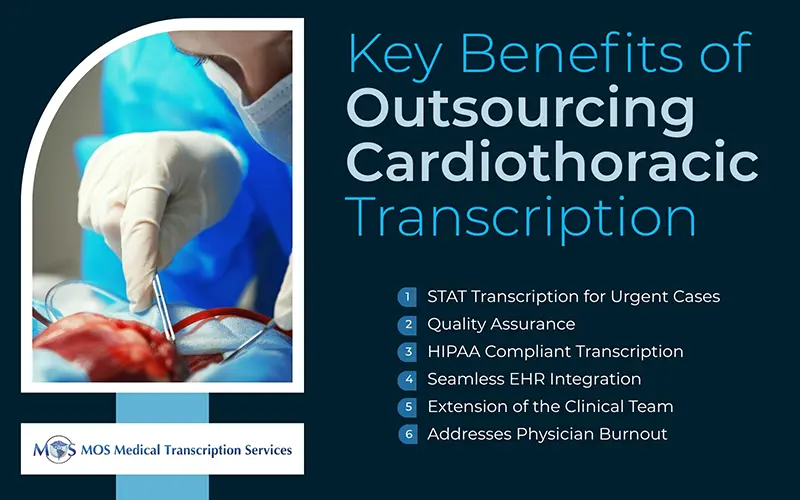
The benefits of outsourcing medical transcription include:
STAT Transcription for Urgent Cases
Emergency surgeries and time-sensitive procedures are common in cardiothoracic settings. Outsourced transcription services provide round-the-clock support, ensuring that critical reports, such as operative notes or emergent imaging interpretation, are documented immediately. This ensures timely access to medical information and supports efficient patient care.
Quality Assurance
A reliable medical transcription service provider will have multi-level editing and quality checks in place to ensure error-free documentation. This ensures that even reports with complex terminology are transcribed accurately. By catching errors early and correcting them, the QA team will maintain documentation integrity.
HIPAA Compliant Transcription
Patient privacy is paramount in any healthcare setting. This is especially critical in cardiovascular care where detailed health histories and sensitive imaging are involved. Choosing a HIPAA-compliant outsourcing partner will ensure encrypted data transfers to protect patient information at every stage.
Seamless EHR Integration
Leading service providers offer integration with your electronic health record (EHR) systems, reducing manual entry and speeding up report availability for the care team. EMR/EHR integration for transcription not only improves efficiency but also supports continuity of care.
Extension of the Clinical Team
Specialized transcription partners work as an extension to your team. By understanding the preferences of individual physicians and aligning with specific workflow needs, they become a trusted documentation partner. By ensuring timely and accurate cardiovascular and thoracic medical documentation, they enable physicians to spend more time with patients.
Addresses Physician Burnout
According to the American Medical Association, internal medicine-which includes subspecialties like cardiothoracic care-has one of the highest physician burnout rates, affecting 52% of doctors. When expert transcriptionists handle complex cardiac and thoracic reports, physicians can focus more on patients, lessen after-hours EHR work, improve overall job satisfaction, and reduce provider burnout.
Outsource Medical Transcription – Improve Patient Outcomes, Compliance, and Workflow Efficiency
With benefits such as 24/7 support for emergency surgical cases, dedicated QA, HIPAA-compliant handling of sensitive cardiovascular data, and EHR integration, the case for thoracic and cardiovascular transcription outsourcing is strong. Outsourced solutions also seamlessly integrate with voice recognition technology, allowing for real-time dictation capture and transcription. This hybrid method enhances documentation efficiency, especially in high-pressure surgical settings or urgent cases. Outsourcing documentation tasks is a strategic decision that allows hospitals and clinics to ensure precise cardiothoracic medical records, streamline workflows, and ensure the highest standards of care.
Optimize your workflow and protect patient safety with our specialized medical transcription services!
Advancements in teleconferencing has brought about new possibilities in the field of medicine. One such plan recently announced by the public health commissioner of the state of Georgia reveals their intent to open telemedicine clinics in every public health center, depending upon the availability of grant money.
They hope the telemedicine clinics will be a regular feature all over the state in a few years and are budgeted at $20,000 each. The Georgia Department of Public Health (GDPH) is applying for grant money. All the existing public health departments were provided with the infrastructural requirements for active teleconferencing as 2012 came to a close. GDPH reports that around 15 sites were regularly using teleconferencing system even earlier that year.
Just a few more steps remain to complete the process such as installing some technical bits of the telemedicine package, sensors, exam cameras, endoscopes and stethoscopes.
Such moves are an indication of the indispensability of technology in modern healthcare. These steps are always welcome, since they will help improve access to quality healthcare, especially in rural areas.
Technology assisting in the transcription of medical data is also indispensable for the healthcare system. It helps improve efficiency in administering vital, life saving care. Moreover, precise documentation is the key to timely, hassle-free and maximum reimbursement for all types of healthcare facilities. A reliable medical transcription company can ensure this for you. Using advanced technology and skilled manpower, a competent service provider can ensure cost-effective, efficient transcription of all types of notes and reports.
Pain Management or Pain Medicine is a specialized branch of medicine which utilizes an interdisciplinary approach to help patients suffering from pain to ease distress and improve well-being. Once the basic trauma or pathology has healed, pain usually resolves swiftly. If it does not, various treatments and therapies are administered to help patients deal with the trauma. Typically, a team of pain management specialists would include clinical psychologists, medical practitioners, clinical nurse specialists, physiotherapists, nurse practitioners and occupational therapists. Massage therapists and mental-health specialists could also be part of the team.
The nature of their work is such that most pain management specialists do not have the time to carry out their documentation tasks. Dictation relating to patient history, chart notes, consultation notes, physical examinations, discharge summaries, referral letters, and more has to be accurately and promptly transcribed.
The solution lies in outsourcing pain management transcription to an established medical transcription company. The right service provider would have trained and experienced teams of medical transcriptionists specialized in pain management and quality assurance personnel working with advanced technology to provide timely and accurate documentation solutions.
Apart from quality HIPAA compliant medical transcription service, a professional company would ensure services in customized turnaround time as well as competitive pricing that can help their clients save as much as to 30 to 40 percent on costs.
To avoid risk of further injury, athletes with concussions should not be allowed to play until all the concussion-related indications are resolved and the brain has fully recovered. This is one of the key recommendations in a position statement issued by American Medical Society for Sports Medicine (AMSSM) on sports-related concussions, a professional organization with a membership of more than 2,100 nonsurgical sports medicine physicians.
There is rising concern about concussions at all levels of competition, from youth sports to professional leagues. The AMSSM statement provides an overview based on evidence and best practices to assist medical professionals with the evaluation and management of sports-related concussion.
It is noted that the concussion-related cases should be handled by trained medical professionals with sufficient knowledge in sport concussions and awareness about the strengths and weaknesses of tests used to evaluate the concussions.
About 3.8 million sports-related concussions take place in the U.S. each year and half of the cases go unreported. Risks are higher in certain sports and positions, for youth athletes and those with previous concussions. Early recognition of sport-related concussions is essential thereby a medical professional with appropriate training and experience can make necessary evaluations.
Among other things, the statement discusses evidence for different types of tests, including computerized neuropsychological tests, and assessments in athletes. It recommends the use of checklists for assessing concussion symptoms and tracking them over time.
To focus better on the evaluation and management of sports-related concussions and ensure proper documentation, sports medicine specialists can rely on an experienced medical transcription company. This will ensure accurate and timely sports medicine transcription service for hospital progress notes, chart notes, operative notes, narratives, and more at affordable cost.
Medical transcription companies use cloud-based technology to provide efficient solutions in customized turnaround time. The expression ‘cloud’ is used to depict hosted services delivered through a secure Internet connection. Web-based transcription solutions offer many advantages:
Secure transmission of data: With a cloud based HIPAA and HL-7 compliant system, all patient data and transcripts remain safe and confidential. The medical transcription company uses a secure FTP server or web-based encryption for the safe transfer of dictation and completed transcripts over the Internet. Voice files for transcription are uploaded on the FTP server from where transcriptionists download them.
Well-organized and easy to retrieve: After the files are transcribed they are uploaded back on to the server. Each document is fully encrypted and digitally archived, so that the client can retrieve, view and even edit them.
Scalable: The cloud based transcription company can easily expand to the needs of the clients and can deliver scalable technology infrastructure for healthcare organizations. Cloud based solutions can also integrate to EMR/EHR.
Simple: The cloud based transcription service is easy to manage and implement. The service provider uses stats-of-the-art technology that simplifies and improves the efficiency of the transcription process.
A transcription system based on cloud technology will help you in save valuable time and money. You would not have to incur expenses on setting up an infrastructure for in-house transcription, hire expert transcriptionists, or worry about technology and software updates. Choose an efficient and reliable medical transcription company to make the most of a cloud-based documentation system.
 According to a study published in JAMA magazine, hospitals can improve patient care by implement management strategies adopted by the manufacturing sector. Based on a sample of nearly 600 cardiac units, the researchers found that utilizing manufacturing management tactics similar to Toyota’s Lean initiatives led to improved process-of-care steps and lower 30-day mortality rates. Hospitals would benefit greatly by implementing organizational measures and management systems that enable and promote high-quality health care without having to spend too much, say these experts.
 Pain Management or Pain Medicine is a specialized branch of medicine which utilizes an interdisciplinary approach to help patients suffering from pain to ease distress and improve well-being. Once the basic trauma or pathology has healed, pain usually resolves swiftly. If it does not, various treatments and therapies are administered to help patients deal with the trauma. Typically, a team of pain management specialists would include clinical psychologists, medical practitioners, clinical nurse specialists, physiotherapists, nurse practitioners and occupational therapists. Massage therapists and mental-health specialists could also be part of the team.
 To avoid risk of further injury, athletes with concussions should not be allowed to play until all the concussion-related indications are resolved and the brain has fully recovered. This is one of the key recommendations in a position statement issued by American Medical Society for Sports Medicine (AMSSM) on sports-related concussions, a professional organization with a membership of more than 2,100 nonsurgical sports medicine physicians.