How Partial Dictation with Electronic Records Improves Clinical Documentation

Electronic RecordsDigitization of patient records offers the benefit of better accessibility to the health record and for tracking patient outcomes, which would improve the quality of care. However, physicians are finding it difficult to enter patient information into the electronic health record (EHR) system. They are unable to give their patients the attention they need as they are more focused on documenting the encounter. Moreover, EMR increases physician workload as they have to spend extra time on typing.

Despite these drawbacks, many physicians rate the feature that allows them to dictate the patient narrative directly into the EMR as its best feature. There is now an innovative way to blend the benefits of the structured templates of EMR with the physician’s need to ensure detailed documentation – partial dictation.

This blended solution is making a marked improvement in the overall functioning of health care practices. Within the EMR’s structured note, the physician can press a button on the keyboard and perform dictation at select spots for explaining complex or odd details. The partial dictation segments which are referred to as short ‘snippets’ or ‘slices’ of dictation gets transcribed and returns automatically to specific locations within the electronic record. The HL7 process with partial dictation is structured so that the EMR sends the audio and text files to the medical transcription service provider’s platform for editing and processing.

This partial dictation system that allows EMR integration with medical transcription offers many benefits of which the most important is error-free documentation. The speech recognition technology of the EMR system has many issues such as difficulty in interpreting speech patterns and identifying grammar mistakes and homophones. Moreover, if the physician makes a mistake while dictating, the software cannot identify the error. All these issues are resolved when the audio files reach the hands of the medical transcription company.

The company’s team of professionally trained and experienced transcriptionists and speech recognition technology editors can ensure informed edits by correcting the errors in the audio files and filling in any gaps. The partial dictation solutions offered by experienced medical transcription firms are helping health care providers:

  • Ensure error-free documentation
  • Reduce costs
  • Improve care
  • Increase productivity and revenue
  • Minimize risks

This approach allows physicians to utilize EHR templates for documenting some sections while using dictation for certain other sections, in other words, to get the best of both worlds.

Medical Transcription Services Can Add Value to the Clinical Documentation Workflow

Medical Transcription ServicesThere is no doubt that digitization of clinical documentation has greatly improved the efficiency of the healthcare system. It has minimized the risks posed by lost, illegible and inaccessible paper records. However, the next stage, namely EMR adoption has not gone down too well with health care providers. According to HIMSS EMR Adoption Model, only 7.3% of them have reached Stage 6 which includes physician documentation and structured templates. With all the issues related to using structured templates, it is obvious that professional medical transcription services are the better option when it comes to improving clinical documentation workflow.

What is the role of the medical transcriptionist in this fast-changing clinical scenario? The key lies in using the transcriptionist’s knowledge and skill to enhance the documentation process. Medical transcription outsourcing frees up physicians for their core tasks, improves physician-patient interaction, and captures information more comprehensively than structured templates.

In the present day scenario, the medical transcriptionist is helping the physician to get maximum return on investment in the latest technological innovations such as EHR and dictation software. Natural language processing (NLP) powered web-based platforms and technologies convert unstructured text into clinical documents, but a validation process is crucial to ensure accuracy. The role of the transcriptionist can be crucial here with services such as

  • Checking that data capture by the NLP is accurate before it is uploaded to the EHR
  • Checking and correctly tagging concepts such as allergies and medications
  • Pre-coding validation of clinical concepts

All these validation measures help ensure accuracy in electronic clinical documentation systems.

Narrative documentation, as created by dictation and medical transcription, will continue to be relevant especially in the context of the creation of standards for the exchange and use of health information. In fact, all this tells us that the role of the medical transcriptionist is evolving and not being phased out. Medical transcription services can add value to the clinical documentation workflow.

Credentialed Medical Assistants for EHR Data Entry

New certification for Credentialed Medical Assistants for EHR Data Entry meets CMS guidelines

Though EHRs are helping in the management of health care records, most physicians are finding it cumbersome and time consuming to enter patient data into the system. According to a report presented at the American Academy of Family Physicians, resident physicians are spending additional time of 16 minutes a day on EHR documentation. Patient care and professional satisfaction are also affected as the physician is has to enter the data into the digital system during the consultation. Many physicians had resorted to employing medical scribes to help with the data entry. The American Association of Medical Assistants (AAMA) took a cue from this trend and introduced a new assessment based recognition (ABR) program to meet the rules of the Centers of Medicare and Medicaid (CMS) on order entry staff.

Overcoming the Challenge of Data Entry in EHR

As EHR data entry cuts down academic learning time and the ability to practice hands-on patient care, it is better that physicians have personnel with necessary expertise to help with documentation. AAMA announced that as of January 1, 2013, only “credentialed medical assistants” (apart licensed health professionals) can enter medication, radiology, and laboratory orders into the electronic health record (EHR). Only such entry would be considered as meeting the meaningful use conditions of the Medicare and Medicaid EHR Incentive Programs, said AAMA.

Only medical assistants who are graduates from a CAAHEP or ABHES accredited medical assisting program are eligible for the CMA (AAMA) Certification Examination. Working medical assistants who are not graduates from this program are ineligible for the CMA (AAMA) Certification Exam and cannot fulfill CMS requirements through the AAMA. It is to provide these non-CAAHEP or ABHES medical assistants to demonstrate knowledge of electronic order entry and meet the CMS requirements that AAMA introduced the assessment-based recognition certification program.

Achieving the AAMA Credential for EHR Data Entry

ABR certification is awarded to those who meet certain knowledge and experience requirements as well as.

During the final two year of study, applicants should have been employed at a healthcare facility under the supervision of a licensed provider. At the end of the course, the licensed provider has to issue a document/certificate to prove that the applicant is proficient in the use of EHR technology based on knowledge in the following areas:

The applicant should also complete the following five AAMA continuing education courses covering key knowledge elements of electronic order entry:

  • Clinical Laboratory Testing
  • Disease Screening
  • Legal Aspects of Patient Care Documentation
  • Lost in Translation: Eliminate Medical Errors
  • Medical Records: A Vital Wave

With credentialed medical assistants, physicians would be ensured of accurate and efficient electronic order entry and also enjoy peace of mind that their orders will be understood and appropriately transmitted. Patients will have their EHRs handled appropriately with the ABR certified professionals on the job. Integrating medical transcription services with EHR can make the process all the more efficient.

Some Myths and Truths about Medical Transcription

Medical Transcription

According to Transparency Market Research, the global medical transcription services market is expected to cross the value of US$96.7 Bn by the end of 2028. Despite the increasing demand for these services, there are many myths about medical transcription and medical transcription outsourcing. With the valuable support that medical transcriptionists provide in helping healthcare providers maintain high quality EHR documentation, this blog seeks to dispel common myths about medical transcription services:

Need accurate and reliable medical transcription services? Learn how we can support your practice!

Call 1-800-670-2809 today!

Common Myths about Medical Transcription

  1. 1. Myth: Medical transcription is like data entry

    Reality: It’s true that medical transcriptionists do key in a doctor’s spoken words into the computer. Like data entry workers, they need excellent typing skills and have captured information without mistakes. But the skills needed for medical transcription go far beyond that. To ensure medical documentation accuracy, medical transcriptionists also need keen listening skills, comprehension skills, vocabulary, and plain common sense. While typing is a significant part of the job, medical transcriptionists also need to understand medical terminology, context, and nuances to accurately interpret and edit transcriptions. They should be well informed about the specialty they’re handling as well as have an independent mindset and the ability to work under tight deadlines.

  2. Myth: Medical transcription needs little or no training

    Reality: Medical transcriptionists undergo specific and extensive training. They are trained in medical terminology and jargon, in the formatting of the different report types, HIPAA compliance and much more – everything that’s necessary to deliver accurate, timely and secure medical documentation that meets industry standards.

  3. Myth: AI will completely replace human transcriptionists

    Reality: With the rise of Artificial intelligence (AI) and voice recognition technology, a common question arises: Is medical transcription still relevant in today’s healthcare landscape?AI and machine learning (ML) are revolutionizing the clinical documentation process by training on vast datasets to convert spoken language into written text without the need for manual typing. Some argue that automatic speech recognition (ASR) and AI voice to text technology may render human transcriptionists obsolete. While AI undeniably offers impressive transcription turnaround time, its value lessens significantly if the results are inaccurate.

  4. Now, let’s consider the accuracy of human vs AI medical transcription. AI-generated transcripts can contain errors, particularly in situations with multiple speakers, unclear recordings, or specialized medical terminology. Despite the technological advancements, AI still has significant limitations. In this scenario, human transcriptionists remain essential, as they refine and correct AI-generated documents to ensure accuracy. Human transcriptionists are essential for ensuring accuracy, especially in complex cases or when dealing with unclear audio. Ultimately, the expertise of human transcriptionists is vital for producing reliable healthcare documentation.

  5. Myth: Transcriptionists don’t need ongoing training

    Reality: The medical field is constantly evolving, and transcriptionists must stay updated on new terms, technologies, and regulations, often requiring continuous education and training.

  6. Myth: Outsourcing puts the confidentiality of patient information at risk

    Reality: Outsourcing transcription often raises concerns about the security of patient files. Many believe that transferring sensitive information to external vendors increases the risk of data breaches and unauthorized access. However, this perspective overlooks the fact that established outsourcing companies have the necessary measures in place to comply with stringent regulations, such as the Health Insurance Portability and Accountability Act (HIPAA). They invest in advanced security technologies, including encryption, secure access controls, and regular audits to safeguard patient data. Healthcare providers can mitigate risks related to security by choosing a HIPAA compliant medical transcription company.

  7. Myth: Transcription outsourcing in healthcare is only about cost-saving

    Reality: While cost is an important consideration, healthcare providers also evaluate factors such as data security, compliance with HIPAA regulations, and the outsourcing partner’s experience in managing complex medical specialties.

  8. Myth: Transcribed documents are always accurate

    Reality: Transcription can be prone to errors, especially with poor audio quality or multiple speakers Even with outsourced transcription, rigorous quality checks are essential to identify and correct errors, ensuring patient safety.

Partner with an Expert

The role of transcriptionists in healthcare is crucial, as they ensure accurate and timely documentation of patient encounters, supporting clinical decision-making and maintaining compliance with medical record standards. Professional medical transcription not only improves the use of the new technology but also offers several benefits for the physician: more time for patient care, reduced data entry costs, increased productivity, and compliant documentation. Outsourcing medical transcription to a reliable provider can help physicians ensure high quality clinical documentation that supports patient care and complies with industry regulations.

Enhance your documentation process and improve workflow!

Contact us today!

How Electronic Medical Records Could be Affecting Physician Efficiency

Electronic Health Records (EHRs) are designed to ensure accurate patient documentation. However, many physicians are facing challenges with the EHR/EMR system and feel that it affects their efficiency. They find that entering data into the system during the patient encounter detracts from the quality of care. Despite the benefits that EHRs provide, there are issues that need to be addressed.

Electronic Medical Records

Partner with our medical transcription company and ensure quality EHR documentation.

Contact us

Impact of the EHR on Physician Productivity

An article published by the National Library of Medicine highlights the rise of physician burnout in the United States, particularly in primary care, with Electronic Health Records (EHRs) playing a major role. The article discusses how EHR-related issues such as data entry, complex usability, electronic messaging, cognitive load, and time demands are causing burnout among physicians. The shift from paper-based records to EHRs has led to increased documentation requirements and additional clerical tasks for physicians, impacting efficiency, effectiveness, and user satisfaction negatively.

According to a 2018 national survey conducted by The Harris Poll on behalf of Stanford Medicine, half of primary care providers (PCPs) feel that electronic health records (EHRs) hinder clinical effectiveness. Nearly half (44%) of PCPs see EHRs mainly as data storage, with only 3% recognizing their primary value in disease management and prevention. Ultimately, 59% of PCPs think that EHRs require a complete overhaul.

Here are Some of the Drawbacks of the EMR/EHR:

  • Lack of user-friendliness is a major challenge with EHR systems. Given that physicians are not data entry experts, they find it difficult to manage the point-and-click templates.
  • Secondly, using the software consumes their valuable time which would have otherwise spent on patient care. As they are busy typing information into the system during the office visit, they hardly find any time left for interacting with the patient. Overall, this has increased physician stress.
  • Another important concern raised about the EHR is that it is causing errors in patient documentation. The software comes with drop-down lists which suggest the rest of word when the first letter is typed. Physicians are making mistakes by choosing the wrong suggestion, affecting the patient care and reimbursement.
  • Hospital software and EHR are expected to be HL-7 compliant so that data is shared. Even hospitals that have set up EHR are finding it a challenge to generate and share documents so as to meet the goal of ‘continuity of care’.

How Medical Transcription Services Can Improve Physician Efficiency

Medical Transcription Services

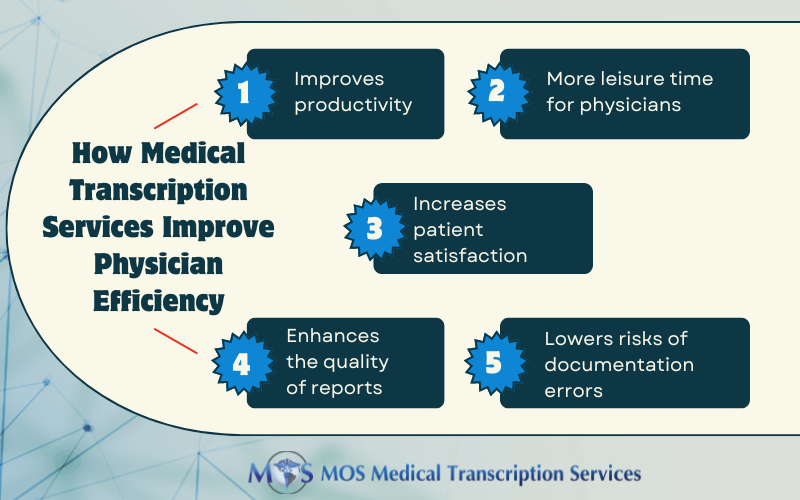
  • Improve productivity and efficiency: Medical transcribing improves physician productivity and efficiency by freeing up more time for other urgent tasks. Skilled medical transcriptionists can efficiently turn recorded dictation of physicians and nurses into written text that can be integrated into the EHR. With medical transcription services, healthcare providers can focus on their patients and deliver better care.
  • More leisure time: With skilled medical transcriptionists handling EHR data entry, physicians will have adequate time. This will enhance their quality of life.
  • Patient satisfaction: When physicians have help with EHR data entry, they can spend more time interacting and concentrating on their patients during visits, which will raise patient satisfaction levels.
  • Enhances the quality of reports: Although EHR shortcuts were intended to increase physician productivity, they may have the opposite impact. By ignoring encounter-specific criteria, EHR shortcuts like copy-and-paste and the ability to automatically insert text blocks can cause note bloat and lower the usefulness of the documentation. If these features are not used appropriately, they might result in mistakes, make documentation hard to understand, and have an impact on patient care and financial results. Medical transcriptionists proofread transcripts and fix mistakes that might have occurred due to the careless use of time-saving EHR shortcuts.
  • Lowers the risks of documentation errors: Inaccurate reporting of a patient’s condition, prescribed drugs, or any other patient-related information can have disastrous consequences for patient safety. Transcription services reduce the possibility of documentation mistakes that could lead to subpar treatment.

When outsourcing transcription, providers should ensure that they partner with a HIPAA-compliant transcription company. Such companies have stringent security measures in place and a data center that is constantly monitored by round-the-clock surveillance. Their security protocols protect both data at rest and data in motion.

Reaching out to a reliable medical transcription company is an ideal way for physicians to ensure quality documentation and get more time to focus on patient care. With EHR-integrated medical transcription support, physicians can experience the benefits of the system without compromising on efficiency and productivity.

Our medical transcription services can improve data entry efficiency and enhance the quality of your reports.

Call us at 1-800-670-2809

Medical Scribe Certification to Ease EHR Data Entry

EHR Data EntryToday, many of the physicians are not enjoying carrying out EHR documentation, as it is slowing them down considerably. Entering patient data in EHR templates is burdensome for many practitioners, as it involves a lot of paperwork and typing, filling out all the forms and scheduling things accordingly.

Though EHR systems help to improve efficiency and cut down documentation mistakes, physicians should spend extra time in front of the keyboard, wasting their valuable time. According to a study presented at the American Academy of Family Physicians, resident physicians were spending an additional 16 minutes a day on EHR documentation. It can also affect their professional satisfaction, as they are forced to stare at a computer screen during consultation with patients.

As a solution to this, many physicians prefer employing medical scribes or qualified assistants for data entry. The American Association of Medical Assistants (AAMA) has come up with a new assessment based recognition (ABR) program to meet the rules of the Centers of Medicare and Medicaid (CMS) on order entry staff.

ABR Certification – An Option to Address the Challenge of EHR Data Entry

In order to have a smooth clinical practice and to ease the burden of data entry, it is better to assign medical transcription to an external agency that can offer the service of trained and experienced medical transcriptionists. According to the rule announced by AAMA, as on January 1, 2013, only ‘credentialed medical assistants’ (in addition to licensed health professionals) have been permitted to enter medication, radiology, and laboratory orders into the electronic health record (EHR). However, as per the rule announced on September 5, 2012, Individuals who are granted with ABR in order entry meets the ‘credentialed medical assistant’ requirement.

More precisely saying, those with CMA (AAMA) Certification or ABR certification are eligible for order entry. For medical assistants to be eligible for CMA (AAMA) Certification Examination, they should be either:

  • Graduates from the Commission on Accreditation of Allied Health Education Programs (CAAHEP) or
  • Graduates from the Accrediting Bureau of Health Education Schools (ABHES)

Working medical assistants who are not graduates of any of these programs are ineligible for the CMA (AAMA) Certification Exam and cannot fulfill CMS requirements put forward by AAMA. As a solution to this, AAMA introduced an assessment-based recognition to those who meet certain knowledge and experience requirements.

How to Obtain AAMA Credential for Data Entry

During the final two year of studies of the ABR program, applicants should have been employed at a healthcare facility, where they were under the supervision of a licensed provider.

They have to submit documentation from their supervisor attesting that the applicant is well-versed in the use of EHR technology. In addition, aspirants must also complete five AAMA continuing education courses in legal and practical EHR-related subjects.

  • Lost in Translation: Eliminate Medical Errors
  • Disease Screening
  • Medical Records: A Vital Wave
  • Legal Aspects of Patient Care Documentation
  • Clinical Laboratory Testing

At the end of the course, the licensed provider will issue a document/certificate to prove that the applicant is proficient in the use of EHR technology and have completed AAMA educational courses in EHR related subjects.

It is estimated that in the near future, physicians will be using a scribe or some other qualified person to help with EHR documentation. Physicians just cannot lose valuable consultation time typing away at the computer. Associating with a medical transcription company allows doctors to select the dictation method of their preference and the transcribed reports are returned within the required turnaround time. Reliable transcription companies also provide state-of-the-art EMR and EHR transcription interface solutions designed to ensure a smooth transcription process and valuable time and cost savings.

Significance of Avoiding Critical Errors in Medical Transcription

To err is human and this may happen with medical transcription just as with any other task. However, it is not pardonable, especially when the errors are critical. As accurate medical transcription has a lot to do with patient health and safety, errors such as this can have serious consequences. So the professionals handling medical transcription have to be very cautious as anything below an accuracy level of 99% is questionable.

Some of the most common transcription errors include the following:

Critical Errors in Medical Transcription –> Exclusion of significant dictated words
–> Choosing incorrect English or medical word
–> Grammatical errors
–> Incorrect usage of words (e.g. affect and effect)
–> Punctuation errors
–> Misspelled words
–> Typographical errors
–> Use of homonyms
–> Lack of consistency (e.g. using both disc and disk in a document)

However, the errors could be critical when using incorrect terminology, excluding relevant dictated information, including information that was not dictated and incorrect patient identification. Serious mistakes in patient documentation can affect patient care and incorrect transcribed reports can lead to disastrous outcomes.

Take for instance, Sycosis that means pustular folliculitis, especially of the bearded area. Psychosis means mental or behavioral disorder. When incorrectly using these similarly sounding terms, the future medical care offered for the specific patient would be affected. Another common example is using hypertension (high blood pressure) and hypotension (low blood pressure) wrongly. The wrong medication when given for these two extreme medical conditions can seriously affect the patient.

In one of the recent real life accidents due to negligence in transcription, the cause was the insertion of an additional numeral in the transcribed report. In the original dictation, the patient’s medication dosage was mentioned ‘8’ and it was wrongly transcribed ’80’ in the document. This led to the patient receiving a dosage ten times more than what her body could withstand.

Even though nobody can assure cent percent accuracy in the medical transcription, such serious errors can be avoided with the support of reliable medical transcription services. Well-versed, trained and experienced medical transcription professionals would deliver precisely transcribed reports. There would be multiple levels of quality assurance by transcriptionists, quality analysts and editors which would in turn ensure an accuracy level of 99%.

With the introduction of electronic medical records and technology such as voice recognition, a reliable medical transcription company has a changed though more significant role to play. Medical transcriptionists now have to don the robe of medical language specialists, editing the output produced by voice recognition software and providing error-free transcripts.

Six Reasons Why EMR is Not an Alternative for Medical Transcription

Medical TranscriptionMany health care organizations are striving to implement Electronic Medical Records (EMRs) and demonstrate ‘meaningful use’ of EMRs in 2014 to retain their existing Medicaid and Medicare reimbursement levels. However, it’s wrong to think that EMR will replace medical transcription. In fact, medical transcription improves the use of EMR and also provides many other benefits. Let’s look at the reasons why EMR is not an alternative for transcription services.
Time-consuming – Unlike dictation, physicians are required to enter key data directly into the EMR system and makes this clinical documentation very time consuming. Though speech recognition software can be integrated into EMR, you may not get accurate results as the software cannot detect grammatical mistakes or understand where to put punctuation. It also cannot expand acronyms. Medical transcriptionists help physicians save time by providing them with accurate and timely documentation.

Decline in Revenues – As physicians need extra time to complete their clinical documentation, they can see only a fewer number of patients every day. This will impair overall productivity and reduce revenue. With a medical transcription company taking care of their documentation, they can focus better on patient care and enhance productivity and revenue.

Data Entry Costs – Physicians are undoubtedly an expensive resource and it would be a waste if they were made to handle all their documentation too. Letting a medical transcriptionist transcribe the dictation reduces data entry costs.

Limitations to Usability – Clinical narrative or documentation in physician’s own words is the first-person view of a patient’s encounter, which is contextual. Such documentation is complete and meaningful. It is quite difficult to accommodate meaningful conversations with EMR drop-down boxes and templates. On the other hand, in medical transcription, narratives are clearly documented and become more meaningful when integrated with EMR.

Copy and Paste Errors – Physicians usually copy information from one file to another in EMR system to save time. While this is done routinely, it may happen that irrelevant or wrong information is entered. For example, an article in Healthcare IT News tells about how documentation for a patient who had a family history of breast cancer went wrong because the condition was entered as “a history of breast cancer”. That patient had almost lost coverage since her insurer thought she had lied and it took several months to track her records and clear the misunderstandings. As the medical transcriptionist documents directly from the physician’s dictation, the chances of such errors are eliminated.

Less Familiar to Physicians – Physicians are familiar with dictation. However, they need to be thoroughly trained on how doing electronic documentation and learning how EMRs work.

In every sense, medical transcription is essential to ensure the accurate and prompt clinical documentation.

The best approach is to combine both transcription and EMR. With the help of trained and experienced medical transcriptionists, physicians’ dictation can be transcribed into accurate documents. The transcribed content can be then populated into the relevant EMR fields using discrete reportable transcription (DRT). This will relieve physicians of complex data entry tasks and document editing and leave them with more time for their core tasks. Professional medical transcription companies offer feeds to EMR system and have multi-level quality checks in place to ensure the accuracy of the transcripts before delivery.

Enabling Offline Dictation on MAC for Physicians

Electronic health records (EHR) are here to stay even as physicians grapple with managing them. However, new speech recognition and dictation software are allowing physicians to improve the use of EHR. Apple’s latest OS version is good news for healthcare professionals.

Apple’s dictation service on OS X Mountain Lion required the physician to speak text and then halt the dictation service so the audio sample could be sent to Apple’s servers for conversion into text. The system made it difficult to enter long pieces of text. Their latest offering, OS X Mavericks, has resolved this inconvenience. OS X Mavericks offers dictation as a local service that runs on the physician’s computer, instead of needing to be sent to Apple’s servers. In other words, the system can process speech without network service.

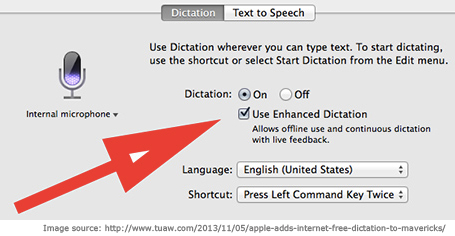
The “enhanced dictation” feature in the OS X Mavericks is a proving to be a boon for for the physicians in situations where an internet connection is unavailable. The flexibility of continuous and live dictation has improved usability as the text is entered word by word when the physician speaks into the microphone. Other useful features of this innovative software:

  • Allows editing of the entered text using the mouse or track pad
  • Permits the speaker to specify commands such as punctuation, caps lock, line breaks, spaces, special characters
  • Words appear on the screen in real-time
  • Can switch between available languages
  • The dictation trigger can be customized as single key press or keystroke
  • Dictation is faster and offers live feedback

Physicians who are worried about handling the complex cardiology transcription and pain management transcription can benefit a lot from this dictation software. Using it is easy:

In the “Dictation & Speech” control panel, check if the dictation feature is enabled. Then check the box for “Use Enhanced Dictation”. This universal dictation feature needs you to download an 800 MB file to make your speech recognition local. Once you have enabled the feature, all you need to do is press the ‘Fn’ key twice to initiate dictation.
Dictation and Speech
Medical transcription, dictation modes, and EHR are reaching new heights with the introduction of such advanced technologies.

Positive Trends Forecast for Global Medical Transcription Services Market

If you are considering a career in medical transcription (MT), it could be the right choice. A recent report from Transparency Market Research says that the value of the global market for medical transcription services is expected to touch a value of USD 60.6 million by 2019 from the level of USD 41.4 million in 2012. The MT market is expected to grow at a CAGR of 5.6% during the next 6 years.

This positive forecast augurs well for freelance medical transcriptionists, medical transcription companies and various stakeholders in countries such as India, the Philippines and other Asian nations which are major BPO hubs providing MT solutions for healthcare providers. A professional medical transcription company with transcriptionists having in-depth knowledge of medical terminologies and skills in transcribing medical reports accurately and quickly can expect to see a rise in demand for their services. With the increasing stress on the security of patient information, they must also have a proper awareness of security issues such as HIPAA compliance.

Medical transcriptionists would need to be experienced in transcribing the following types of reports:

  • Consultation Report (CONSULTS)
  • Operative Note or Report (OP)
  • History and Physical Report (H&P)
  • Discharge Summary (DS)
  • Radiology Report (X-rays or radiographs))
  • Others (Pathology Report (PATH)

Consult repots are expected to witness a CAGR of 3.3% during 2013-2019 and are likely to have a market value of USD 21.1 million in 2019. The reason why consult reports will do better than the other categories is that they are produced every time an individual patient under treatment visits the specialist. The share of H&P reports in the MT service market is also growing due to the fact that they are now created for both inpatients as well as outpatients so as to minimize reimbursement issues.

The growth of the medical transcription industry is being driven by several factors: infrastructural initiatives taken up by governments, adoption of electronic health record systems in developed nations, automation of healthcare operations, and focus on providing quality, speedy access to health care.

The Patient Protection and Affordable Healthcare Act, 2013 and rise in aging population will drive the medical transcription services market in North America, which is already in the leading position. The market value of MT services in North America was over USD 18 million in the past and is expected to grow at a CAGR of over 5% over the period studied.

  • KEY FEATURES

    • 3 Levels of Quality Assurance
    • Accuracy Level of 99%
    • All Specialties Covered
    • Competitive Pricing
    • Digital Recorder Dictation
    • Electronic Signatures
    • Feeds for EHR or EPM
    • HIPAA Compliant Service
    • Quick Turnaround Time
    • Toll Free Phone Dictation
    • Transcription Management Software
    • Volume Rates Available
  • RECENT BLOGS

  • Categories

  • Quick Contact


    • Infographics