What to Look for When Choosing a Medical Transcription Service

Medical Transcription Service

One important pillar that underpins patient care in ways that may not be that evident is medical transcription. A patient’s medical history is made up of all of the notes made, diagnoses made, and written treatment plans. This thorough record gives a clear, comprehensive picture of the patient’s medical journey, which is essential for any healthcare provider taking over or consulting on a case. There’s the legal aspect of things as well. After all, medical records are legally binding documents. As a crucial piece of evidence in any disagreement regarding the quality of care received, they must be exact, accurate, and current. High-quality medical transcription services excel in this precision, making sure that data is documented precisely, leaving no space for doubt or error.

Start your journey with our top-rated medical transcription services.Contact us today!

The prompt availability of these transcribed documents is critical to the effectiveness of healthcare delivery itself. Quick judgments are frequently required in the hectic medical setting, so being able to access a patient’s medical information immediately is extremely helpful. Timely and precise transcriptions guarantee that medical practitioners have access to the necessary data, facilitating prompt and well-informed decision-making that can significantly impact patient outcomes.

Factors to Consider When Choosing a Medical Transcription Company

Choosing the right medical transcription service provider is a crucial decision for healthcare facilities and professionals.
Medical Transcription Company

Here are some key factors to consider when making your selection:

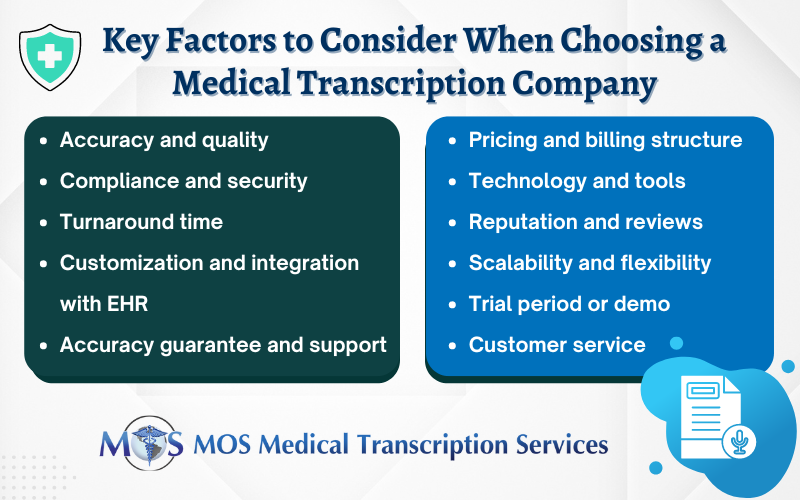
  • Accuracy and quality: Accuracy is paramount in medical transcription. Look for a service with a proven track record of delivering high-quality transcripts with minimal errors. Consider asking for sample transcripts to assess their accuracy and formatting.
  • Compliance and security: Ensure that the transcription service provider adheres to all relevant regulations, such as HIPAA (Health Insurance Portability and Accountability Act), to safeguard patient confidentiality and data security. Inquire about their security measures, encryption protocols, and compliance certifications.
  • Turnaround time: Prompt turnaround time is essential for maintaining efficient healthcare operations. Evaluate the company’s ability to deliver transcripts within your desired time frame, whether it’s 24 hours, same day, or even real-time transcription.
  • Customization and integration: Look for a transcription company that offers customization options tailored to your specific needs. Consider whether they can integrate seamlessly with your existing electronic health record (EHR) system or dictation software for streamlined workflow.
  • Accuracy guarantee and support: Choose a transcription company that stands behind their work with an accuracy guarantee. Additionally, assess the level of customer support they provide, including availability, responsiveness, and assistance in resolving any issues or concerns.
  • Pricing and billing structure: Compare pricing models and billing structures offered by competitors. Consider whether they charge per line, per minute, or have flat-rate pricing, and inquire about any additional fees or hidden costs.
  • Technology and tools: Evaluate the technology and tools utilized by the company, such as: speech recognition software, AI-driven algorithms, and quality assurance processes. Determine how these technologies contribute to accuracy, efficiency, and transcription quality. The ability to integrate seamlessly with your existing Electronic Health Record (EHR) and practice management systems is crucial, as it allows for a streamlined workflow and easy access to patient records.
  • Reputation and reviews: Research the reputation of the provider by reading reviews, testimonials, and client references. Look for feedback from other healthcare professionals or organizations to gauge their satisfaction and experience with the service. Consistent positive feedback on accuracy, reliability, and customer service is a good indicator of a reputable service provider. Additionally, request case studies or references from the company to understand how they have successfully managed similar projects and met client needs in the past. Third-party ratings and accreditations from industry watchdogs or organizations that evaluate service providers can also be a useful measure of a company’s credibility and reliability.
  • Scalability and flexibility: Consider the scalability and flexibility of the transcription company to accommodate your evolving needs, such as fluctuating transcription volumes or specialized medical terminology. Ensure they have the capacity to scale their services accordingly.
  • Trial period or demo: Whenever possible, take advantage of a trial period or demo offered by the provider to test their capabilities, assess the quality of their transcripts, and evaluate their compatibility with your workflow and requirements.
  • Customer service: Excellent customer service is essential for a smooth and productive partnership. Choose a company that offers 24/7 support to address any issues or queries promptly, ensuring minimal disruption to your operations. A dedicated account manager can enhance service quality by providing personalized support tailored to your specific needs. Furthermore, comprehensive training and onboarding sessions from the transcription service can facilitate a smooth transition and help your staff make the most of the new system, ensuring optimal use and efficiency.

Want to know how medical transcription services can be of assistance?

Read our post: Medical Transcription Services: A Game Changer in Hospital Medical Record Management

Considering these factors will help ensure that you choose a medical transcription company that meets your legal requirements, leverages modern technology, provides excellent customer service, and has a strong reputation backed by positive reviews. Choose a U.S-based medical transcription company that can successfully meet your needs and expectations.
Upgrade your transcription process with our cutting-edge technology.

Call us at 1-800-670-2809.

Medical Transcription – Career Prospects

If you are searching for a fruitful career in the healthcare industry, then medical transcription is a good choice. Many people choose this career primarily due to the immense flexibility the job allows in one’s schedule. Below mentioned are some points on how to become a transcriptionist and other important facts that you need to know about this profession.

Medical transcription services are of great help to physicians or medical practitioners as it helps them to create and maintain separate records for each patient they treat. Each time a patient leaves a doctor’s office, the doctor dictates or records his/her patient notes into a digital tape recorder or Dictaphone. Medical transcription companies also provide the option to dictate via a toll-free number. Medical transcriptionists listen to these audio recordings and generate accurately typed reports and documents. These transcribed reports that include history and physical reports, clinic notes, consultation reports, diagnostic test reports, procedure notes, ER reports and other follow-up notes become a permanent record in the patient’s file. Accurate and top quality medical transcription services allow physicians to save time and prevent documentation errors.

Qualifications of a Medical Transcriptionist

A two year associate degree or a diploma degree in medical transcription after high school is essential to become a transcriptionist. You can also attend tests to become a Registered Medical Transcriptionist (RMT) or Certified Medical Transcriptionist, but they are not essential requirements to work as a medical transcriptionist. In addition to this, distance learning programs, vocational schools and community colleges offer transcription training in the form of one–year certificate program or associate degree.

Flexibility of schedule is one of the major advantages of this profession. Normally, transcriptionists can either work in an office or from a work–from–home setting. Employment opportunities also exist in hospitals, corporations and healthcare facilities. Also, some transcriptionists may choose to work on a freelance basis.

Normally, transcriptionists work for about 40 hours a week. Payment for this job is either by the hour or by line. So, the more you work, the more payment you receive. A transcriptionist is required to strictly meet the set deadlines.

Medical Transcriptionists – Key Skill Set and Personal Qualities

  • Thorough knowledge of important medical terminology (as well as abbreviations and medical jargon used by physicians)
  • Fast typing skills
  • Good listening skills
  • An ear for accents
  • Excellent command over English language
  • Good hearing faculty
  • Computer skills
  • Attention to detail

Moreover, medical transcriptionists need to follow certain rules to protect the privacy and security of protected health information (PHI). They need to comply with the rules set under HIPAA guidelines. As per this rule, transcriptionists are prohibited from using or disclosing any protected health information (PHI) in any manner that would violate the privacy rule. An HIPAA compliant medical transcription company ensures:

  • Guaranteed data security
  • Privacy of patient records and data
  • Increased data efficiency

The job prospects for medical transcriptionists are promising. As per the findings of the Bureau of Labor Standards (BLS), a 14% growth in medical transcription is projected for the 10 year period ending 2016. Even with the introduction of speech recognition software, many physicians still prefer professional medical transcription companies for transcribing their patient notes.

With Voice recognition software, the only difference is that rather than typing documents from scratch, transcriptionists are now editing them as electronically typed documents by listening to the original dictation to make sure it matches the draft document originally transcribed by the software.

Diagnostic Errors – A Top Concern of the Healthcare Industry

Correct medical diagnosis is the cornerstone of medical care. Imagine you consulting a doctor for a crippling headache. It could be a sinus headache but your physician wrongly diagnoses it as caused by migraine. You are administered treatment for the sinus, which means you are not getting the right medicines and in the long run, this could make your condition worse and have dire consequences on your health.

When you see a doctor and describe all your symptoms, you would imagine that the physician will correctly analyze the issue. However, despite the rigorous training that they go through, doctors do err with diagnosis. In fact, a recent study showed that failure to diagnose and provide timely treatment was the most common reason for a patient safety incident, with a rate of 155 per 1,000 hospitalized patients!

The point to note is that making the right diagnosis is not easy. According to an article in ConsumerReport.org, physicians make wrong diagnosis in 10–15 % of office visits for a new problem because of many reasons. Often, doctors need to come up with a correct diagnosis within a limited period of time (as an average patient office visits lasts only for 20 minutes). Moreover, patients may not disclose complete or accurate information about their medical history and this can restrict doctors from making a correct analysis about their health condition. Even the most astute physicians can go wrong if they are interrupted during the consult by office staff members.

Entering wrong patient complaint by office staff in the electronic health record can mislead the doctor. An online review published in BMJ Quality and Safety on Aug. 7, 2013, suggests that laboratory tests are incorrect in 2 percent to 4 percent of medical cases can also lead to diagnostic errors. The prescription of the wrong drug or dosage by a physician can also prove to be deadly.

Medical transcription errors such as misspelling or misinterpretation of terms in the physician’s dictation can eventually affect treatment at a later stage. Errors in diagnosis can prove fatal in patients suffering from invasive diseases. A study conducted by the Houston Veterans Affairs Facility found that a large number of misdiagnoses involve conditions like cancer, pneumonia, acute renal failure, urinary tract infections and congestive heart failure. Misdiagnoses can often increase the medical cost if unnecessary laboratory tests are recommended by the doctor.

The following tips can help reduce the incidence of diagnostic errors:

  • Arriving at a final analysis or judgment with the initial information provided by the patient should be avoided
  • Do not connect symptoms to similar complaints experienced by patients
  • Do not allow stereotypes to interfere with clinical judgment
  • Don’t be in a rush to come to a conclusion
  • Pay attention to peer opinion

Lack of communication between doctor and patient contributes to more than 80% of the medical misdiagnosis. These generally include – improper review of patient medical history, errors in diagnostic tests and misinterpretation of test results. As a patient, you need to understand the different steps to be followed starting from the first day of the visit. Try to schedule your appointment early in day so that your consultation time will not be shortened. Discuss all your current health issues and symptoms and previous medical history in detail with the physician. Patients can enquire how the doctor plans to conduct a diagnosis. Patients who are not satisfied with the diagnosis or treatment plan can seek a second opinion from another trained physician.

Crowdsourcing for Medical Transcription

With the drive towards Electronic Medical Record (EMR) implementation and ‘meaningful use’ by 2014 gathering pace, healthcare providers are in a hurry to transcribe their written health care documents and notes into electronic format and enter them in a secure database. The billing and coding process has also become complicated in recent years due to the intense scrutiny by payers. As the documentation requirements continue to increase, crowdsourcing is gaining popularity in the medical field, especially in the area of medical transcription to help in the effective management of the complex health care system.

So what exactly is crowdsourcing? It’s the process of getting work done online by a crowd of people who can be spread across various locations in the world. So crowdsourcing or microsourcing as it is also called, is simply outsourcing work to a crowd of workers.

What is intriguing is that crowdsourcing is becoming popular in medical transcription, an area where proper training and adherence to government regulations is important. The fact is that crowdsourcing is possible in this field as several Internet-based training courses and programs are available for people to learn transcription online. Crowdsourcing has created a wider base of medical transcriptionists who can perform the task in a cost-effective manner.

While implementing a big data management system, whether on-premise or in the cloud, a healthcare provider would need to invest heavily on hardware and software. The provider would also need to hire permanent staff as well as contract workers to get the job done. With the big data crowdsourcing model, the provider can distribute their tasks among the workers who have online access across anywhere in the world. The tasks will be completed within the turnaround time with high quality and at lower cost.

Many of uses of crowdsourcing in healthcare today are supported by increasing global connectivity and require high levels of bandwidth and security. Clear instructions are also essential for success with crowdsourcing. Freelancers in medical transcription are usually beginners and this could tell on the quality of the transcripts. It would also be difficult to track each person’s work and retain good talent. On the other hand, these issues would not arise with medical transcription outsourcing to an experienced HIPAA-compliant medical transcription company. Better monitoring of the process and the rules of crowdsourcing are necessary to ensure better value for the healthcare industry.

To learn more about Crowdsourcing for Medical Transcription we have written a new blog “Crowdsourcing Helping to Diagnose Rare Medical Conditions Quickly” on August 7, 2017

Obamacare Expected to Spur the Growth of Medical Transcription Jobs

According to official estimates, more than 2 million Americans have signed up for health coverage under Obamacare. The administration also expects that around 7 million people will be enrolled by March 31, 2014. One of the sectors that will be directly impacted by Obamacare is medical transcription. Industry leaders expect that the Affordable Care Act (ACA) or ‘Obamacare’ will make medical transcription a $20 billion industry.

No denial of coverage for pre-existing conditions or other discriminatory practices such as charging women more than men, allowing young Americans to stay on their parents’ health plan, tax credits for businesses to buy insurance, subsidies to help individuals buy plans, and the setting up of health insurance exchanges offering a choice of affordable plans – these are some of the main reasons for the popularity of Obamacare.

As more people get insured, the demand for health care services is also expected to increase substantially. Some experts point out that doctors in the United States are expected to see double the number of patients than they normally do. This would result in more medical records being dictated by physicians, clinics and hospitals, and as these need to be converted into health care documents, the demand for medical transcription services is expected to go up.

Under Obamacare Act, healthcare providers will be periodically audited for compliance. Those who violate the law by not transforming their medical records into proper documents will be required to pay a penalty. That’s why healthcare providers are in a hurry to get their records transcribed into Word documents and get their documentation in order, a task that is assigned to in-house or outsourced medical transcriptionists.

EHR alone cannot help providers achieve documentation goals

American Recovery and Reinvestment Act (ARRA) of 2009 insists that all public and private healthcare providers and other eligible professionals to adopt and demonstrate ‘meaningful use’ of Electronic Health Records (EHRs) as of January 2014 to maintain their existing Medicaid and Medicare reimbursement levels. However, the extent to which EHR can help healthcare providers with their documentation is limited. Though EHR vendors initially thought that this electronic system could eliminate transcription, they have now realized that the meaningful conversations cannot be captured with a drop-down box. Moreover, physicians are finding it difficult and cumbersome to enter data into the EHR system during an encounter, which, in addition to detracting from patient care, may result in inaccurate documentation and over-billing, eventually leading to penalties.

On the other hand, medical transcription services are a much more reliable option, even with the use of speech recognition dictation systems. Professional medical transcriptionists accurately transcribe the clinical narrative down to the last detail, which most EHR systems cannot accomplish. Reliable medical transcription companies even offer feeds to the EHR system. By reducing the time physicians spend on documenting in the EHR, medical transcription services are helping them find more time for their patients. Blending transcription with the EHR can ensure accurate and timely clinical documentation.

Smart Technology in Healthcare: Transforming the Workplace and Medical Transcription

Medical Transcription

Smart technology is transforming many fields and healthcare is no exception. Advanced technologies from wearable devices that monitor vital signs to AI-driven diagnostic tools are reshaping healthcare delivery. One area where this innovation is making a significant impact is medical transcription. Smart technology has reduced the time and effort needed to convert physician dictated reports into written text for patient records. Medical transcription services provided by humans support these innovations by ensuring that machine-generated reports are accurate and complete.

Learn how our smart transcription solutions can benefit your practice! Call 1-800-670-2809 today!

Here are the main technological developments that are transforming the healthcare workplace:

  • Electronic Health Records (EHRs): Paper-based medical records have given way to EHRs. EHRs have made patient care more efficient, accurate, and patient-centered. These standardized systems offer a secure repository for patient records and make them easily accessible to authorized users. EHRs ensure accurate and up-to-date information, reducing risk of errors and improving patient safety. They also drive collaboration among healthcare providers, improving care delivery.
  • Data Analytics: In today’s healthcare landscape, data is king. Advanced analytics tools empower healthcare organizations to harness the full potential of their data. By analyzing this information, they can identify trends, optimize resource allocation, and improve patient care delivery. Predictive analytics, in particular, can pinpoint patients at risk of developing certain conditions, facilitating early intervention and preventive care.
  • Artificial Intelligence (AI) and Machine Learning (ML): These powerful technologies are revolutionizing healthcare workplaces by enhancing efficiency, accuracy, and patient outcomes. AI and ML are being utilized to analyze vast amounts of medical data, helping healthcare providers make more informed decisions. In diagnostics, these technologies can identify patterns and anomalies in imaging and lab results, often with greater speed and accuracy than human interpretation. AI and ML are also optimizing administrative tasks, such as scheduling, billing, and resource management, freeing up healthcare professionals to focus more on patient care.

Telehealth and Telemedicine

Telemedicine and telehealth systems allow physicians to deliver medical services remotely. They are becoming integral components of modern healthcare workplaces, facilitating real-time consultations and supporting remote monitoring and chronic disease management with timely follow-ups, without the need for in-person visits. Telehealth bridges the gap between healthcare providers and patients, especially in in underserved or geographically isolated areas. They also allow healthcare providers in different locations to collaborate, thus improving the quality of care.

Smart technology has also improved the efficiency of medical transcription. Let’s see how.

How Smart Technology Enhances Medical Transcription

Traditionally, medical transcription, the process of converting voice-recorded physician reports into written text, was done by dedicated human transcriptionists.

Smart technology has transformed the transcription process in several ways:

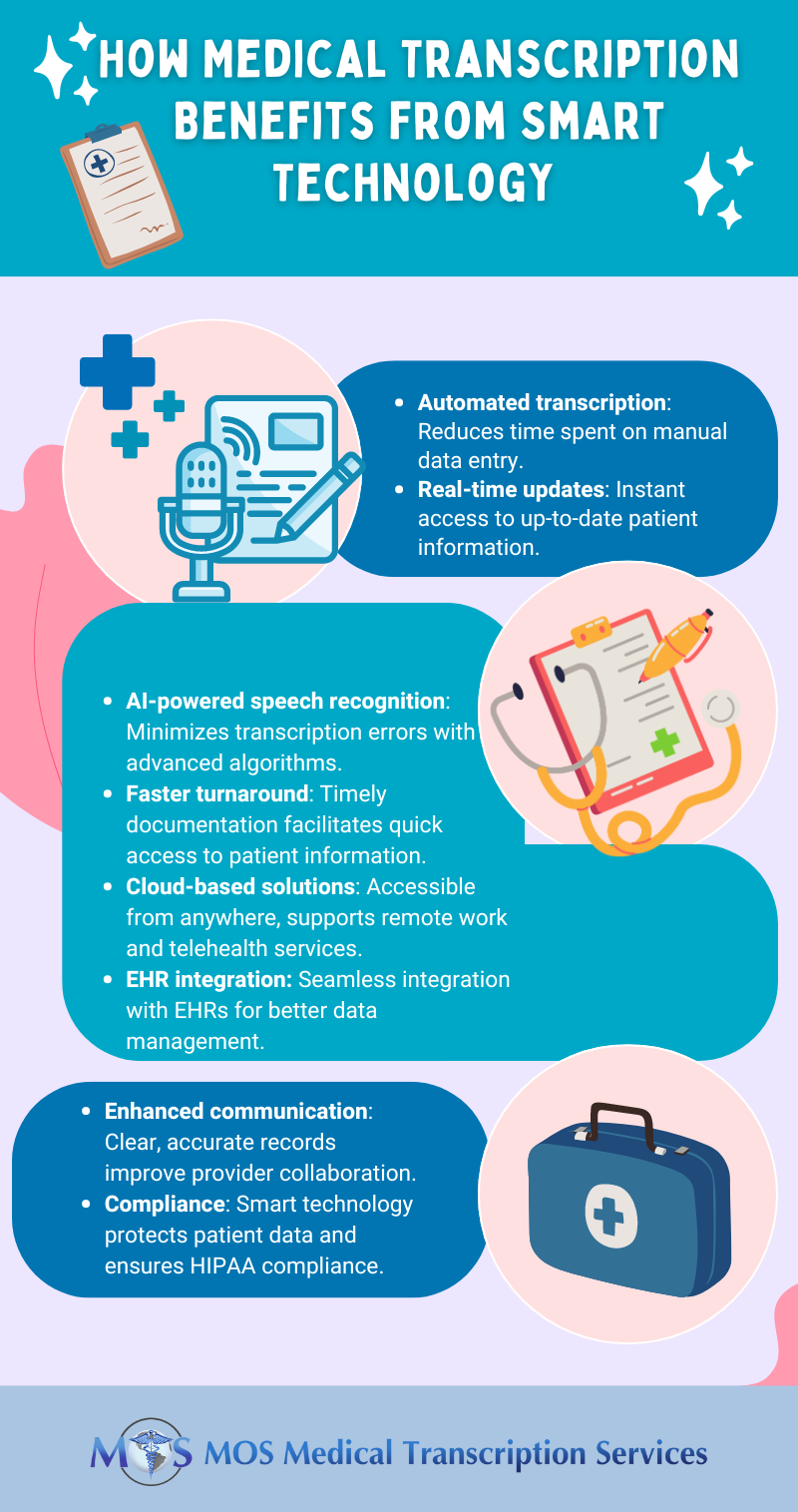
  • Voice Recognition Software: Advanced AI-powered voice recognition software can accurately transcribe spoken words into text, reducing the time and effort required to do it manually. This technology not only speeds up the transcription process but also enables real-time documentation during patient visits. Physicians just need to dictate and the tool will automatically capture and convert the voice recordings into text. This technology learns from previous data, continually improving its accuracy over time.
  • AI-Powered Error Detection: Smart transcription systems are now equipped with AI algorithms that can detect and correct errors in real-time. For e.g., medication errors, such as incorrect dosages or wrong medications, can have serious consequences for patients. AI systems can analyze patient data, medication orders, and clinical guidelines to identify such errors before they happen. This improves patient safety as well as the accuracy of medical records, ensuring that healthcare providers have reliable information to base their decisions on.
  • Natural Language Processing (NLP): NLP algorithms can understand context and medical terminology, enabling the software to interpret complex phrases correctly. This results in fewer errors and a more reliable transcription process.
  • Integration with Electronic Health Records (EHRs): Smart technology enables seamless integration of transcribed documents into EHR systems. This means that transcriptions can be automatically uploaded and organized within a patient’s digital records, making it easier for healthcare providers to access and update patient information.
  • Remote Transcription Services: Cloud-based medical transcription dictation software allows clinicians to dictate notes any time, regardless of location or device. Transcriptionists can access the data, work from anywhere and provide transcriptions 24/7, which is especially useful in emergency or high-demand situations. The software also comes with advanced security protocols to protect sensitive information.

Benefits of Smart Technology in Medical Transcription

  • Increased Accuracy: AI-driven error detection and correction improves, medical transcription accuracy, reducing the risk of errors in patient records.
  • Enhanced Efficiency: Enables faster transcription turnaround times, allowing physicians to focus more on patient care.
  • Cost-Effective Solutions: Can lower operational costs required for manual transcription
  • Improved Patient Care: Ensures that healthcare providers have up-to-date information, leading to better patient outcomes.

How Medical Transcription Benefits from Smart Technology

Smart technology is reshaping healthcare, particularly in the field of medical transcription. Future advancements may include even more sophisticated AI that can understand complex medical terminology, contextual aspects, and potentially handle transcription with minimal human intervention. Embracing these innovations is crucial for the future of healthcare, ensuring that providers can deliver the best possible care in an increasingly complex environment.

However, even while technology enhances the transcription process, the role of skilled transcriptionists will remain vital. Their expertise is essential in ensuring that transcriptions are not only accurate but also contextual and complete.

We provide tailored medical transcription services tailored for all specialties!Contact us today to discuss your needs!

Advantages and Disadvantages of Using Speech Recognition Software for Medical Transcription

Advantages and Disadvantages of Using Speech Recognition Software for Medical TranscriptionHospitals and medical practices are increasingly using speech recognition technology to implement more efficient documentation workflows and cut costs. Speech recognition systems allow healthcare providers to use their own voice to log information directly into the electronic health record (EHR). Nevertheless, while speech recognition tools expedite the clinical documentation process, they are not perfect and may not be sufficient for ensuring comprehensive and error-free medical records. As a result, providers often rely on human-based medical transcription services to enhance the accuracy of machine-generated documentation.
Need accurate and timely medical transcription services?

Get started with a Free Trial!

According to Statista, the global speech recognition market size will reach a value of US$4.83bn by 2030. The report estimated that the United States would have the largest market size in 2024, valued at US$1,903.00m. The increasing demand for speech recognition technology in healthcare is a major growth factor for the speech recognition market.

While speech recognition technology offers numerous advantages in the healthcare setting, physicians should also be aware of its limitations.

How does Medical Speech Recognition Work?

Speech recognition software digitizes your speech. It converts your speech into sound waves and then compiles it into recognizable words and phrases. Beyond mere transcription, advanced speech recognition tools leverage natural language processing (NLP) to “understand” the context and meaning behind your words.

When speech recognition technology is integrated directly into the EHR system, it enables healthcare providers to complete their entire medical note using only their voice, without having to manually type or enter information. The software automatically transcribes the provider’s dictation and enters the information in the relevant fields and sections of the patient’s electronic chart.

There are two broad categories of speech recognition systems: traditional speech recognition software and AI medical scribes. The traditional software types as the physician dictates. AI-powered medical scribes go further by leveraging NLP. The AI listens to physician-patient conversations and automatically generates complete transcripts with all the relevant details discussed, including helpful suggestions.

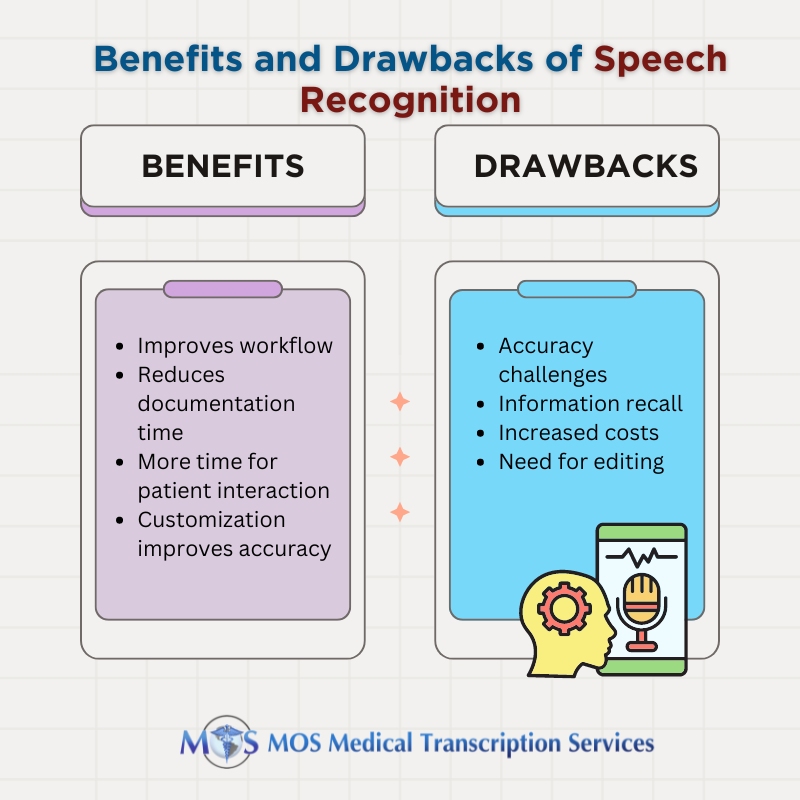
Benefits and Drawbacks of Speech Recognition for Medical Transcription

First, let’s consider the benefits of speech recognition technology in the clinical setting:

  • Improves workflow: The seamless integration of speech recognition into the EHR creates a truly hands-free, voice-driven clinical documentation workflow. This can improve efficiency and reduce the data entry burden, leaving more time for direct patient interaction.
  • Reduces documentation time: One of the key benefits of speech recognition is that it can help to reduce documentation time. Traditional medical documentation, where clinicians manually type or write patient notes, can be a time-consuming process that detracts from direct patient care. Speech recognition allows providers to dictate their observations, diagnoses, and treatment plans directly into the electronic health record (EHR) system. This real-time voice-to-text conversion can significantly speed up the documentation workflow compared to manual typing. Studies have shown that speech recognition can reduce documentation time by 30-50% compared to keyboard-based entry.
  • More time for patient interaction: Speech recognition allows clinicians to spend more time with patients, leading to better conversations about their condition and care. This extra time can enhance patient interactions and improve health outcomes.
  • Customization improves accuracy: Medical speech recognition systems adapt to your unique voice and medical terms the more you use them. They also work for multiple users, learning from different voices and inputs to become more accurate over time.

Now, let’s consider the drawbacks.

  • Accuracy challenges: Using speech recognition for transcription comes with several challenges: The software may struggle with:
    • comprehending specialized medical terms and jargon
    • variations in accents and dialects
    • differences in individual voice patterns and speech rhythms
    • complex sentences or fast speech
    • context-specific meanings and nuances in medical conversations

Additionally, background noise or overlapping conversations can interfere with the system’s ability to capture clear audio. Addressing the above-listed challenges and improving accuracy often includes continual customization, training, and integration with specialized medical vocabularies.

  • Information recall: A major issue with speech recognition is the risk of forgetting important details discussed during the patient encounter. If you rely solely on speech recognition to dictate your notes, you may not be actively engaged in the physical act of writing or typing. When you are more focused on speaking the notes, it can affect how you process and retain the information. This might lead you to forget some of the information discussed with the patient, which can affect the accuracy of the final documentation.
  • Burdensome: Dictating medical information using speech recognition can be burdensome for providers. Since the technology often requires dictating even basic punctuation, it can become exhausting. For example, when updating the patient’s record, the physician might have to say: “The patient presents with headaches comma nausea comma and dizziness period.” After a long day of seeing many patients, verbally specifying punctuation to format the text correctly can be very tiring.
  • Cost: Speech recognition technology is expensive to set up. Before investing in the software, you need to consider the initial infrastructure requirements, future technology upgrades, and maintenance costs.
  • Need for editing: As explained earlier, speech recognition technology cause errors in the transcript due to misinterpretation of medical terms, variations in pronunciation or speech patterns, lack of contextual understanding, failure to capture specialized terms, and formatting issues. All of this necessitates manual corrections in automatic transcriptions.

Benefits and Drawbacks of Speech Recognition

The bottom line is that speech recognition software requires human intervention to guarantee the highest accuracy. However, it would be impractical and time-consuming for physicians to proofread and check their own transcripts. Fortunately, they can rely on a medical transcription company to review, edit, and correct the reports generated by these applications. Leading companies have stringent quality assurance checks to ensure top accuracy.

The use of EHR-integrated speech recognition in combination with human based medical transcription can generate legible, comprehensive documentation that improves the quality of patient care and creates efficiencies for the health care organization.

Free up time and focus on patient care by outsourcing your transcription needs!

Contact us today!

Differences Between Transcription and Copy Typing

The terms ‘transcription’ and ‘copy typing’ confuse most people and they wonder what exactly makes them different. They also doubts as to why the cost of transcription is higher than that of copy typing. After all, both involve typing. However, transcription involves much more than typing from copy. One of the sectors where transcription is widely used is healthcare. Physicians need to convert their dictation or audio files into well-written text documents. It’s important to know what exactly transcription and copy typing involve and why they are priced differently.

Copy typing typically involves typing from a written document. The document could be a hand written one or one that was typed on a typed writer. Copy typing is usually done to enter the information into a computer. Not much hard work is needed in this case as the typist simply enters what’s in the written document. If the handwriting is clear and legible, copy typing services will be relatively cheaper.

Transcription, on the other hand, is the conversion of audio or video files (that contains recorded voice) into digital format. As recorded speech is the input for transcription services, it should be clear and coherent to provide accurate results. It can be single person dictations or group dictations.

So the core differences between copy typing and transcription are:

  • In copy typing the input is in the form of paper documents, whereas in the case of transcription, it is audio/video files.
  • Transcription is more complex while copy typing needs just simple typing skills. Specific training and skill is required to handle medical transcription.
  • Due to their greater complexity, transcription services are costlier.

When it comes to medical transcription there are even more specific requirements:

  • Client Demands: – The transcription should be carried out to meet the client’s specific requirements. Medical transcription involves the documentation of dictation for various medical specialties such as cardiology transcription, pain management transcription, and much more.
  • Input Quality: – The quality of the audio recordings is another factor which impacts the quality of the transcript. Recordings with too much noise are often challenging to transcribe.
  • Interpretation of medical terms: – Interpreting dialogues are much difficult than reading the content from a document. Moreover, when transcribing for any medical specialty, the transcriptionist should be familiar and well-versed in the relevant medical terms and jargon.
  • Dealing with strong accents: – If the speaker has a strong accent, the transcriptionist should be able to decipher what is being said.
  • Special Infrastructure: – Medical transcription requires special infrastructural facilities
    • a workstation with a computer, transcription software and a sound card. The software would feature word processing programs and programs for labeling, segmenting and transcribing voice files, speed typing software
    • Noise canceling headphones and a foot pedal for managing dictation playback
    • Medical dictionaries are necessary for references on medical definitions and abbreviations
    • Networking software and a high speed or (minimum) dial-up Internet connection are also necessary
    • Additional servers and large storage devices may be necessary for feeds to Electronic Medical Records (EMR)
    • Encryption software and paper shredders are crucial to ensure the confidentiality of patient information

It’s quite obvious that medical transcription is much more than simple copy typing and that’s why it costs more. Outsourcing to professional transcription company that have a team of qualified and trained medical transcriptionists is more affordable than doing the job in-house. Physicians can save on staffing and training and setting up the needed infrastructure as well as get customized transcripts in minimum turnaround time.

Physicians Moving to EMR from Regular Medical Transcription – Implications

Some US healthcare providers have achieved full conversion to electronic medical records (EMR) and many others are making steady progress towards this goal. The aim of an EMR plan is to close the gap between paper and electronic records, a time-consuming but mandatory task that has to be completed by 2014. Facilities that fail to meet the deadline will face penalties in Medicaid and Medicare reimbursements in 2015. The big questions are – what will be the implications of EMR for medical transcription and whether EMR can replace regular transcription services?

Steady Progress to EMR

According to a recent report, St. Francis Medical Center has achieved 50% conversion and their aim is to attain 100% target by 2014. LA based West Carroll Health System started the conversion process three years back and has now completed 90%. It is quite obvious that most healthcare facilities are progressing to EMR, but not only because of the law put forward by President Barack Obama, but also of the many benefits offered by the conversion of medical records to electronic format.

Advantages of EMR Conversion

Electronic medical records are improving patient care and staff-level communication. Here are the main benefits that an EMR system offers:

  • EMR ensures smoother communication between hospital administrators and physicians
  • Physicians can access/examine any file or report from any location, which means that they do not have to be on site to order and review tests
  • As the system is electronic, staff can keep a track of who accessed and interacted with a patient
  • This online patient information system has greatly helped in the centralization and timeliness of patient information for doctors
  • Authenticated access and encryption of records ensures for security in operations and the confidentiality of patient health information (PHI)
  • EMR has improved continuity of care as patients can move easily from one healthcare facility to another as all their health information is online

Maintaining electronic health records is also much more cost-effective than storing voluminous patient records which may even contain handwriting (doctors’ prescriptions) which can be difficult to decipher

Medical Transcription Continues to Be Relevant

While physicians are lauding the benefits of EMR, they are also aware its limitations. One thing that most physicians have noticed it that EMR has detracted from their relationship and communication with their patients. Most find it difficult to eneter information into the EMRs while paying attention to what their patients are saying. EMRs have multiple templates which physicians have to navigate through even as hundreds of items appear on the screen that need review, signature and follow-up. These can prove big distractions in the process of building authentic doctor-patient connections.

With regular medical transcription services, such issues hardly exist. Physicians can simply dictate during the patient encounter and get their notes and reports transcribed and delivered to them in custom turnaround time. Moreover, professional medical transcription companies are keeping ahead with these technological advancements. Their teams of trained and experienced transcriptionists can provide feeds to EMR and EHR (electronic health records) for any specialty. Even doctors using voice recognition software to create medical reports can rely on medical transcription services for correcting and editing their reports. It seems the role of the medical transcriptionist is more valid than ever.

Significance of Accuracy in the Transcription Report

People who know the real significance of medical transcription in the healthcare industry would never describe it as an ‘easy typing job’. Professionals who carry out medical transcription need to have special skills. In addition to excellent typing speed and accuracy, they need to have good listening skills, powers of comprehension, and an in-depth knowledge of medical jargon and terminology. The ability to understand strong accents and grammar proficiency are added advantages.

Accuracy is paramount and related to not just using the correct words but also conveying the right meaning as meant in the dictated report. The best way to ensure accuracy in a report is to check for the following

  • Misspelling
  • Incorrect use of medical and English words
  • Patient information errors
  • Many flags
  • Omitted dictations
  • Incorrect verbiage usage
  • Incorrect format protocol

In a professional medical transcription company, the editor in charge would check the documents thoroughly to see that they meet the accuracy level, which could be as high as 99%. Compromising on accuracy will have devastating consequences for the physician and the patient. It is the prime responsibility of a transcribing professional to deliver error-free reports – even in the face of challenges such as slow or rapid speech, difficult accents, or mumbling. With a reliable medical transcription company that has a team of qualified, trained, and experienced transcriptionists, physicians can be ensured of quality medical transcription services.

  • KEY FEATURES

    • 3 Levels of Quality Assurance
    • Accuracy Level of 99%
    • All Specialties Covered
    • Competitive Pricing
    • Digital Recorder Dictation
    • Electronic Signatures
    • Feeds for EHR or EPM
    • HIPAA Compliant Service
    • Quick Turnaround Time
    • Toll Free Phone Dictation
    • Transcription Management Software
    • Volume Rates Available
  • RECENT BLOGS

  • Categories

  • Quick Contact


    • Infographics