Most Common Medical Transcription Myths [Infographics]

Medical transcriptionists play a significant role in healthcare documentation. The process of medical transcription begins once the patient consults a physician and seeks advice and treatment for the health problem. Yet there are many myths and misconceptions regarding medical transcription. To realize the true value of these services, it is important to dispel these misconceptions.

Most Common Medical Transcription Myths [Infographics]

Use of Electronic Health Records by Nurse Practitioners – Problems and Solutions

Electronic Health RecordsElectronic health records (EHRs) have become ubiquitous part of the health care system. Medical transcription companies provide EHR-integrated documentation solutions to help clinicians manage heavy patient loads with extensive data entry and reporting requirements. A recent study published in the Journal for Nurse Practitioners shows the importance of such support for nurse practitioners (NPs). According to the study, NPs should follow best practices when using computerized health information systems in order to improve the quality of care, ensure accuracy in the record, and protect themselves against the hidden liabilities associated with these systems.

As of October 2015, over 479,000 health care providers received payment for participating in the Medicare and Medicaid Electronic Health Records Incentive Programs. In April 2016, the Centers for Medicare and Medicaid Services (CMS) proposed a rule to replace meaningful use for Medicare physicians and establish key parameters for the new Quality Payment Program, an agenda that includes the Merit-based Incentive Payment System and Alternative Payment Models.

Computerized health information systems are routinely used by NPs to document patient information. These also often serve as clinical data repositories that are shared among health care professionals and support medical billing processes. However, as the study points out, these systems pose many problems for NPs:

  • Detracts from the patient experience: EHR data entry prevents the NP from maintaining eye-to-eye contact with the patient. It stands in the way of discussions about the patient’s health status, test results, or prescribed medications
  • Difficult data entry: Cumbersome templates and rigorous data entry requirements can lead to errors. Prescribing, transcribing, dispensing, and administering can be disjointed and result in medication administration errors. Other issues that could cause medication errors include difficult-to-use screen and font sizes, auto-correct or auto-fill functions, insufficient LED lighting, and a lack of hand-held devices used to bar code scan medications, and delayed access to lab results or a lack of interoperability with other systems.
  • Risk of malpractice liability caused by online patient charting: The study found that online charting caused problems that increased medical malpractice risks. These include:
    • Mistakes due to the tendency to copy-paste information from previous exams
    • Templates that are narrow in scope and do not allow entry of data suggesting alternative diagnoses
    • Risks posed by ignoring the continuous alerts and recommendations that EHRs provide
    • Attempt to maintain medical record integrity with late entries and charges
    • Failure to document or incomplete/inaccurate documentation, including not transferring all information from the paper chart to EMR or EHR, failure of NPs to sign their notes, or checking boxes indicating that services were performed without providing supporting documentation

The study also noted that as clinical decision-making is based on real-time information, NPs can face care issues when they have only partial or incomplete medical data when dealing with a patient. This could occur when the medical record system is offline and no back-up is available or when patient medical data is held in the form of both electronic and paper charts.

The author recommends several measures that can help NPs protect themselves and their patients:

  • Participate in in-house training that supports the EMR or EHR in their practice or hospital.
  • Learn how to work with the system to ensure accuracy in the record
  • Be aware of the hidden liabilities associated with these systems and follow best practices when entering information, especially with annotations, addenda, and corrections after patient visits.

Outsourcing medical transcription is also a proven strategy to ensure accuracy in patient records. Trained and experienced medical transcriptionists in a reliable US based medical transcription company would be well-equipped to help NPs and physicians ensure error-free EHR data entry to improve patient care, increase efficiency and protect themselves against malpractice litigation or licensing issues.

Emergency Room or Urgent Care-Unraveling the Dilemma

Emergency RoomWhether emergency room (ER) reports or urgent care documentation, experienced medical transcription companies can ensure error-free EHR-integrated solutions in fast turnaround time. However, when an accident, injury or sudden illness occurs, patients are often confused as to whether they should see an ER physician, approach an urgent care center, or contact their primary care physician. A recent report published by wuwf.org looks into the question: ER or urgent care – what’s right and when? Considering that time and expense are involved, making the right decision is crucial.

The key lies in knowing the difference between these three types of services. Most of the confusion between ER and urgent care arises because both terms indicate that there is a medical situation that needs to be dealt with quickly. Examples of such needs include intense abdominal pain in the middle of the night, a sprained ankle, or a child developing a high temperature. If their primary care physician is unavailable, most people are uncertain about where they should go for treatment in such situations.

Patients can save time and money by choosing the right option. The ER visit should be reserved for extreme medical conditions such as chest pain, severe injuries, paralysis, high fevers or rash, especially in children, repeated vomiting, allergic reactions, and poisoning. Hospital emergency rooms have the resources and services to handle such situations.

On the other hand, urgent care is meant for a condition that is not life threatening, but which needs to be taken care of in a couple of hours or within the day. Patients should opt for urgent care if their primary care physician is not available. Fever, flu symptoms, allergic reactions, minor cuts, animal bites, and broken bones can be handled in urgent care centers – with less cost and time than the emergency room. In fact, United Healthcare reports that in Florida, a non-emergency ER visit could cost about $1,500-2,000 while the cost of an urgent care center visit averages $150-200. If necessary, urgent care physicians make referrals to specialty care departments.

The third option – primary care – is the right choice for non-acute and non-urgent conditions such as routine health problems as well as chronic, complicated conditions. ERs and urgent care centers are not equipped to deal with non-emergency and chronic conditions such as depression or diabetes.

For physicians, the goal should be to provide patients with the kind of care they need, when they need it. A report in The Ambulatory M&A Advisor notes that overlap of services sometimes leads competition between primary care physicians and urgent care centers. The solution, says the author, lies in these centers working together. The primary care physician can refer patients to an urgent care center if they can be treated appropriately there, instead of to emergency care. If a primary care center is overbooked, providers can refer patients to the nearest urgent care center. Such strategies will also reduce ER congestion, a problem that hospitals across the country are struggling to address. Overcrowding is linked to poorer outcomes for patients.

In all of these care models, providers require customized medical reports that meet their specific needs. Reliable medical transcription service providers can ensure this. They have skilled teams that are well-versed in transcribing the terms relating to ER care, urgent care, and primary care. They can provide error-free transcripts of ongoing care of chronic problems and medical conditions, surgical procedures, trauma resuscitation, patient progress reports, history and physical reports, chart notes and discharge summaries in custom turnaround time, including standard 24 hour TAT and STAT (2 hours, 4 hours or 6 hours). Such value-added transcription support is crucial as physicians focus on providing patients with quality care.

Direct Primary Care – New Paradigm that Maximizes Health Care Value

Direct-Primary-Care-Maximizes-Health-Care-ValueDirect primary care (DPC) is catching on with many family medicine physicians extolling its virtues. The key benefit of this relatively new paradigm is that it maximizes health care value. As a medical transcription service provider with years of experience, we know how important it is for the physician to focus on the patient during the consultation. The DPC model permits this. It allows physicians to spend more time with their patients, provide higher quality of care than under the traditional model and enjoy greater professional satisfaction. Patients across the U.S. are experiencing better access and lower costs using direct primary care.

DPC is a departure from the fee-for-service approach, which is on its way out. In this “alternative” practice model, physicians do not take insurance but instead charge patients a monthly fee-usually in the range of $25 to $125- which covers the primary care they need.

A recent article in Medical Economics reports the cofounder and head of a large DPC network as saying, “What is motivating physicians to convert is primarily a desire to be able to spend more time with patients.”

The benefits of the DPC model for physicians and patients are:

  • DPC reduces the complexity of running a practice. It minimizes the paper work and regulatory burdens associated with billing insurance and frees up physician to focus on patient care.
  • Physicians can build meaningful relationships with their patients, which leading delivery of improved care.
  • Patients need pay only a monthly membership fee which will generally cover everything from office visits to basic lab tests.
  • The monthly fees are affordable because DPC practices have low overhead expenses since they do not accept insurance.
  • Patients have access to around-the-clock primary health care and can call or email their doctor any time.
  • Patients can schedule same-day appointments and longer office visits with their doctors as needed.
  • Physicians have better control over their schedule – while in the traditional fee-for-service model, a physician would have to see a patient every 15 minutes, in the DPC model, they may be able to allot as much as 45 minutes for each patient visit.
  • Another significant benefit of DPC is its lack of bureaucracy – there is a far less need for office staff and other resources. Staff would be needed only for getting insurance authorizations, referrals, or disability papers, and managing accounts.
  • The DPC model helps chronically ill patients manage their complex health care needs more effectively.
  • Physicians may make house calls available on a case-by-case basis with an additional charge based on location.
  • Experts say the DPC model could be useful to deal with explosive Medicaid costs and improve health care access for Medicaid patients.
  • DPC addresses the problem of physician burnout in primary care.

With the right technology and expert family practice medical transcription services, primary care physicians can streamline their work even further. However, the direct primary care model is not without challenges. Fixing the retainer fee is one problem, with many physicians fearing that some patients may not be able to afford paying the subscription fee, which could spark a negative reaction in other patients. Further, handling referrals could also be challenging.

The American Academy of Family Physicians supports direct-pay primary care for the many benefits it offers patients and physicians. According to a Wall Street Journal report, the federal government’s new health care plan calls for expanding the presence of DPC by expanding the use of health savings accounts (HSAs). The proposal is to allow patients to pay their DPC membership fees out of their HSA.

How Bedside Rounds Assist in Improving Patient Care

Patient CarePatient care is the primary responsibility of nurses, doctors and other members of the healthcare team. Error-free medical records are indispensable for appropriate patient care, and hospitals usually ensure accurate transcripts of physicians’ notes with the support of medical transcription services. Collaboration between physicians and nurses is beneficial for patients as it can provide greater communication, coordination of care and patient-centered decision making. One way to promote this type of team-based care is by conducting bedside rounds. Patient rounds are multidisciplinary rounds that involve visiting a patient at their bedside. Generally, doctors along with nurses and medical students participate in the bedside rounds. They discuss intensively with each other and other health team members the results of x-rays, CT scans, electrocardiograms, blood and urine tests conducted on a patient. Note taking is often an important constituent of such visits, and if these are recorded they are later transcribed accurately to ensure more clarity and detail. Doctors’ and nurses’ notes are transcribed in-house in the hospital’s transcription department or outsourced to a medical transcription company for accurate documentation.
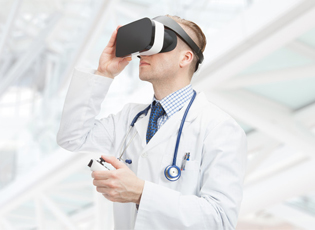
Key Benefits of Multidisciplinary Rounds

  • Multidisciplinary rounds are an excellent way to improve throughput, patient satisfaction, and reduce length of stay and re-admissions.
  • Effective communication is the key to patient safety. Communication between healthcare professionals that is made possible by these rounds helps to reduce mistakes and confusion regarding a patient’s treatment plans.
  • It ensures that expectations are met and the treatment planned is optimal.
  • Working together at the patient’s bedside ensures safe and timely discharge of the patient.
  • Bedside rounding provides a good learning experience to healthcare providers. Especially medical students who participate in these rounds learn more about a disease, the various remedies available and the best strategies for providing excellent patient care. This benefits both the learners and future patients.
  • It helps in proper and effective utilization of available resources.

Things to Consider While Conducting Bedside Rounds

  • Multidisciplinary rounds should have clear goals, structure and leadership.
  • The patient and family should be engaged in the process.
  • Patient goals should be set daily.
  • Outcomes of the multidisciplinary rounds process should be measured.

According to research reported in HealthcarePapers, efficient teamwork greatly benefits doctors, their peers and patients. The workplace becomes more exciting and productive, safety issues are reduced and retention rates increase.

Teamwork is important in all partnerships. Good teamwork between doctors and medical transcription service providers helps in the preparation of accurate medical records. Day-to-day medical documentation is the basis on which a patient gets continued treatment from his/her physicians. That is why timely and proper medical documentation is crucial for better patient care.

New Google Glass based Assistant Enhances Physician-Patient Bond

New Google GlassPhysicians make use of medical transcription services as well as medical scribes to accurately document patients’ medical records. These strategies have evolved with the adoption of EHRs, and both medical transcriptionists and scribes provide effective EHR-integrated documentation solutions.

The electronic health record (EHR) enables physicians to make well-informed treatment decisions quickly and safely. EHRs allow providers to access patient charts remotely, get alerts to critical lab values, receive reminders about preventive care, and much more. However, one main criticism is that EHR data entry by the physician during the office visit has affected their relationship with patients.

This is where scribe services and medical transcription companies have made a mark. One of the main advantages of using these medical documentation strategies is that they free the physician of EHR data entry chores during the office visit, thereby enhancing their bond with the patient.

The latest development in the field of EHR documentation is a Google Glass-powered remote scribe service that can perform up to 3 hours of charting and documentation each day. According to www.news-medical.net, the Augmedix Google Glass based platform “essentially removes the computer keyboard from the patient visit”.

How does this remote clinical documentation solution work? Well, all the physician has to do is wear a pair of smart glasses at the patient encounter. This allows the scribe in the remote location to observe, hear and participate in the consultation, and transcribe the entire encounter real-time.

Besides getting accurate, real-time chart notes of the visit, the physician can retrieve the patient’s medical history, lab notes and pharmacy records during the encounter. This improves physician efficiency and productivity. Most important, with the remote scribe taking care of EHR documentation, the physician can focus on the patient, pay attention to their concerns and deliver a higher level of quality care. Patients can, of course, opt not to use this remote scribe service.

Medical transcription service providers also play a key role in freeing up physicians of their EHR-documentation tasks. While scribes document into structured paper or electronic templates with minimal use of free text, medical transcriptionists provide comparatively detailed verbatim documentation using free text by listening to a recording of the physician’s dictation. This ensures that nothing is missed out. With medical transcription services, physicians benefit from:

  • An interface that integrates transcribed notes into the electronic medical record (EMR)
  • Data entry into the correct discrete reportable data fields
  • Clinical documentation that fulfills Meaningful Use goals and Medicare/Medicaid reimbursement requirements
  • Comprehensive and timely EHR-integrated documentation at affordable rates

Besides enhancing physician-patient interaction, both medical transcription services and scribe-based platforms improve office efficiency and save time on charting, allowing physicians to see more patients and focus on meeting their evolving needs.

Study: Talking to Patients before Procedures can Prevent Potential High-cost Incidents

Talking to Patients Before ProceduresOutsourcing medical transcription helps busy physicians get error-free documents of dictated notes and other records in quick turnaround time. They can focus on their core tasks without concerns about their EHR documentation being incomplete or inaccurate. A new study says that the more time physicians spend talking to their patient, the lower the risks of high-cost incidents.

In his article published in the New England Journal of Medicine, Senior Fellow Robert S. Kaplan, the Marvin Bower Professor of Leadership Development, Emeritus, at Harvard Business School, explains that physicians can improve value in health care by talking to patients through procedures beforehand. This will help prevent adverse events that could occur later and reduce recovery costs.

Prof Kaplan and his colleague evaluated the cost of joint-replacement surgery at 30 large orthopedic hospitals across the United States. They found that in some hospitals the practice was to discharge patients to high-cost skilled nursing facilities for their recovery, where they were trained to walk, climb stairs, and get into a car with their new joint. On the other hand, the researchers found that doctors in other hospitals reduced the costs involved in recovery by discussing these skills in a 30- to 60-minute conversation with patients before the surgery. They also got patients to practice these skills before they were discharged. This face-to-face discussion with the physician allowed most patients to be discharged to inexpensive home health recovery.

According to the HBS report on this study that cites from Data Visualization, the benefits of the holistic pre-surgical patient discussion include:

  • Shorter inpatient stays
  • Fewer complications
  • Higher rates of at-home rehab
  • Potential savings of more than 10% of the cost for the initial visit

Following Kaplan’s findings, some hospitals switched from the expensive rehab approach to the lower-cost pre-surgical consultations.

The transition to electronic medical records (EMR) has created increased demands on physician time. Physicians need to enter information in the EMR during the patient encounter, which can detract from the quality of care. Medical transcription services have evolved to overcome this problem. Besides entering the problem list, past medical and surgical history, medications, allergies, social and family history, and relevant laboratory and test data, medical transcriptionists provide summaries of pertinent clinic visits, hospitalizations, and relevant past medical history. By ensuring high quality EMR-integrated documentation solutions, medical transcription companies are doing their bit to improve the efficiency of care and the physician–patient interaction.

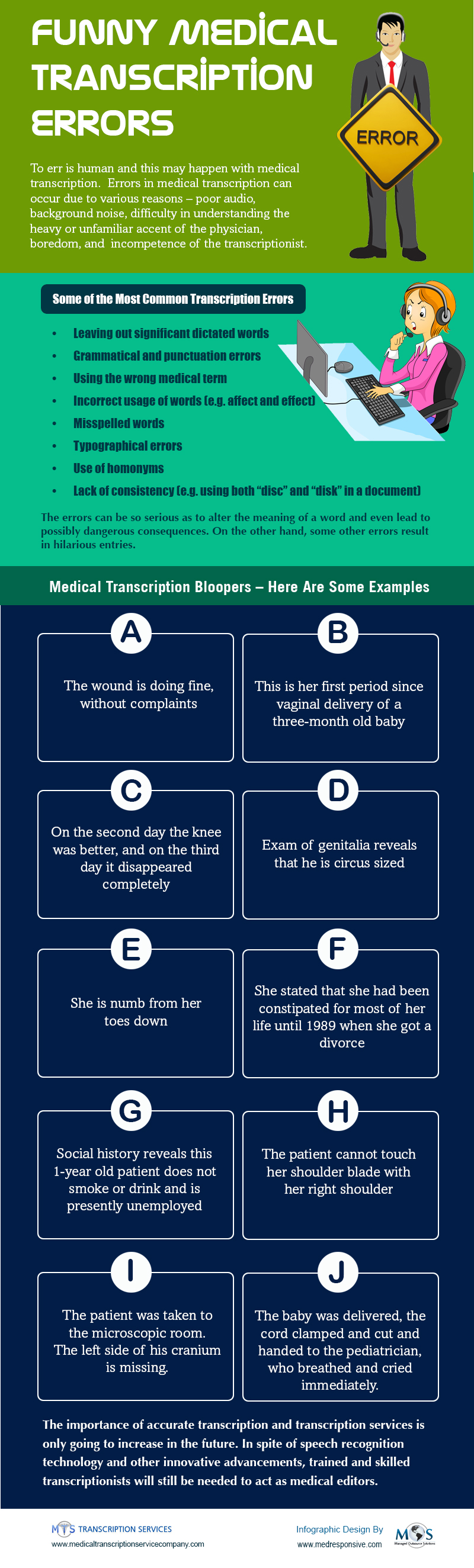
Funny Medical Transcription Errors

Accurate transcripts of your medical dictations are necessary for ensuring better quality of care and patient safety. High error rates can affect diagnosis and treatment, and compromise patient safety. If you want to reduce or eliminate errors in transcription, a good option to consider would be outsourcing.

While transcription errors can prove costly, they can be funny at times. This infographic shows some such medical transcription bloopers that are hilarious.

Funny Medical Transcription Errors

Telemedicine Improves Patient Engagement and Reduces the Costs of Care

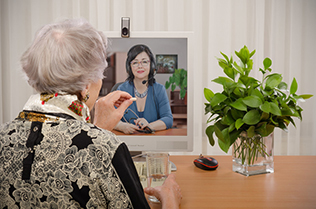
Telemedicine Improves Patient Engagement and ReducesWith advancement in telecommunication, telemedicine has gained popularity and requires accurate documentation of patient records with the help of medical transcription services. Faster internet connection speeds and increased use of smartphones has made healthcare providers turn to electronic communication to interact with patients. Telemedicine helps doctors to link with the patient using a phone or interactive video conferencing. Patients must have medical technical equipment to monitor blood pressure or diabetics so that they can provide the doctors with the values of important parameters for better care. Telemedicine is also a good option in places where medical expertise is hard to come by.
In 2016, a study published by the American Academy of Sleep Machine reported higher levels of patient satisfaction with the telemedicine visit compared to the traditional visit. The reason was easy access to care without the hassles of travel and waiting periods for patients living in remote areas.

In 2014, research by the VA Medical Centre in Albuquerque, New Mexico found that 95% of the respondents wanted to continue receiving care via telemedicine instead of personal visits. It was also noted that patient savings netted $48000 due to the reduced need for travelling from remote locations to the clinic or hospital.

The telehealth encounter is usually only 15 minutes long compared to 12 minutes of the office encounter, according to HIT Consultant. The online visit therefore comes with time savings of 106 minutes.

One of fastest growing medical services, telemedicine connects consumers with clinicians who they have never met before. It is a great option in the case of non-emergency situations such as flu, skin rashes, etc. Various health plans and employees have rushed to offer the service and promote it as a convenient method for plan members to get medical care without leaving their home or work place. According to the American Telemedicine Association, web companies like Teladoc, Doctor on Demand and American Well are expected to host some 1.2 million such virtual doctor visits this year. However, telemedicine services can be useful only for non-emergency disease and have limited applicability for emergency situations.

Telemedicine can ensure better patient care and support. High quality EMR-integrated medical transcription services are available to help providers document the conversation between the patient and doctor. The telemedicine visit has a short duration and providers need to stay focused on those aspects of the consultation that deliver the most value to their patients. This leaves little time for documentation of various elements of the patient encounter. The skilled team in a reliable medical transcription company allow providers to do this by freeing them by providing quality services to document the virtual office visit.

Simple Blood Test can Differentiate Between Parkinson’s and Similar Medical Conditions

Blood Test Detect ParkinsonsOne of the important services that expert transcriptionists in medical transcription companies provide is the documentation of laboratory tests. Accurate transcription of simple and complex blood tests prevents diagnostic data errors that can have critical consequences for patient care. Such services are gaining importance with new medical discoveries. The American Academy of Neurology (AAN) reports that a simple blood test could help distinguish Parkinson’s disease from similar diseases.

Earlier studies have explored the utility of spinal fluid tests in diagnosing Parkinson’s and predicting dementia risk. Spinal fluid is collected via a lumbar puncture, which is painful and comes with side effects like headaches. Now, new research says that a simple blood test is all that is needed to diagnose Parkinson’s and distinguish it from other medical conditions.

The symptoms of Parkinson’s disease are similar to atypical parkinsonism disorders (APDs) like multiple system atrophy, progressive supranuclear palsy and corticobasal degeneration. As a result, in the early stages of Parkinson’s disease it is usually difficult to distinguish it from APDs. However, early identification of these conditions is crucial as expectations concerning progression and possible benefits from treatment differ significantly between Parkinson’s and APDs.

According to the study published online in the February 2017 issue of AAN’s medical journal Neurology, a simple blood test may be as accurate as a spinal fluid test when trying to determine whether symptoms are caused by Parkinson’s disease or another atypical parkinsonism disorder.

The researchers from Lund University in Sweden found that “concentrations of a nerve protein in the blood can discriminate between these diseases as accurately as concentrations of that same protein in spinal fluid”. People with APDs had higher levels of the nerve protein levels than those with Parkinson’s and those who were healthy.

To be able to transcribe blood tests, transcriptionists need to be knowledgeable about:

  • Acronyms for tests
  • The purpose of each type of lab test
  • The components or items found on that specific test
  • The normal values, which helps in flagging discrepancies
  • Punctuation and grammar to present laboratory data
  • The various components and normal values for all of the components of the individual tests

High quality medical transcription service providers have trained and experienced transcriptionists who ensure that diagnostic laboratory data is entered correctly from dictated records in patient charts. They can provide error-free transcripts of blood work to interpret various diseases. This allows physicians to correctly interpret the results of blood work, arrive at an accurate diagnosis, and take proper therapeutic decisions for timely care. With researchers discovering new uses for commonly performed laboratory tests, medical transcription outsourcing to a reliable service provider is crucial for diagnostic accuracy.

  • KEY FEATURES

    • 3 Levels of Quality Assurance
    • Accuracy Level of 99%
    • All Specialties Covered
    • Competitive Pricing
    • Digital Recorder Dictation
    • Electronic Signatures
    • Feeds for EHR or EPM
    • HIPAA Compliant Service
    • Quick Turnaround Time
    • Toll Free Phone Dictation
    • Transcription Management Software
    • Volume Rates Available
  • RECENT BLOGS

  • Categories

  • Quick Contact


    • Infographics