
Key Aspects of Medical Data Quality and Controls

Medical Data Quality and Controls

Precise and timely documentation of patient records is critical in the healthcare sector. Medical transcription is essential for turning physician dictations and other audio recordings pertaining to healthcare into accurate medical records and promote efficient communication among healthcare practitioners. The information contained in a patient’s medical records is essential for providing the right kind of treatment. When prescribing medication, medical professionals rely on this information to guide their decisions. Ensuring the completeness of the records is crucial. To help the patient receive more care, these records are frequently referred to experts and other medical facilities. Due to rising demand for quality medical records more medical organizations are using medical transcription services which increase the productivity of documentation entry and ensure patient safety.
Trust our team of expert transcriptionists for precise and timely documentation of patient records.

Contact us today

Quality Medical Data

Features of Quality Medical Data

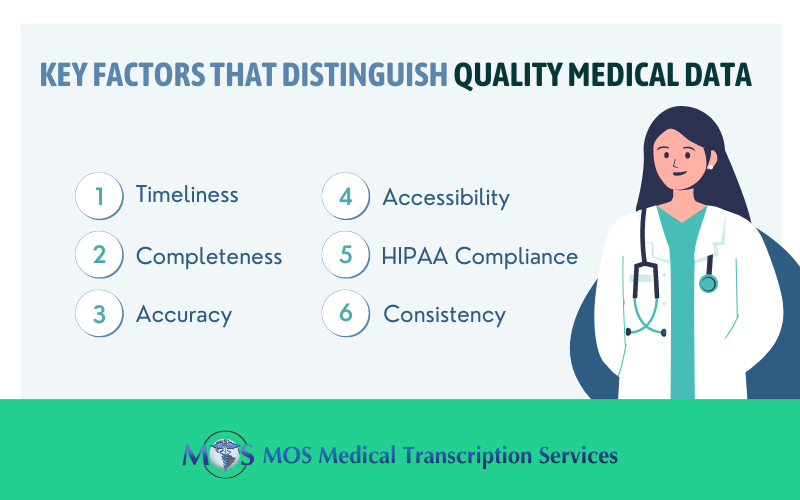
Let’s look into the essential characteristics of medical data and the various measures that health care providers need to adopt to ensure quality.

  • Timeliness: Timeliness means that the data should be recorded within an appropriate time frame, typically as it is being collected. If the nurse monitors a patient at 5 pm, the note in the patient record should be written soon after that and preferably at the point-of-care. Surgeons need to record operative notes shortly after the surgery and not weeks later.

    According to The Joint Commission’s 2012 accreditation standards, an operative report must be documented immediately after the operation. The Federal Register (2012) recommends that a history and physical must be dictated and present in the health record within 24 hours of admission or before an operation. The Joint Commission and Conditions of Participation (COP) standards recommend that following a patient’s discharge from an acute care facility, the record must be completed within a specified time, usually 30 days. If state licensing law recommends a shorter time frame, this should be given precedence.

    Medical transcription service companies play an important role in ensuring timely medical documentation by providing transcripts of healthcare providers’ dictation in custom TAT. They also offer several convenient options for dictation such as toll-free phone-in, digital recording, smartphones and conference calls.

  • Completeness: Complete data is necessary to support patient care. Completeness refers to collection or recording of all relevant medical data including vital signs such as blood pressure heart rate, respiration rate, temperature, neck and head exam, neurological exam, dermatological exam, and physical and sensory changes. A record would be considered incomplete if any vital sign or data had been missed out and if the time and date has not been entered. For a progress note to be complete, it must be authenticated.
  • Accuracy: This means avoiding errors in data entry. An article published by Modern Healthcare in February noted that electronic health records (EHRs) are breeding grounds for wrong data entry due to confusing computer displays. This could lead to errors such as ordering the wrong medications or missing key patient information.

    In order to ensure that the data collected is timely and complete, health care providers need to develop and implement data quality controls. These include preventive controls, processing controls and corrective controls. Preventive controls refer to procedures, processes or structures developed to minimize errors at the point of data collection. Examples include software alerts when date is entered wrongly or verbally identifying the patient before taking a blood sample. Drop-down menus in EHRs are designed to prevent invalid data entries. However, the errors can occur if the physician selects the wrong item. Processing controls help discovery of errors through quantitative analysis and error reports which highlight mistakes as well as omissions. Corrective controls involve correction of errors that have been discovered. The problem is that certain errors such as the administration of a wrong medication cannot be corrected. So the source of the error must be investigated to prevent future occurrence.

  • Accessibility: The ease of communication and cooperation between healthcare providers involved in a patient’s care continuum depends on the accessibility of medical records. Secure electronic health record (EHR) systems and other approved platforms should make transcribed medical records freely available. Regardless of whether they are accessing records within the facility or remotely, healthcare providers need to be able to retrieve patient information quickly and effectively. Medical personnel can make prompt decisions, maintain continuity of care, and enhance patient outcomes by making sure that they are accessible.
  • HIPAA Compliance: Ensuring patient privacy and confidentiality through medical transcribing requires adherence to the Health Insurance Portability and Accountability Act (HIPAA). To maintain the privacy of patient information found in audio dictations and transcribed documents, transcriptionists are required to abide by strict security measures and HIPAA rules. Protecting protected health information (PHI) from unauthorized access, disclosure, or misuse entails putting in place access controls, confidentiality agreements, secure file transfer protocols, and encryption technology. Medical transcription providers maintain the highest levels of patient data security and confidentiality by placing a high priority on HIPAA compliance.
Are you looking for detailed steps to amp up your medical documentation? Read our blog post about How to Improve Medical Documentation Efficiency
  • Consistency: Improving the readability and usability of medical records requires consistency in layout, language, and style. To ensure consistency among patient records and healthcare facilities, medical transcriptionists must consistently transcribe different kinds of dictations. Respecting the uniform forms, policies, and procedures set out by medical associations aids in ensuring that medical records are consistent and interchangeable. Both patients and healthcare providers gain from rapid information retrieval, data analysis, and decision-making made possible by consistent transcription procedures.

Learn more about how our HIPAA-compliant services can streamline your medical documentation process.

Call us at (800) 670 2809

Paying attention to the key factors listed above is necessary to ensure the quality of medical records during the medical transcription process. Medical transcriptionists contribute significantly to the creation of accurate, trustworthy, and useful medical records that facilitate clinical decision-making, the best possible patient care, and regulatory compliance in the healthcare sector by adhering to these criteria. Outsourcing medical transcription is a practical option when it comes to avoiding clinical documentation errors. Reliable companies have stringent quality control measures in place to ensure documentation of physician dictation with up to 99% accuracy.

Doctors who Type Less Score Higher in Patient Satisfaction

Doctors Type Less Score Higher in Patient SatisfactionIn an article published in the Wall Street Journal (WSJ) recently, two doctors described the deterioration of the patient-doctor relationship as the most pernicious problems facing modern medicine. They point out that the health care system has lost its humanity in the world of “increasingly automated and computer-driven interactions between doctors and patients”. It’s no secret that while electronic health records (EHRs) provide accurate, up-to-date, and complete information about patients at the point of care, they have depersonalized care. Unlike the past, when physicians relied solely on medical transcription services to produce various clinical reports, they now have to enter patient data into the computer even during the consultation. Studies have found that physicians who type more score lower in patient satisfaction.

According to the WSJ report, primary-care appointments have been reduced to a short span of five minutes and the physician must spend much of that time typing into the computer instead of attending to the patient. Documenting details of the encounter electronically is crucial for reimbursement, fiscal incentives, and compliance with new industry regulations.

On the other hand, in the past, doctors spent most of their time asking questions at the face-to-face. They paid attention to patients’ replies and discussed the course of action with them. They dictated all their reports and got them accurately transcribed by reliable medical transcription companies in custom turn around time.

The results of a study published in Jama Internal Medicine last year show that patients had a better experience with physicians who typed less on the computer. Researchers from the University of California, San Francisco, analyzed data from patient-doctor interactions between 2011 and 2013 and found that:

  • Doctors who spent less time typing on the computer scored excellent care ratings 80%.
  • Those who were deemed high computer users achieved an excellent rating less than half the time.

The researchers concluded that higher computer use by a clinician was linked to lower patient satisfaction and less bonding between patients and physicians. So EHRs seem to reduce the therapeutic efficiency of physicians who use them.

EMR-EHR integrated medical transcription services provide a way out. This blended approach of dictation and transcription can resolve the technology challenge, according to an article published by the American Health Information Management Association (AHIMA). In this method, physician dictation is captured using different modalities such as toll-free phone-in, digital recorder or mobile phone. Physicians can also opt to use different documentation methods, such as structured history and physical templates entered by their assistant or a dictated and a transcribed narrative report for inpatient discharge summaries, encounter notes, findings, and assessments. This strategy streamlines processes without compromising on quality patient care.

Technology should not overwhelm the goals of care – it should improve the working lives of physicians and boost patient satisfaction.

Positive Global PACS and RIS Market Outlook augurs well for Medical Transcription Services

PACS and RIS Market Outlook Inspirits Medical Transcription ServicesAccording to a recent Transparency Market Research report, the global PACS and RIS market is expected to grow at a rate of 7.0% during the period 2016-2024. The report says that the value of the picture archiving and communication system (PACS) and radiology information system (RIS) market stood at US$2.2 bn in 2015 and estimates that it will be worth US$3.9 bn by 2024. This forecast augurs well for medical transcription companies that provide integrated transcription services for medical imaging and radiology information systems.
The study found that the PACS and RIS market is driven by the increasing adoption of electronic health record (EHR) systems.

Sys-Con Media reports the lead analyst as saying:”The importance and benefits of healthcare IT have been recognized with several governments around the world, spurring technological advancements in the field.”

PACS allows for the storage, retrieval, distribution and management of medical images, greatly simplifying the sharing and viewing of radiology images. RIS enables radiology departments in patient scheduling, resource management, examination performance tracking, examination interpretation, results distribution, and billing.

In countries like the U.S., government mandates have encouraged the adoption of healthcare IT products such as RIS-PACS and hospital information systems (HIS) to maintain electronic health records (EHRs). This has had a favourable impact on the radiology imaging and information system market. With more and more hospitals and practices adopting EHR systems, the demand for PACS and RIS has gone up. Based on product type, the study found that PACS held the majority in the global PACS and RIS market, accounting for a huge share of over 82% in 2015.

Professional medical transcription service companies that provide radiology transcription can expect to see demand for their services to increase with the growth of the PACS and RIS market. Reliable companies integrate and import medical transcripts into EMR/EHR and Radiology Information System (RIS) systems, allowing radiologists to save time and focus on their core tasks.

In fact, another recent study by Transparency Market Research reported that the growth of global medical transcription services market is being driven by the adoption of automated services in the healthcare sector. According to the report, the global medical transcription services market which was valued at US$41.4 bn in 2012 is expected to touch US$60.6 bn by 2019, and will grow at a high CAGR of 5.6% between 2013 and 2019. Radiology reports are one of the crucial segments in this market, which is turn, is fuelling the demand for PACS and RIS software.

Google Gears Up to Improve Speech Recognition Capabilities

Google Gears Up to Improve Speech RecognitionThe introduction of speech recognition technology has significantly impacted the way documents are produced, especially healthcare documents. Medical transcription speech recognition platforms are designed to interpret physicians’ dictation and convert it into text that can be stored on a computer. In fact, this technology makes things easier for medical transcription companies as they can edit and produce complete clinical documents faster from these text files.

Earlier this year, TechCrunch reported that Google is planning to compete directly with voice recognition companies by opening up its speech recognition API to third-party developers. According to a recent report in The Verge, Google is trawling social media network Reddit to improve its voice recognition capabilities, especially the ability to interpret accents. Voice interfaces are becoming more and more critical to Google’s software and hardware. A voice recognition interface that uses a narrow selection of voices cannot respond to accents that fall outside of its frame of reference. According to The Verge, Google is looking to rectify this problem by recruiting Redditors to collect more speech data and uses a third-party company, Appen, to corral a varied range of accented audio samples from the website’s users.

There are high tech apps that turn voice recordings on mobile devices into text that can be sent to computers using different methods. For instance, physicians who have Google Voice can use any phone to call their Google Voice number and leave themselves a message. The voice mail message appears as text in their Google Voice inbox. The text can be saved as a document on the computer. Google’s Cloud Speech API recognizes over 80 languages and variants and transcribes the text of users dictating to an application’s microphone, and allows enabling command-and-control through voice, or transcribing audio files.

Despite the advances in voice recognition technology, many challenges affect its accuracy such as:

  • Mediocre voice samples
  • Changes in a speaker’s voice due to factors such as mood, health condition, and other changes over time
  • Background disturbances
  • Changes in the call’s technology, for e.g., digital vs. analogue and upgrades to circuits and microphones
  • Misinterpretation of complex medical terms and homophones
  • Inadvertent errors in physicians’ speech

These are the reasons why, despite the advances in voice recognition, conventional medical transcription services are still relevant.

Use of voice recognition technology in radiology transcription is fraught with problems. A report in Diagnostic Imaging points out that when using voice recognition and self editing, the radiologist would to rapidly and frequently shift his visual attention. It is quite impossible to view images and type or edit text simultaneously. According to the report, a research study found at least one major error in almost 23 percent or one-fourth of the speech recognition reports, while only 4 percent of reports produced by conventional dictation transcription had errors.

Medical transcriptionists employed by established medical transcription service companies can recognize different accents, and also adapt to speed of speech and background noises. They go through several hours of training using real doctor dictation for a real world experience. Their knowledge base spans medical terminology and jargon, anatomy, physiology, language, grammar, and word-processing programs. These professionals have moved with the times and provide EHR-integrated services. They are skilled editors who can transcribe, edit voice recognition draft reports, and also proofread physician documents on EHRs with top accuracy.

New Medscape Survey Reveals Physicians’ Challenges with EHRs

Medscape Survey Reveals Physicians Challenges with EhrsA vast majority of physicians’ practices across various specialties have implemented electronic health records (EHRs), according Medscape’s 2016 EHR report. The survey revealed that the percentage of current EHR users has risen to 91% – from 74% in Medscape’s 2012 report – with another 5% expecting to switch to the system soon. However, this year’s report also notes that physicians continue to face many challenges with EHR implementation and use.

The key findings of the report are as follows:

  • Design flaws in some EHR models prevented physicians from meeting meaningful use requirements.
  • Digitization of paper charts was reported to be one of the great challenges in implementing an EHR system.
  • Compared to small practices, EHR systems used in large organizations require complex networks and software to manage more activities, more specialties, and more reporting.
  • Ease of EHR use appears to be the most important quality for many physicians. While some organizations provide extensive training on EHR use, many do not, so that physicians end up dealing with operational issues themselves.
  • Vendor support is crucial to satisfaction with an EHR.
  • Despite the relative dissatisfaction with most EHR systems, 81% of physicians said they plan to continue with their current EHRs.
  • Unlike systems for large networks, small-practice systems were generally rated closer to “poor” on the scale when it came to connectivity and interoperability which are critical for care coordination, higher quality, increased safety, and lower cost.
  • Up to 56% of physicians reported that EHRs improve documentation, and a little under a third said they improve patient service (30%), clinical operations (32%), and bill collections (31%).
  • About 21% of respondents said that EHRs have made the documentation process worse, and 25% mentioned barriers to patient service and clinical operations.
  • Up to 57% of respondents complained about deterioration of the physician-patient relationship. This was the keygrievance, with respondents saying that EHRs reduce face-to-face time with patients, and also reduce the number of patients they can see.
  • The copy-and-paste function was found to be the most controversial aspect of EHRs. Though many attorneys strongly caution against its use, many physicians say it is necessary and makes their work easier and faster. The survey found that 31% of physicians often copy and paste, 11% always do so, and 24% do so occasionally. Legal experts say malpractice risks are higher when comments are copied and pasted instead of being written by the physician. This EHR function also increases the possibility or mistakes and makes fraud easier. Due to these reasons, this practice deserves greater attention.

One highlight of the Medscape survey is the tips that respondents offered to improve the patient experience while physicians perform EHR data entry:

  • Look up and make eye contact as often as possible
  • Explain that some important items need to be entered, but you are still listening
  • Learn touch typing
  • Allow patients to see what you are typing
  • Don’t type continuously
  • Write on paper first and enter data into the EHR later

They also recommended entering data at the end of the consult, if possible and avoiding documentation during sensitive discussions.

When it comes to freeing the physician of data entry tasks, EHR-integrated medical transcription services are a viable option. Professional medical transcription companies can help maintain the integrity of the patient record. In fact, electronic health records have changed the role of the conventional medical transcriptionist. They now transcribe directly into the EHR as well as edit medical reports for accuracy. Opting to outsource their EHR data entry requirements is a great way for physicians to overcome many of the clinical documentation challenges that they face.

How EHRs Have Impacted the SOAP Note Format

How EHRs Have Impacted the SOAP Note FormatCreated in 1968, the subjective, objective, assessment, plan or SOAP ordering for organizing physician progress notes is now in the midst of a controversy. Perceptions about the efficacy of this standard format for organizing patient information have undergone a change with the advent of electronic health record (EHRs). Many clinicians point out that while the SOAP worked well when notes were made on paper, using this format is not feasible in the EHR age.

The order of the traditional progress note format is: Subjective – history; Objective – vital signs, physical exam and test results; Assessment – diagnosis and documentation of the thought process and decision making, and Plan – plan of treatment.

A study published in 2013 reported that the main concern with the use of the SOAP format in EHR was that it involved excessive clicking and scrolling to find the assessment and plan. This has led many physicians to switch from SOAP to APSO, where assessment and plan come before subjective and objective. An early adopter of the alternative to SOAP, the author of the 2013 study noted that putting the assessment and plan first was more practical as physicians usually go to the assessment page of paper charts first to see what previous visits or referring doctors may have found.

Today, physicians continue to be divided in their opinion about the progress note format in EHRs. This is what critics of SOAP have to say:

  • In medical records viewed on a computer, history of present illness, past medical history, family, and social history, review of systems, and physical exam more space than available on the monitor.
  • To find the assessment and plan, the physician has to scroll to areas that are not visible at first glance.
  • This is aggravated by the fact that, in EMR notes, physicians end up documenting repeated information like past medical history and family history in great detail. In a dictated note, such information is stated very briefly.
  • In electronic medical record templates that simply try to reproduce the end product of a dictated SOAP note, the result is a note in which key information can be found only by scrolling through two or three pages of data

On the other hand, in an article titled ‘Can APSO really displace SOAP’ published in the Medical Practice Insider, a supporter of the SOAP format noted that it’s “more about the order the notes are ultimately displayed than how they are recorded.” This physician calls APSO an “upside down methodology” that fails to meet quality care or compliance mandates. He points out that the current EHR templates result in truncated ‘Present Illness’ information, while medical history information is far more extensive in the traditional format and includes “the critical subjective elements of chief complaint, past medical history, social history, family history and review of systems.” This information needs to be documented, failing which it would result in problematic clinical care, preventing physicians from providing the level of care necessary for complex patients.

As the debate continues as to whether APSO can displace or replace SOAP, physicians can ensure accurate and timely documentation with EHR-integrated medical transcription services. In fact, professional medical transcription service companies provide customized EMR-friendly documentation of clinical notes, consultation records, imaging and lab reports, operative reports and discharge summaries – all of which are critical to medical decision making and continuing care.

Global Medical Transcription IT Spending Market to Grow at a CAGR of Over 6% Until 2020

Medical Transcription IT Spending MarketAccording to a recent market research report by Technavio, the global medical transcription IT spending market is expected to grow at a CAGR of over 6% over 2016-2020. The report says that the need for a digital healthcare system will drive the demand for IT-empowered medical transcription services during the forecast period.

The report presents the market outlook and growth prospects of the global medical transcription IT spending market in the Americas, EMEA and APAC. Overall market size is calculated based on revenue generated from transactions of medical transcription software, hardware and IT services.

Technavio’s report stresses that the need for a digital healthcare ecosystem is emerging as one of the primary drivers of this market’s growth.

In recent years, digital health solutions have significantly transformed the healthcare industry as well as the patient experience. An international survey by Mckinsey revealed that in many countries more than 75 percent of the respondents would like to enjoy digital healthcare services, provided the services meet their needs and provide the expected level of quality. Digital solutions enhance the way healthcare providers connect, understand, and engage with the patients, which in turn, would enhance the quality of care and result in better health outcomes.

Healthcare informatics technologies used in hospitals and super specialty clinics include EHR and RIS integrated with medical transcription IT solutions. The Technavio report says that these strategies help in two ways:

  • reduce medical documentation timelines
  • allow providers to invest greater efforts in diagnostic procedures

The main findings of the report are as follows:

  • The Americas is the largest medical transcription IT spending market with a share of 52% in 2015.
  • In the Americas, the need for organized patient records due to new medical documentation standards is driving market growth. Healthcare facilities in the Americas have transitioned to the ICD-10 coding system which has more diagnosis codes than ICD-9. Physicians and medical transcriptionists now need to include detailed patient information, such as the clinical condition, the cause, treatment methods, and frequency of clinical visits. This has paved the way for IT-integrated medical transcription in the US.
  • The US is a leading market for medical transcription services due to the greater focus on healthcare IT infrastructure improvements and reliable healthcare data models.
  • Healthcare providers in the US are focused on getting efficient and accurate medical transcription solutions. Advances in technology, such as speech recognition platforms and medical health applications help minimize errors and optimize working processes. Vendors are developing innovative platforms to enhance the confidentialty and security of personal health information (PHI).

A lead analyst at Technavio for research on IT professional services summed up the findings:  “Connected and integrated healthcare technology generates an enormous amount of information that can be processed by efficient IT solutions. The integration of medical transcription with healthcare informatics software solutions such as EHR requires additional IT investments. This IT trend will attract numerous start-up vendors and medical outsourcing solutions providers in the medical transcription market in the coming years.”

Report: Geriatric Emergency Rooms Improve Care for Seniors

Geriatric Rooms Care for SeniorsAccording to official statistics, more than 20% of US residents are expected to be 65 years or older by 2030, which is a 102% increase from the year 2000. Along with the growth in the number of elderly, the incidence of chronic diseases among them is also rising. According to a recent CNN report, more and older adults are coming to the emergency departments (EDs), leading many hospitals to set up separate geriatric emergency rooms (ERs) to treat them. Evaluation of patient experiences has revealed that emergency rooms can reduce stress and medical risks for older patients.

The factors are driving the growth of new geriatric ERs, according to the recent reports are:

  • Increase in older patients with complex conditions coming to regular ERs has prompted providers to look for more effective and efficient ways to treat them.
  • The Affordable Care Act penalizes facilities that see a larger of patients returning and one way hospitals are trying to reduce readmissions is through improved emergency care and triage.
  • The Centers for Medicare and Medicaid Services recently ruled that half of all traditional Medicare payments will be based on quality of care rather than quantity of services. ERs are seen as an efficient and less expensive care option for Medicare patients.
  • Hospitals also may look upon specialized EDs as a way to market health services to the growing elderly population. Some leading providers have customized their geriatric ER to suit the needs of seniors with facilities such as thicker mattresses, noise proofing, and handrails in the hallways.

Newly set up geriatric ERS have physicians, nurses and others trained specifically to diagnose and care for the elderly, allowing the elderly to benefit from more expertise. Seniors need special attention as they have special health problems and may not be able to communicate with caregivers like normal patients.

These specialized geriatric ER care facilities are a great improvement over traditional ERS where elderly patients are often put through a large number of tests and procedures, some of which may be unnecessary, according to experts. Compared to younger patients, seniors have longer stays, less accurate diagnoses, and more frequent admissions to the hospital by ER doctors, who have to deal with a large number of very sick patients.

While medical advances have extended life expectancy, improving continuity of care for seniors is critical to reduce costs and complications. Whether in specialized geriatric ERs or traditional ERs, proper clinical documentation is paramount to support efficient and continual care. The golden rules when it comes to quality ER clinical documentation are: time, content, and completeness. Today’s electronic health record (EHR) systems integrated with medical transcription services are designed to enable information flow to support the continuity, quality, and safety of care. They also serve legal requirements, accreditation, accountability, and medical coding and billing purposes. Professional medical transcription companies ensure timely, accurate and customized documentation of patient progress reports, history and physical reports, chart notes, and more, for all specialties. Such support can be crucial for the geriatric emergency room where interdisciplinary decision-making is based on the shared knowledge of clinicians.

How Hospitalists Can Mitigate Diagnostic Mistakes and Improve Patient Care

Mitigate Diagnostic Mistakes and Improve Patient CareResearch has found that thousands of hospitalized patients die every year due to diagnostic errors. A Harvard Medical Practice Study reported that diagnostic mistakes were responsible for 17% of preventable errors in hospitalized patients. A recent American College of Physicians (ACP) report noted that the rates of diagnostic errors range from 10% to 15% in internal medicine and that hospitalist can play an important role in avoiding and mitigating these mistakes.

Gathering the patient’s history, findings from the physical examination, and other data is crucial for making accurate diagnoses. However, current electronic health record (EHR) documentation practices are largely governed by billing and legal requirements. Health Information Technology (HIT) errors can occur at any time due to malfunction, incorrect use, and data entry errors, resulting in information being lost, and wrongly displayed or transmitted. This can cause diagnostic errors, leading to delay or failure to treat an existing condition, or to treating a condition that was not actually present.

The ACP report points out that hospitalists are extremely important in establishing the correct diagnosis. They are the first point of contact once the patient is hospitalized and can review the decisions made up to that level. They are therefore well-positioned to detect any diagnostic errors that may have been made in the clinic or in the emergency room. Hospitalists can reduce the incidence of errors by improving their diagnostic skills. This includes:

  • Taking a thorough history
  • Conducting a proper physical exam
  • Examining past medical history and tests done carefully
  • Listening to patients and caregivers
  • Ensuring that patients can contact them if symptoms change or persist
  • Use diagnosis-specific decision support resources
  • Pay attention to second opinions
  • Communicate directly with the staff providing diagnostic test results
  • Learn the causes of system-related and cognitive error and how to avoid snags

Experts say that deriving a differential diagnosis can be a very useful strategy to avoid missing a key diagnosis.

Even as specialists in internal medicine grapple with the complexities of ensuring correct diagnosis, they can always rely on professional medical transcription companies for accurate and timely documentation of history and physical reports, diagnostic and treatment plans, emergency reports, surgical reports, examination reports, laboratory reports, and more.Even with the shift to electronic clinical documentation from paper records – medical transcription services continue to be a reliable option for ensuring that information from patients’ clinical encounters and tests are readily available. It is common knowledge that copy/paste notes are very harmful to diagnostic quality. Medical transcription service providers ensure that physician dictation is correctly documented and even provide feeds to the EHR.

Unique Challenges of Sports Medicine Specialists and How Medical Transcription Services Help

Unique Challenges of Sport Medicine SpecialistsWith a spate of serious injuries occurring just a few days after the start of the 2016 Olympic Games, sports medicine is in the news. Today, there is a lot at stake for professional athletes, their team, coaches and parents, which makes sports medicine a very demanding field.

Sports medicine specialists focus on diagnosing, treating and preventing injuries related to participating in sports and/or exercise. Most sports injuries involve the rotation or deformation of joints or muscles caused by engaging in sporting activities. While team physicians consider treating professional athletes as an honor and a privilege, they face many unique challenges.

One main issue is that they have to deal with the conflict of interest between players and team owners. Both parties tend to think that they are acting in the best interests of the opposing party. Of course, reliable team physicians will keep their focus on treating the patient.

Professional athletes have high expectations for treatment outcomes, which makes the task of treating them quite demanding. Sports medicine physicians need to determine the best method of treatment so that their patients can return to play as quickly as possible. Most physicians exhaust non-operative options before recommending surgery. Factors that go into deciding the best method of treatment for professional athletes after an injury include the location of team in the season and the athletes’ long-term goals and expectations.

When an athlete is injured on the road, team physicians need to communicate and collaborate with other concerned medical professionals such as the physical therapist, athletic trainer and strengthening and conditioning coach. Such collaboration is crucial to evaluate and track the player’s rehab and return to the sport. All the necessary clinical documentation should be available at hand. An article in Becker’s Orthopedic Review cited a leading orthopedic sports medicine surgeon as saying:

“In the National Hockey League, they have a system where you can electronically encrypt into the players’ medical records so if he gets injured in another state, you can access the MRI and physicians’ notes.”

Such documentation is much easier today with EMR/EHR integrated sports medicine medical transcription services. Expert transcriptionists in leading medical transcription companies can deliver timely and accurate transcripts of SOAP notes, operative notes, consultations, evaluations/assessments and reports, referral letters, and medical/legal reports, effectively helping sports medicine doctors with their documentation challenges.

Immediacy of diagnosis and treatment is an important requirement for injured athletes. Sports medicine specialists need to be knowledgeable about how exactly to rehabilitate a patient. Athletes are dedicated to their sport and make no compromises when it comes to their diet and training. To help them, physicians need to understand them and work to keep them in the game.

Thorough, accurate medical documentation decreases the potential for miscommunication and errors. A reliable medical transcription service company helps sports medicine specialists manage patient information easily and efficiently, allowing them to focus on their most important challenge – patient care.

  • KEY FEATURES

    • 3 Levels of Quality Assurance
    • Accuracy Level of 99%
    • All Specialties Covered
    • Competitive Pricing
    • Digital Recorder Dictation
    • Electronic Signatures
    • Feeds for EHR or EPM
    • HIPAA Compliant Service
    • Quick Turnaround Time
    • Toll Free Phone Dictation
    • Transcription Management Software
    • Volume Rates Available
  • RECENT BLOGS

  • Categories

  • Quick Contact


    • Infographics