In healthcare, even a small documentation mistake can lead to have serious consequences, affecting patient care and compliance. From patient histories to treatment plans, every word in medical records matter, which is why avoiding medical transcription errors should be a top priority for healthcare providers. Whether it’s a misheard term or a missed detail, these errors can affect patient safety, billing accuracy, and clinical decisions.
Maintaining medical transcription accuracy plays a vital role in supporting patient safety and minimizing documentation-related risks. While speech recognition systems support efficient and fast documentation, errors can occur. Working with a reliable medical transcription company to review automated transcripts helps providers maintain clinical documentation quality while freeing up their time to focus on patient care.
What is Speech Recognition in Medical Transcription?
Speech recognition (SR) in medical transcription converts spoken words from clinicians into written text. This voice-to-text technology allows doctors, nurses, and other healthcare providers to dictate patient notes, histories, procedures, or discharge summaries, which the system automatically transcribes into digital records.
The software captures the dictated notes and uses natural language processing (NLP) and AI to analyze the sound patterns and convert speech to text. Advanced medical speech recognition systems understand medical terminology, abbreviations, drug names, and procedures to improve accuracy.
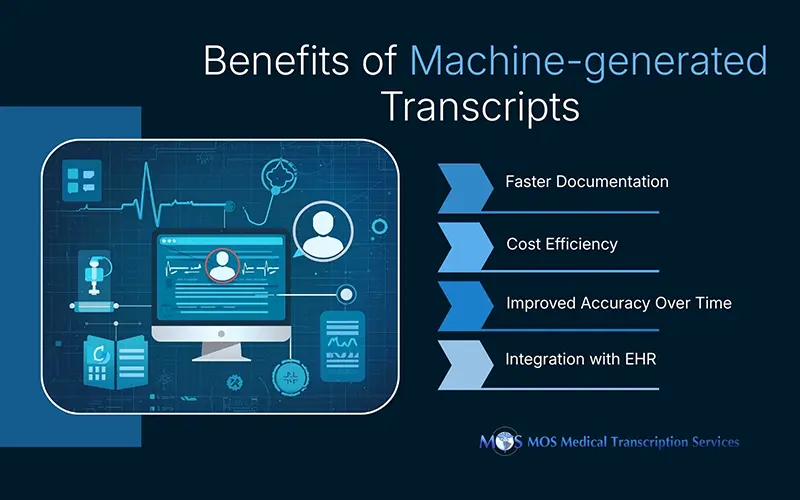
Benefits of machine-generated transcripts
-
- Faster Documentation: Clinicians can create notes in real time without waiting for manual transcription.
-
- Cost Efficiency: Reduces labor hours for transcription teams.
-
- Improved Accuracy Over Time: Modern AI-driven SR learns the clinician’s voice and medical vocabulary to improve precision.
-
- Integration with EHR: Many systems directly input notes into electronic health records, improving workflow.
However, errors can occur. Modern medical transcription workflows must balance innovation with rigorous quality control. AI can generate fast, structured drafts, but trained medical transcriptionists and clinicians remain essential for validating clinical intent, correcting contextual errors, and ensuring compliance with medical coding and billing standards. Updating transcription practices to reflect this blended model helps healthcare providers reduce documentation errors that can lead to claim denials, compliance risks, and workflow inefficiencies. This is why providers have a medical transcription company review the text for errors, context, and formatting before finalizing it in the patient’s electronic health record (EHR).
Best Practices to Minimize Errors in AI-Integrated Medical Transcription
Here are 12 proven tips to reduce errors in healthcare documentation generated by automated systems:
- Use Reliable Transcription Tools and TechnologyHigh-quality hardware and updated transcription software are essential, even in AI-driven workflows. Clear audio input and compatible systems reduce AI recognition errors and make post-editing more efficient for transcriptionists.
- Verify AI Output Against Original DictationMedical transcriptionists should always listen to the original audio alongside the AI-generated transcript. This helps identify misheard words, missing details, and context-related inaccuracies, ensuring the final document reflects the physician’s true intent.
- Follow Standard Transcription GuidelinesProfessional editing standards-such as correct punctuation, capitalization, spelling, and verbatim accuracy—remain critical. Transcriptionists must correct AI-inserted fillers, clarify unclear phrases, and avoid paraphrasing or assumptions.
- Stay Updated with Medical TerminologyContinuous learning is vital as AI may not immediately recognize new medical terms, drugs, or specialty-specific language. Up-to-date knowledge allows transcriptionists to correct AI errors and maintain documentation accuracy.
- Cross-Check Critical Data CarefullyLab values, dosages, measurements, and abbreviations require meticulous verification. Transcriptionists must cross-check these elements against audio and reference sources to prevent clinical and medication errors.
- Prioritize Accuracy While Maintaining EfficiencyAlthough AI speeds up documentation, accuracy should never be compromised. Skilled transcriptionists balance productivity with thorough quality checks to deliver timely, precise, and compliant medical records.
- Establish Clear Dictation ProtocolsEncourage providers to dictate clearly, speak at a steady pace, follow structured templates, and minimize background noise. High-quality audio significantly improves AI speech recognition accuracy and reduces downstream editing time.
- Adopt an AI-Human Hybrid WorkflowUse AI tools to generate initial transcripts, followed by thorough review by medical transcriptionists and final clinician approval. This layered approach ensures misinterpretations, omitted details, and contextual errors are identified before records enter the EHR.
- Invest in Ongoing Training and System UpdatesContinuous education on new CPT codes, ICD updates, drug names, and specialty-specific terminology is essential. Regular AI model retraining ensures systems adapt to evolving clinical language and provider dictation patterns.
- Implement Robust Quality Assurance ProcessesMulti-level quality checks, routine audits, feedback loops, and error tracking should be standard. Accuracy must take precedence over speed, especially for documentation tied to coding, billing, and compliance.
- Leverage the Right AI Tools and IntegrationsChoose HIPAA-compliant transcription platforms with advanced NLP, EMR integration, and auto-flagging of low-confidence terms, dosages, and abbreviations. Be mindful of potential limitations such as accent bias or software inconsistencies, and address them through human oversight.
- Ensure Compliance and Track Performance MetricsAutomated transcription systems must adhere to HIPAA and HITECH requirements for data security and healthcare documentation standards. Track performance metrics such as error rates, audit outcomes, and denial reductions, aiming for error rates below 1% through continuous improvement.
Medical transcription has rapidly evolved with the adoption of AI-driven automation, reshaping how clinical documentation is created and managed. While advanced speech recognition and natural language processing have significantly improved speed and scalability, transcription errors continue to occur due to factors such as physician accents, background noise, inconsistent dictation styles, and constantly evolving medical terminology. This is why a hybrid approach—combining AI efficiency with human expertise—has become a best practice for healthcare organizations aiming to maintain documentation accuracy, regulatory compliance, and revenue cycle efficiency.
By following proven best practices and partnering with an experienced medical transcription company, healthcare organizations can significantly reduce errors and improve overall record accuracy. Taking the right steps today helps ensure safer care and smoother clinical workflows tomorrow.