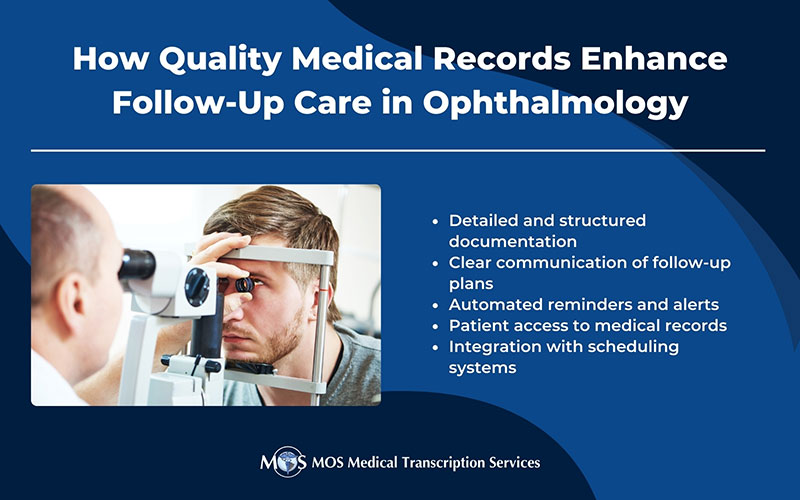
Ophthalmology practices must maintain accurate and comprehensive documentation of patient interactions and surgical procedures to support quality care, ensure precise coding and billing, and meet legal requirements. Besides standard Electronic Health Record (EHR) notes, ophthalmology clinical documentation often includes highly specialized observations, measurements, and even detailed sketches.
However, ophthalmology transcription presents unique challenges. It requires in-depth medical knowledge, exceptional attention to detail, familiarity with eye care workflows, and the ability to interpret fast-paced, abbreviation-heavy dictation.
Fortunately, advances in artificial intelligence (AI) and specialized ophthalmology transcription services are transforming this process. These solutions help convert complex dictations, from consultations and diagnostic exams to surgical reports, into accurate, structured, and timely clinical documentation.
In this blog, we examine the key challenges of clinical note-taking in ophthalmology and how AI-powered tools and expert medical transcription services help providers improve documentation accuracy and support better patient care.
Ophthalmology Transcription: Key Requirements and Challenges
Ophthalmology documentation involves dense clinical terminology and precise measurements across multiple components:
- Patient Demographics and History
- Visual Acuity Assessment
- Refraction Findings
- External and Anterior Segment Examination
- Intraocular Pressure (IOP)
- Posterior Segment Examination
- Diagnostic Test Results
- Assessment and Diagnosis
- Treatment Plan
- Procedure and Operative Notes (when performed)
Fast-paced dictation approaches make accuracy critical. However, various factors make medical transcription for eye specialists particularly challenging:
- Highly specialized terminology: Ophthalmology includes a vast array of anatomical terms, diagnostic findings, and procedures, many of which are derived from Latin or Greek. This risk of transcription errors is high because terms related to the retina, cornea, macula, and optic nerve can sound similar.
Additionally, ophthalmic medications often have look-alike or sound-alike names. For example, ‘Tobradex’ (tobramycin + dexamethasone) is a combination antibiotic-steroid while ‘Tobrex’ (tobramycin) is an antibiotic only. Mishearing them can lead to serious documentation errors.
- Abbreviations and shorthand overload: Abbreviations such as OD (right eye), OS (left eye), OU (both eyes), and numerous condition- and procedure-specific shortcuts are common in ophthalmologists’ dictation. Strong domain knowledge is essential to ensure accurate ophthalmic report transcription because the same abbreviation can have different meanings depending on context.
- Need for precision in measurements: Eye care documentation features precise numerical values for visual acuity (e.g., 20/20), intraocular pressure, lens power, etc. Even a small mistake in numbers can affect diagnosis, treatment, or surgical planning.
- Fast-paced dictation styles: Ophthalmologists often dictate quickly, making it difficult for transcriptionists to accurately capture every detail, especially heavy terminology.
- Complex procedures and technology: Ophthalmology EHR documentation may include details from slit-lamp exams, fundus photography, OCT (Optical Coherence Tomography), and surgical procedures like cataract extraction. Transcriptionists must understand these processes to accurately interpret the dictation.
Moreover, ophthalmology is a rapidly evolving field with new diagnostic tools, surgical techniques, and therapies. Keeping up with updated terminology and practices can be challenging.
- Legal compliance and billing: Accurate documentation is critical not just for patient care but also for coding, billing, and medico-legal compliance. Even minor transcription errors can lead to claim denials or legal risks.
Medical knowledge, attention to detail, a proper understanding of eye care procedures, and the ability to handle fast, abbreviation-dense dictation are crucial to ensure accurate and timely ophthalmology transcription.
Impact of Poor Documentation in Ophthalmology Practices
Poor documentation can have far-reaching consequences for ophthalmology practices, affecting both patient care and financial performance.
Incomplete or inaccurate records may lead to misinterpretation of clinical findings, delayed or inappropriate treatment, and gaps in continuity of care, especially in complex conditions requiring ongoing monitoring.
From a revenue cycle perspective, insufficient documentation can result in coding errors, claim denials, and compliance risks. It also increases medico-legal vulnerability, as detailed records are essential for defending clinical decisions. Overall, poor documentation undermines efficiency, creates administrative rework, and compromises the overall quality of care delivered.
Many practices find that outsourcing their documentation needs to experts is the best way to maintain precise records, achieve ophthalmology workflow optimization, and improve patient care.
Benefits of Outsourcing Ophthalmology Transcription Services
Research shows that structured ophthalmology documentation systems can significantly improve the accuracy, completeness, and transfer of clinical information, supporting better care coordination and patient outcomes. Outsourcing medical transcription to a specialized provider can help practices achieve these goals.
Outsourcing ophthalmology transcription isn’t just about offloading work—it directly impacts documentation quality, physician efficiency, and overall practice performance. Here are the key benefits you can highlight:
- Improved Accuracy and Quality
Specialized transcription providers are trained in ophthalmic terminology, procedures, and abbreviations (OD, OS, OU, etc.). This reduces errors in complex reports involving visual acuity, intraocular pressure, surgical notes, and imaging findings. Professional transcription services also follow standardized formats and templates, ensuring uniform, structured, and compliant records across all reports and providers. They also review physicians’ automated transcripts for accuracy.
- Faster Turnaround Time (TAT)
Outsourcing partners typically offer quick turnaround, including within hours, ensuring that clinical documentation is completed promptly. This supports timely decision-making and continuity of care.
- Improved Patient Care
With accurate, timely, and well-structured documentation, providers can make better clinical decisions, ensure continuity of care, and ultimately improve patient outcomes.
- Reduced Physician Administrative Burden
Physician note overload, primarily driven by complex EHR systems, is a leading cause of the current physician burnout epidemic. By shifting documentation tasks to experienced transcriptionists, ophthalmologists can spend more time on patient care rather than note-taking and EHR updates.
- Cost Efficiency
Outsourcing eliminates the need for hiring, training, and maintaining in-house transcription staff as well as associated infrastructure and software costs. Reliable ophthalmology dictation services offer flexibility, allowing practices to handle fluctuating workloads such as high patient volumes or surgical days–without compromising documentation quality or turnaround time.
- Improved Support for Coding and Billing
Accurate and complete documentation ensures proper code assignment for both minor and detailed ophthalmic procedures and diagnostics. This reduces claim denials and improves reimbursement.
- Access to Advanced Technology
Many transcription providers leverage AI-powered speech recognition, quality checks, and secure platforms to enhance speed and accuracy while maintaining human oversight.
- HIPAA Compliance and Data Security
Experienced US based medical transcription services follow strict security protocols to ensure patient data confidentiality and regulatory compliance, reducing legal and compliance risks.
Enhancing Ophthalmology Documentation with AI and Human Expertise
Accurate and timely documentation is critical to delivering high-quality eye care, supporting proper coding, and ensuring compliance.
While AI-powered transcription tools have significantly improved speed and efficiency, they are not infallible, especially in a complex specialty like ophthalmology. This is where ophthalmology medical transcription outsourcing with human validation makes a meaningful difference.
By combining advanced AI capabilities with the expertise of trained transcription professionals, practices can ensure highly accurate, clinically relevant documentation while minimizing errors associated with automated systems alone. This hybrid approach not only streamlines clinical workflows but also strengthens documentation quality, ultimately supporting better patient outcomes and operational efficiency.