Medical transcription plays a critical role in creating accurate, complete clinical records—but it also introduces significant HIPAA compliance risks if not handled correctly. Healthcare providers remain ultimately responsible for protecting patient data, even when transcription work is outsourced. Understanding what HIPAA compliant medical transcription services imply, assessing vendor risks, and awareness about what safeguards should be in place is essential to avoiding costly PHI security violations, reputational damage, and regulatory penalties.
This guide explains what HIPAA compliance in transcription means and outlines practical steps healthcare providers should expect and verify for avoiding HIPAA violations in medical transcription.
What HIPAA Compliance Means in Medical Transcription
According to HHS.gov, a business associate is any person or entity that performs functions or activities involving the use or disclosure of Protected Health Information (PHI) on behalf of a covered entity. Medical transcription companies fall directly into this category.
Since transcription vendors routinely handle sensitive patient data, HIPAA requires them to sign a Business Associate Agreement (BAA) with the healthcare provider. This written assurance confirms that the transcription company will appropriately safeguard PHI and comply with HIPAA Privacy and Security Rules.
Here are common examples of what causes HIPAA violations in medical transcription workflows and how to prevent them:
| Violation | Example | Prevention |
| Unauthorized access | Staff accessing patient files without need | Role-based access controls |
| Unsecured transmission | Sending PHI via unencrypted email | Use encrypted channels |
| Improper disposal | Throwing away notes with PHI | Shred paper records, wipe digital files |
| Lack of training | Staff unaware of HIPAA rules | Regular training sessions |
| Vendor non-compliance | Outsourcing to non-HIPAA compliant firms | Sign BAAs, audit vendors |
For physicians, working with a HIPAA-compliant service provider means ensuring that the vendor has the infrastructure, policies, and controls necessary to protect healthcare data security and compliance at every stage of the transcription workflow.
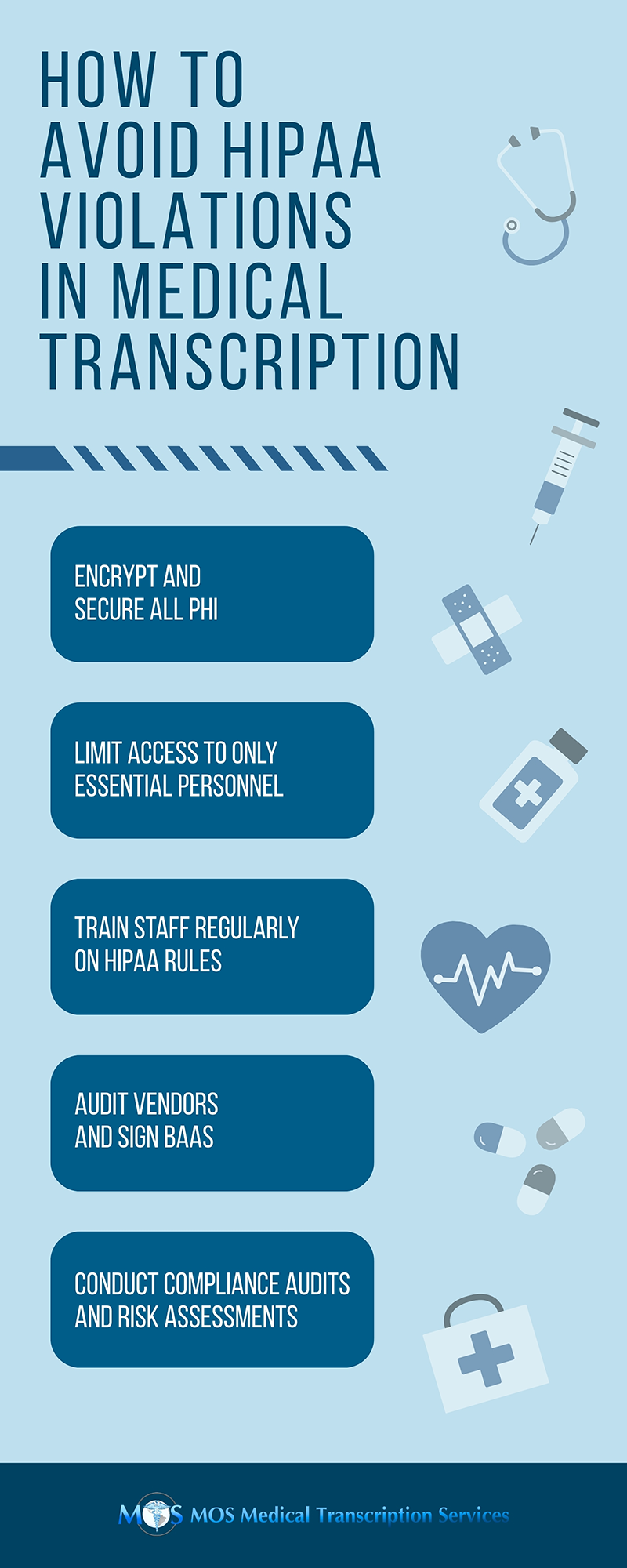
Avoiding HIPAA Compliance Risks: Key Tips for Healthcare Providers
Hospitals and medical practices should have the following measures in place to ensure protected health information (PHI) security:
- Secure Data Handling
- Encrypt all electronic PHI (ePHI) during storage and transmission to prevent unauthorized access.
- Use secure servers and VPNs when outsourcing transcription services.
- Ensure transcriptionists use password-protected systems and avoid unsecured devices.
- Limit Access to PHI
- Follow the “minimum necessary rule”: only provide access to staff who need PHI for their role.
- Implement role-based access controls in transcription platforms.
- Regularly review access logs to detect unusual activity.
- Staff Training and Awareness
- Train transcriptionists and healthcare staff on HIPAA confidentiality rules.
- Conduct annual refresher courses to keep employees updated on evolving regulations.
- Educate staff on the importance of not sharing PHI via email or unsecured messaging apps.
- Regular Audits and Risk Assessments
- Conduct internal audits to identify vulnerabilities in transcription workflows.
- Perform risk assessments to evaluate potential threats like unauthorized access or data leaks.
- Document compliance efforts to demonstrate due diligence in case of investigations.
- Vendor Compliance
- If outsourcing transcription, ensure vendors sign Business Associate Agreements (BAAs) confirming HIPAA compliance.
- Audit vendors regularly to verify adherence to HIPAA standards.
- Choose transcription services with certified HIPAA compliance frameworks.
Outsourcing Medical Transcription: Understand Key HIPAA Obligations for Vendors
One of the most notable breaches that occurred in the US was in 2023, affecting about 8.95 million patients. Hackers accessed the medical transcription service provider’s systems, exposing data such as names, addresses, dates of birth, medical records, diagnoses, medications, and insurance details. This highlights the vulnerabilities in outsourced services.
To prevent such PHI violations, healthcare providers should understand the HIPAA requirements for outsourced medical transcription and confirm that their vendor meets the following requirements:
- Ensure the confidentiality, integrity, and availability of all PHI they create, receive, maintain, or transmit
- Use or disclose PHI only as permitted under the BAA or as required by law
- Implement administrative, physical, and technical safeguards in accordance with the HIPAA Security Rule
- Protect PHI against reasonably anticipated threats, unauthorized access, or data breaches
- Enforce workplace compliance, including access controls and employee accountability
A HIPAA compliant vendor will implement transcription security best practices to protect both electronic and physical PHI, including:
- Restricted physical access to facilities, computers, and servers
- Password-protected systems and portable devices
- Secure PHI using strong passwords, encryption, intrusion detection/prevention software, and disabled USB ports
- Physical protection of workstations to prevent unauthorized viewing or access
- Secure backup procedures to create and maintain retrievable copies of electronic PHI (ePHI)
- Malware detection and prevention policies
- Incident reporting and response procedures for potential security breaches
- Disaster recovery and emergency response plans for fire, system failures, or natural disasters
- Device and media controls for the movement, reuse, or disposal of hardware containing PHI
- Secure transmission protocols to protect PHI shared over the internet
Vendor failure in any of these areas can expose healthcare providers to compliance violations. Working with a HIPAA compliant medical transcription company in the US can ensure accurate, timely EHR documentation and robust measures to safeguard patient information.