Medical documentation plays a key role in ensuring continuity of care, accurate billing, and regulatory compliance. Even small mistakes in records can affect clinical decisions, delay treatment, and create legal and financial issues for healthcare providers. These mistakes can occur due to time constraints, inconsistent note-taking, unclear terminology, or incomplete patient information.
Understanding the common errors in medical documentation is the first step toward preventing them and maintaining clear, reliable patient records to support quality care, compliance, and accurate billing. As healthcare systems face increasing documentation demands, many providers turn to medical transcription outsourcing to improve clinical documentation accuracy.
Five Common Medical Documentation Errors
Clinical documentation mistakes can result in inaccurate diagnoses and treatments, which can be risky or even fatal. Examples of medical documentation errors in hospitals and clinics include misspellings, inaccurate dates, switched numbers, and omitted information. Also problematic is handwriting that is incomplete or illegible. In some circumstances, a mistake in one section of a document can render the entire document invalid.
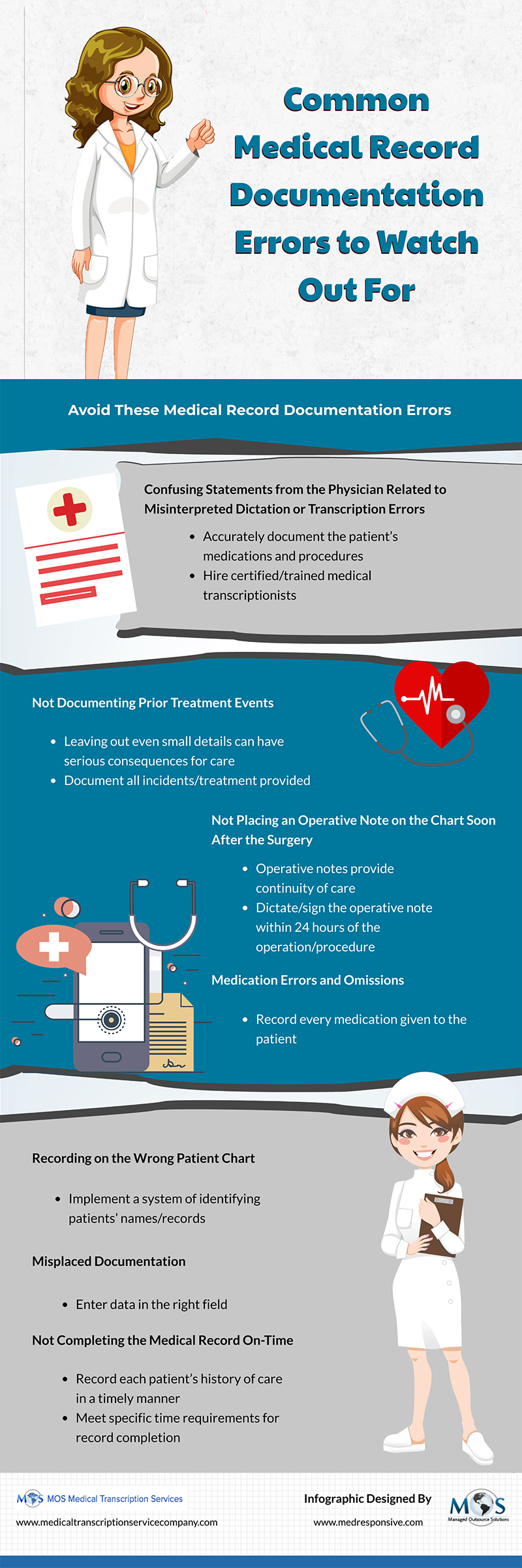
- Confusing Statements from a Physician leading to Misinterpreted Dictation or Transcription Errors: If patient’s medications, procedures, and activities and ongoing developments in treatment are not transcribed correctly, it can significantly impact clinical documentation accuracy. These impact all caregivers of the patient, leading to miscommunication, care delays, and downstream coding and billing issues.
- Not Documenting Prior Treatment Events: Leaving out even small details of the treatment given to the patient across nursing shifts can have disastrous consequences. All incidents that occurred and treatment provided should be documented so that there is no room for doubt about the patient’s condition. The Nurse Service Organization (NS) recommends that nurses leverage hospital standard flow sheets in the patient’s EHR to document details of the treatment given to the patient.
- Not Placing an Operative Note on the Chart Immediately after an Operation is Performed: The operative note should be dictated and signed within 24 hours of operation/procedure. This document records the operation that the patient had, what was found during the surgery, and the surgeon’s post-operative instructions. Having this information in the chart is crucial for continuity of care when patient is moved into the recovery room or discharged.
- Medication Errors and Omissions: Medication documentation errors can occur during prescribing, transcribing, dispensing and during administration. It is critical to record every medication given to the patient over the entire course of treatment-including the dose, route, and time of each administration. Studies found that many mistakes were due to dose omissions, wrong dosage or over dosage, and extra dosages. Errors were also caused by improper documentation of medication instructions in the EHR, such as when prescribers entered free-text instructions in the order comments field, which may go unnoticed by a pharmacist or nurse.
- Recording on the Wrong Patient Chart: Another EMR documentation mistake is entering orders in the wrong patient’s chart. Though uncommon, this mistake usually occurs when patients share the same name. It poses a major patient safety hazard. For instance, if a medication order is transcribed onto the wrong patient’s chart it will result in the medication being administered to that patient. The Nurses Services Organization (NSO) recommends assigning a different nurse to each patient when there are two or more patients with the same name. The patient’s wrist band should be checked before giving medications. Organizations should also implement a system of identifying patients’ names and medication records.
Other Errors in Medical Records
- Misplaced Documentation: According to the American Health Information Management Association (AHIMA) misplaced documentation concerns range from “data entered into the wrong field in an EHR to scrounging for missing pieces in a hybrid health record environment, misplaced information”. Common issues include misplaced progress notes, different providers using different terminology to explain the same condition, etc.
- Not Completing the Medical Record within the Specified Time: Each patient’s condition and history of care should be recorded in a timely manner. There are specific time requirements for completion of each element in the medical record:
- History and Physical – completed and signed within 24 hours of admission
- Post-op note – written immediately after surgery
- Operative Note – dictated and signed within 24 hours of operation/procedure
- Medical Record – should be completed within 7 days of discharge or outpatient visit
Importance of Accurate Medical Documentation
Here are four reasons why accurate record patients’ medical information is essential:
- To communicate with other medical personnel: Documentation explains the what, why, and how of providing clinical care to patients. These data give other medical professionals access to patient histories, enabling them to continue offering each patient the best care possible. Along the continuum of treatment, from EM to HM and transitioning into the post-acute care setting, proper documentation also aids in patient navigation and coordination.
- Minimizes exposure to risk management: Accurate and thorough documentation lowers risk as well as the likelihood of a malpractice claim being upheld. In the event of a claim, having a thorough record of the patient’s care and treatment allays any worries about culpability. When you are in the middle of a professional liability claim and several years have passed, it is doubtful that you would recall the specifics of a particular instance. In this circumstance, your documentation will serve as your trusted ally.
- Documents, PQRS Measures and CMS Hospital Quality Indicators: Documentation captures the data required to support value-based care measures that hospitals are increasingly required to report to government programs. This includes MIPS metrics and other hospital quality indicators, helping organizations meet healthcare documentation compliance.
- Supports proper reimbursement: Accurate and thorough medical records can speed up payment, avoid hassles associated with claims processing, and support proper reimbursement and revenue cycle performance.
AI Medical Transcription Minimizes Medical Record Errors
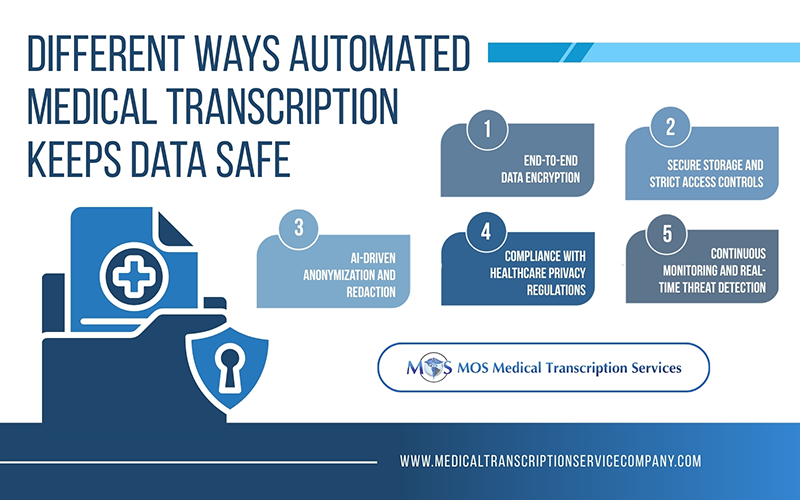
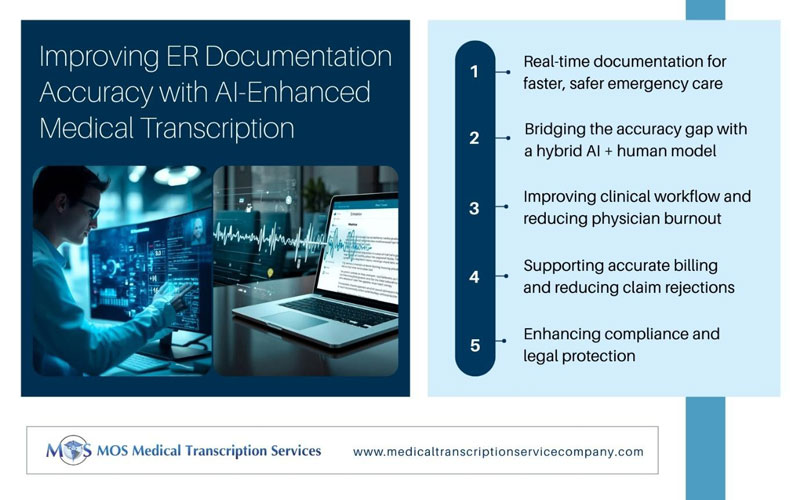
AI medical transcription transforms clinician dictation into structured, clear, and consistent medical records. Advanced speech recognition systems trained in medical terminology accurately capture diagnoses, procedures, medications, and clinical notes, reducing omissions and formatting errors commonly caused by manual typing or rushed documentation.
AI-powered transcription tools also apply built-in quality checks, including terminology validation, contextual analysis, and error flagging. These capabilities help identify inconsistencies, missing details, and potential documentation errors before records are finalized. When paired with human review, AI medical transcription enhances documentation reliability, supports informed clinical decision-making, and promotes safer patient care.
Leveraging professional medical transcription services remains one of the most effective ways to ensure documentation accuracy. By combining certified medical transcriptionists with advanced automation, these services deliver timely, precise transcription that supports compliance, continuity of care, and revenue cycle efficiency.