Every second matters in an emergency department and so does every word recorded in a patient’s chart. That’s why many hospitals are turning to AI integrated medical transcription to reduce errors, ensure emergency room accuracy, and improve care delivery. AI-assisted medical transcription services help clinicians capture patient details instantly in high-pressure situations where documentation mistakes can put patient safety at risk.
As ER teams juggle rapid diagnoses, frequent handoffs, and urgent decision-making, AI-supported transcription ensures that no symptom, instruction, or treatment step goes unnoticed. This smarter, faster, hybrid approach is transforming how emergency rooms document and deliver life-saving care, strengthening emergency room clinical documentation standards across departments.
How AI Medical Transcription for Emergency Room Accuracy Improves Care
Medical transcription has always been important in healthcare, but it becomes even more essential in emergency departments where physicians move quickly from one patient to another. Traditional documentation methods, typing notes, writing summaries, or entering details manually in the electronic health record (EHR), slow down clinicians and increase the risk of omissions. AI transcription for hospital workflows solves this problem by converting spoken words into structured clinical notes instantly, supporting both speed and consistency.
When a clinician speaks during or after a patient interaction, AI captures the details and organizes them into a readable and complete report. Human transcriptionists or editors then review and refine these notes, ensuring near-perfect accuracy. This hybrid approach keeps the speed of AI and the precision of expert review, greatly reducing chances of mistakes.
Why Emergency Rooms Need AI-Integrated Transcription
Emergency departments deal with critical scenarios like trauma cases, cardiac events, respiratory distress, strokes, and severe infections. Each case requires precise communication between paramedics, nurses, physicians, and specialists. Poor documentation can delay the right treatment or cause the care team to miss essential information.
Some common emergency room documentation issues include:
- Misheard medication names
- Incorrect dosage entries
- Missing symptoms or past medical history
- Delayed note entry due to workload
- Confusing abbreviations or handwritten notes
AI-powered transcription reduces these risks by producing clean notes in real time, even when the physician is speaking quickly. With automated ER medical documentation, physicians can stay focused on patient care while ensuring every detail of the interaction is captured.
AI Medical Transcription: A Game Changer for Emergency Room Safety
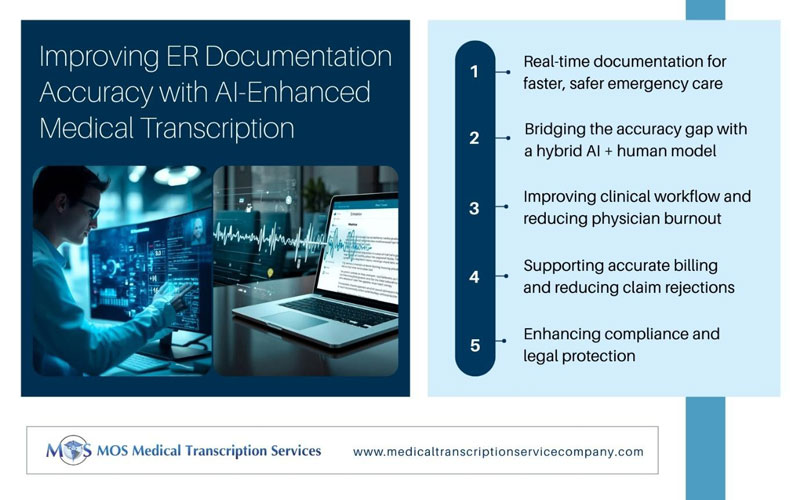
- Real-time documentation for faster, safer emergency care
AI medical transcription solutions for emergency departments allow clinicians to dictate n
otes during the patient encounter, capturing symptoms, clinical findings, and treatment decisions instantly. This prevents critical details from being forgotten or documented incorrectly. Real-time note creation ensures every clinician accessing the chart later—especially during shift changes or handoffs—receives complete and accurate information, reducing communication-related errors and enabling emergency rooms to function effectively. - Bridging the accuracy gap with a hybrid AI + human model
While AI systems offer impressive speed, their average accuracy (around 86%) is not sufficient for high-stakes clinical documentation. Human transcriptionists achieve 96–99% accuracy but cannot match AI speed for emergency environments. By combining both, hospitals get immediate transcripts from AI along with high-precision final review from human experts. AI highlights unclear areas, identifies key terms, and formats notes, while human reviewers refine terminology, structure, and completeness. This approach reduces common medical errors caused by misheard or incomplete documentation.
- Improving clinical workflow and reducing physician burnout
Emergency room providers often spend hours after their shift finalizing charts or correcting documentation errors. AI-integrated transcription dramatically cuts this workload by capturing information instantly and reducing manual typing. When clinicians spend less time on paperwork and more time with patients, job satisfaction improves and burnout decreases. ER workflow efficiency with AI transcription results in better patient interactions and more efficient care delivery.
- Supporting accurate billing and reducing claim rejections
Inaccurate or incomplete ER documentation often leads to coding errors, rejected claims, and delayed reimbursements. AI transcription helps prevent these issues by ensuring that all procedures, assessments, and patient history details are captured thoroughly. This leads to cleaner claims, fewer coding mistakes, and improved revenue flow for hospital systems, strengthening financial performance.
- Enhancing compliance and legal protection
Emergency room notes play a major role in audits, regulatory reviews, and legal cases. AI-assisted documentation produces standardized, time-stamped, and complete records that meet compliance requirements. When paired with human verification, these records become even more reliable. This combination protects healthcare organizations from legal challenges and ensures transparency in clinical operations.
Emergency departments face intense workloads, constant interruptions, and the pressure to make accurate decisions quickly. Leveraging AI medical transcription services gives hospitals the perfect balance of speed and precision. AI captures information instantly, while human experts ensure accuracy, structure, and compliance.
This hybrid model reduces clinical errors, prevents documentation backlogs, supports cleaner billing, and strengthens legal protection. Most importantly, it allows clinicians to focus on what matters most, providing safe, timely, high-quality care. For any ER looking to improve efficiency and patient outcomes, AI-powered transcription is essential.