The dynamic nature of healthcare and digital documentation has contributed to the rapid growth of the medical transcription outsourcing industry, underscoring how outsourcing addresses a wide range of challenges. Beyond the technical benefits—such as improved accuracy, faster turnaround times, and seamless EHR integration—outsourcing medical transcription also comes with significant cost savings. Maintaining an in-house transcription infrastructure is expensive, requiring dedicated staff, software, and ongoing training. Today, many healthcare organizations are partnering with a professional medical transcription company not only to reduce costs but also to leverage AI-assisted workflows, ensure compliance with HIPAA and other regulations, and scale their transcription services efficiently in response to fluctuating patient volumes.
This post discusses the key drivers of medical transcription growth, top transcription challenges faced by healthcare providers, and how outsourcing addresses them.
Why the Demand for Medical Transcription is Growing
The medical transcription market is forecast to expand by USD 28.63 billion at a CAGR of 6.55% between 2023 and 2028, according to Technavio. This growth highlights the increasing challenges healthcare organizations face as they adopt electronic health records (EHRs) and manage rising data complexity.
Two key hurdles – ADT normalization and audio identification—are areas where medical transcription plays a vital role.
- ADT Normalization
Admission, discharge, and transfer (ADT) data must be consistent and precise to ensure seamless integration into the patient’s official EHR. Transcription addresses this by:
- Standardizing patient demographics and identifiers across records.
- Formatting admission and discharge dates, times, and provider names accurately.
- Maintaining consistency in documenting locations such as wards, ICUs, and clinics.
- Aligning with EHR system requirements so records are linked to the correct patient and encounter.
By normalizing ADT data, medical transcription eliminates inconsistencies, prevents duplicate records, and ensures that clinical and administrative information remains reliable for both care and billing purposes.
- Audio Identification
With multiple clinicians dictating simultaneously, associating each recording with the correct provider and patient is a significant challenge. Modern transcription technologies overcome this through audio identification, which:
- Correctly attributes dictations to the right speaker.
- Links each recording to the correct patient chart and encounter.
- Prevents mismatched or duplicate records in the EHR.
- Enhances billing and coding accuracy.
- Improves patient safety by ensuring that every note is tied to the right medical record.
- Evolving Demands: Telehealth and AI
The rapid adoption of telehealth and AI-powered tools adds further complexity, from managing virtual visit documentation to automating parts of transcription. Advanced transcription services leverage machine learning and natural language processing to streamline patient forms, discharge summaries, and treatment notes—helping reduce staff burden while supporting evidence-based care.
So, medical transcription is no longer just about typing notes. It actively resolves key challenges in healthcare documentation, making records more accurate, interoperable, and usable in a digital-first environment.
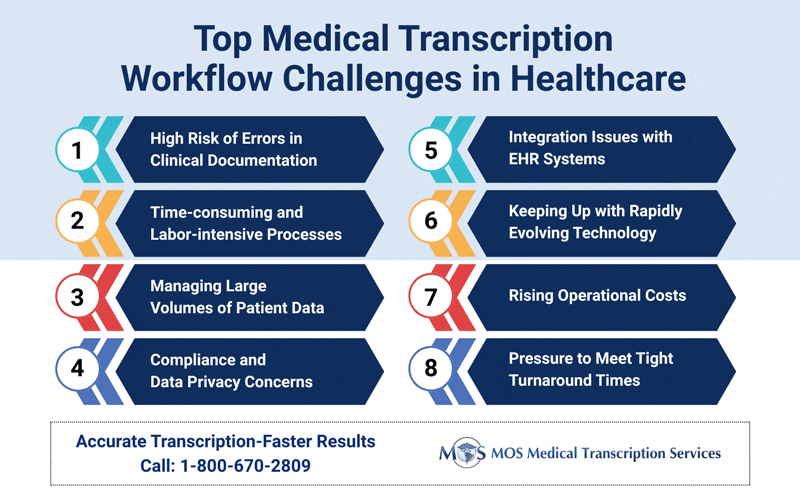
Top Medical Transcription Workflow Challenges in Healthcare Organizations
- High Risk of Errors in Clinical Documentation: Manual transcription is prone to errors, including misspellings, omissions, or misinterpretation of medical terms. Inaccurate records can compromise patient safety, lead to incorrect treatment decisions, and increase liability risks.
- Time-Consuming and Labor-Intensive: Transcribing medical notes in-house requires significant staff time, often diverting clinicians and administrative teams from patient care and other critical tasks.
- Managing Large Volumes of Data: Healthcare providers generate vast amounts of documentation daily. Each patient generates approximately 80 megabytes of data annually, encompassing electronic medical records (EMRs), imaging, and other health-related information, according to Harmony Healthcare IT. Handling, organizing, and storing these records manually can be overwhelming and inefficient.
- Compliance and Privacy Concerns: Healthcare transcription involves sensitive patient information. Healthcare is a prime target for hackers; 2023 saw thousands of reported breaches affecting millions of patient records. Ensuring HIPAA compliance and maintaining data security is challenging, especially for practices with limited IT infrastructure.
- Integration with EHR Systems: Accurately entering transcribed data into Electronic Health Records (EHR) can be complex, particularly when EHR systems have compatibility or formatting issues, which may slow workflows.
- Rapidly Evolving Technology: Advanced audio-to-text converters can quickly and accurately transcribe speech. But keeping up with AI-assisted transcription tools, speech recognition software, and other digital solutions can be difficult. Adopting these technologies requires training, system upgrades, and budget considerations.
- High Costs: Maintaining internal transcription staff, software licenses, and quality control processes can be expensive, making it a financial burden for smaller practices or those with fluctuating patient volumes.
- Turnaround Time Pressures: Delays in completing medical record documentation process can impact patient care decisions, insurance claim submissions, and overall workflow efficiency.
Benefits of Outsourcing Medical Transcription
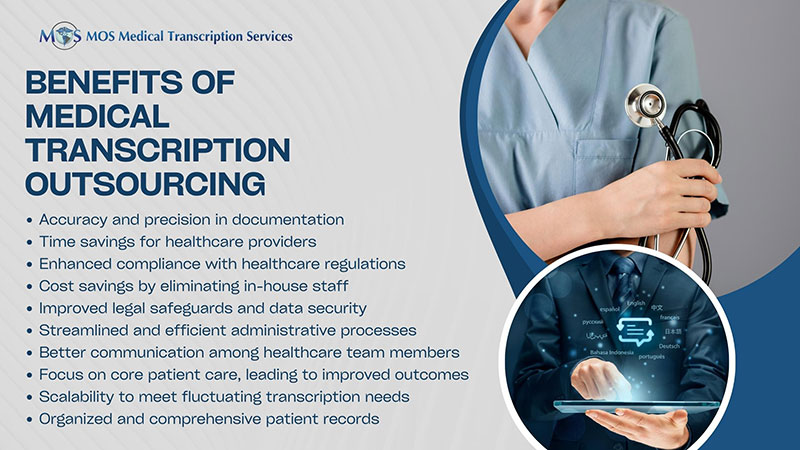
Outsourced transcription solutions for hospitals and clinics come with several benefits:
Accurate Patient Records
Regardless of the specialty, skilled transcriptionists can ensure accurate and timely speech-to-text conversion. They are well-versed in medical terminology and jargon and work with the latest tools and technologies to ensure precision. By ensuring error-free medical records, these services support timely and informed patient care decisions.
Clinical Documentation Improvement
Professional transcription services ensure that clinical notes are precise, standardized, and free from errors or ambiguities, supporting better care decisions and reducing misinterpretations. Improving clinical documentation through outsourcing improves the way documentation aligns with medical codes, reducing claim denials, audits, and reimbursement delays.
Quick Access to Patient History
EHR-integrated transcription services allow healthcare providers to retrieve patient histories rapidly, supporting timely and informed care decisions.
Modern Tools for Enhanced Accuracy
Advanced technologies, including speech recognition and AI-assisted workflows, reduce manual errors and improve medical record documentation quality.
Smooth Claims Processing
Accurate and timely documentation supports clean claims, minimizing denials and speeding up reimbursements.
Supports Evidence-Based Decision Making
Well-organized and error-free medical records enable providers to make informed, evidence-based clinical decisions.
Saving Time and Reducing Costs
By eliminating the need for in-house transcription infrastructure and staff, practices can reduce operational costs while increasing productivity. Outsourcing helps healthcare teams maintain up-to-date charts efficiently, freeing up time for patient care.
HIPAA Compliance
Reliable transcription companies follow strict HIPAA guidelines. HIPAA-compliant transcription outsourcing safeguards patient information and maintaining confidentiality.
Outsourcing medical transcription to the right company is critical to experience these benefits.
If your practice or hospital is planning to outsource transcription, it’s important to evaluate vendors carefully. Key factors to consider include cost, response time, service quality, turnaround time, accuracy, and overall return on investment.
Choose a provider with proven experience in providing outsourced transcription solutions for hospitals and clinics and a solid track record in handling specialty-specific requirements. It’s also critical to ensure that the company is HIPAA-compliant and follows strict data security protocols to protect sensitive patient information.
The right partner will not only guarantee secure, high-quality documentation but also deliver significant cost savings—often in the range of 30% to 40% compared to in-house transcription. By selecting a reliable and compliant vendor, your organization can streamline workflows, reduce administrative burden, and enhance the efficiency of patient care delivery.