
The digital boom has transformed healthcare, from patient care to documentation and billing. But this shift to digital systems also brings new challenges. One of the biggest hurdles healthcare providers face today is the implementation of Electronic Health Record (EHR) systems.
Medical transcription services are now essential for managing this transition smoothly. They help maintain accurate clinical notes, reduce documentation errors, and make workflows more efficient. While EHRs promise better accuracy and patient care, their setup often causes issues like technical errors, staff resistance, and steep learning curves.
A Becker’s Hospital Review article found that nearly 40% of healthcare leaders faced major challenges with recent EHR rollouts, and only 38% considered their efforts successful.
What Is EHR Implementation and Why Does It Matter?
EHR implementation is the process of selecting, introducing, and integrating electronic health record software into a healthcare system. It requires planning, preparation, and execution.
Key steps include:
- Planning and assessment
- System design and customization
- Data migration and testing
- Go-live and post-live support
- Staff training and ongoing optimization
EHRs are vital for improving patient care, minimizing medical errors, and speeding up workflows. By combining digital systems with outsourced transcription solutions, providers can easily record, access, and share patient data. This leads to better coordination and improved outcomes. EHR systems also help healthcare organizations meet regulatory requirements, and reduce administrative costs, contributing to better patient care.
Common Challenges in EHR Implementation
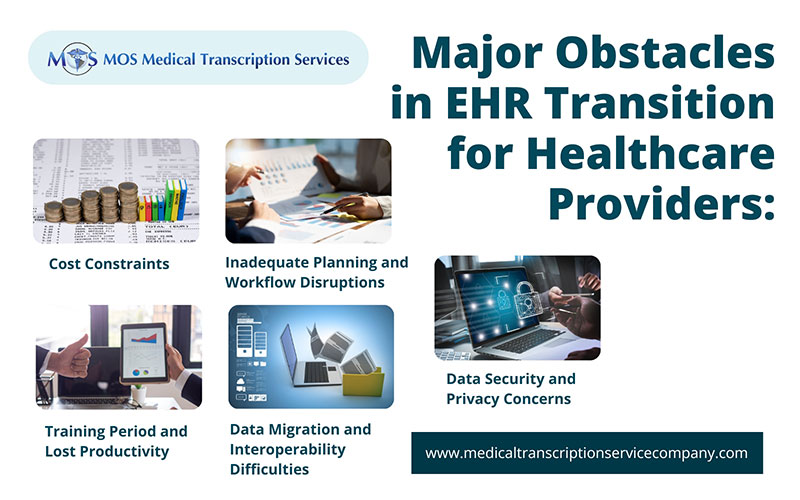
- Cost Constraints: Setting up EHR systems can be expensive. Costs include software, hardware, training, and ongoing maintenance. Smaller clinics often struggle to afford these expenses, making it hard to complete successful implementations.
- Poor Planning and Workflow Disruptions: A lack of detailed planning and coordination often leads to problems. Miscommunication between leaders, vendors, and staff can delay timelines and increase costs. Many healthcare organizations report that weak planning is their top challenge in EHR implementation.
- Inadequate Training and Productivity Loss: When staff don’t receive proper training, productivity drops. Poor training causes resistance to new systems, errors in data entry, and longer patient wait times. Continuous support and practical learning are key for success.
- Data Migration and Interoperability Issues: Transferring data from paper records to digital systems isn’t easy. Missing or incorrect data can cause clinical mistakes and workflow delays. If systems don’t communicate well across departments, it can result in repeated tests, slower diagnoses, and fragmented care.
- Security and Privacy Risks: EHRs hold sensitive patient information, making them targets for hackers. Weak cybersecurity can lead to breaches, ransomware attacks, or data loss. Healthcare providers must use strong encryption, secure access controls, and meet HIPAA standards to protect data.
Strategies for Successful EHR Implementation
Implementing digital health records can be complex and time-consuming. However, with the right approach, healthcare organizations can make the process smoother and more efficient. Below are key strategies for a successful and seamless EHR integration.
- Plan Thoroughly: Start with a detailed plan. Assess your current workflows and existing systems. Define clear objectives that align with your organization’s goals, so everyone understands why the new system is needed.
- Get Key Stakeholders Involved: Engage physicians, nurses, and IT professionals from the very beginning. Their input is essential for creating a system that truly works for those who use it daily.
- Provide User Training and Support: Training is critical for successful EHR implementation. Conduct hands-on training sessions so users can get comfortable with the new interface.
- Choose the Right EHR Vendor: Selecting the right EHR vendor is one of the most important steps. A reliable vendor can make or break your implementation success.
- Test the System before Full Implementation: Never skip the testing phase. Once your legacy systems are integrated, test the new setup thoroughly before the full rollout. Select a small group of users to test the system and share feedback. Address any issues or inefficiencies immediately.
- Continuous Monitoring and Improvement: EHR implementation doesn’t end after the launch. Continuous monitoring is vital to maintain system performance.
Create a step-by-step roadmap with realistic timelines. This will help your team stay organized, avoid common mistakes, and ensure a smooth transition from the old system to the new one.
Form a dedicated project team to keep everyone on track. When key staff members are involved early, they are more likely to support and adapt to the new system, leading to better outcomes.
After the system goes live, continue to provide technical support. Issues and questions will arise, and having immediate help available ensures a smoother transition.
Provide easy-to-follow manuals and resources so users can find answers independently when needed.
Do your research before signing a contract. Choose a provider whose system fits your practice’s needs and can adapt as your organization grows.
Look for vendors with a proven record of successful implementations and responsive technical support.
Fixing problems early prevents major disruptions later and ensures a smoother experience for everyone when the system goes live.
Regularly collect feedback from users to identify areas for improvement. Update the system with new features and enhancements as needed.
By keeping the system optimized, your organization stays efficient, compliant, and ready to adapt to future healthcare needs.
Overcome EHR Documentation Challenges with Medical Transcription
EHR deployment is essential for modernizing healthcare systems. However, it also brings several ongoing challenges, especially in maintaining timely and accurate clinical documentation. Before digital records became common, providers relied heavily on medical transcription services to document patient encounters.
Even today, transcription services remain valuable in improving efficiency and accuracy in healthcare workflows.
Manual data entry can be time-consuming and stressful for physicians. To address this, many healthcare organizations can work with professional medical transcription services. These partnerships help reduce administrative burden and improve documentation quality.
With medical transcription, healthcare providers can:
- Capture detailed clinical notes accurately.
- Ensure smooth integration of notes into digital patient records.
- Save time on manual data entry.
- Focus more on patient care instead of paperwork.
Accurate transcription not only supports efficient EHR documentation but also enhances the overall quality and timeliness of patient care.