Around one in five American adults experience a mental health condition each year, according to the National Institute of Mental Health. Over the past decade, mental health care has become increasingly common in the United States as awareness grows and barriers to treatment slowly diminish. Data from national surveys show that the percentage of U.S. adults receiving any mental health treatment rose between 2019 and 2023, with both counseling and medication use increasing during that period, according to a US Pharmacist report.
As the demand for care grows, high-quality behavioral health documentation has become more important than ever to protect both patients and providers. Unlike many other specialties, behavioral health relies heavily on narrative notes to capture patient symptoms, therapeutic interventions, risk assessments, treatment progress, and care plans. Many providers rely on medical transcription services to maintain mental health documentation standards, supporting efficient behavioral health record keeping as part of routine care.
Clear, accurate, and complete patient records support medical necessity, coding, billing, and continuity of care. It also helps behavioral health specialists stay focused on their patients while delegating parts of the documentation process to trained professionals.
Why High Quality Behavioral Health Documentation is Important
In today’s value-based care environment, providers are evaluated not on the basis of the volume of services delivered, but how effectively those services improve a patient’s symptoms, stability, and quality of life. In this situation, precise behavioral health clinical documentation is crucial to track patient progress, drive compliance, and provide measurable outcomes that reflect quality of care.
Robust mental health documentation practices are essential to:
- Determine medical necessity: ensure treatments are justified, capture clinical reasoning, and meet payer requirements.
- Track patient progress: monitor symptoms, response to treatment, and care outcomes.
- Support evidence-based decisions: guide clinicians in making informed, data-driven treatment choices.
- Reduce claim denials: support claims and minimize the risk of reimbursement issues.
- Enhance care coordination: provide multidisciplinary teams with access to timely, accurate information for consistent patient care.
- Protect patient safety: ensure comprehensive records that preserve critical clinical history.
- Facilitate informed handoffs: avoid missing context or gaps.
Beyond clinical value, clear, defensible records support behavioral health audit readiness, protecting providers against legal risks and reimbursement disputes.
Key Components of Therapy Session Documentation
Mental health EHR documentation consists of objective, professional records that track client treatment, support billing, and ensure continuity of care. Essential components include session details, client presentation, risk assessment, interventions used, and the treatment plan. Standard formats like SOAP (Subjective, Objective, Assessment, Plan) or BIRP (Behavior, Intervention, Response, Plan) are used to maintain compliance. Providers should maintain clear records of the following:
- Intake and Assessment: Accurate intake and assessment documentation helps support a proper diagnosis. It should include a detailed diagnostic evaluation, clinical interview, and psychiatric assessment. Providers should also rule out alternative diagnoses.
Essential information to document:
- Presenting concerns
- Mental health history
- Previous treatments
- Current healthcare providers
- Demographics
- Medications
- Substance use details
- Physical and mental health conditions
This section should also include descriptions of current medications, treatments, assistive devices, and any past medication side effects.
- Treatment Plan: A strong treatment plan outlines the patient’s diagnosis, goals, objectives, interventions, and treatment options. It should also specify the treatment modality, session frequency, and how progress will be measured over time.
- Ongoing Care: If a patient needs a referral or a transfer to another provider, clear documentation is essential. This includes details of the informed-consent discussion, reasons for the change, and confirmation that the patient understands their rights. Documenting the potential benefits and risks of new programs or services is also important.
- Transferring Care: Accurate progress notes in behavioral health support proper billing, reimbursement, and overall care. These notes are also important for other providers involved in the patient’s treatment. They should include demographic information, subjective and objective descriptions of client behavior, symptoms, a diagnosis summary, what the client discussed in each session, the clinician’s professional opinion, a treatment plan, and referrals if necessary. Details that should be recorded:
- The basis for the referral or transfer
- The specific provider or program the patient is being referred to
- The important points covered in the informed consent conversation
- The patient’s agreement to go ahead with the referral/transfer
- Discharge Summary: When treatment is complete, a discharge summary should be prepared and signed by both provider and patient. This summary must include the final diagnosis, reason for discharge, progress toward treatment goals, any safety risks, and helpful post-discharge resources or referrals.
Ensuring medical necessity in behavioral health records requires documenting that services are clinically appropriate, evidence-based, and directly address functional impairments linked to a specific diagnosis.
Best Practices for Behavioral Health Clinical Notes
Adopting best practices in behavioral health recordkeeping helps providers improve patient outcomes, reduce audit risk, and strengthen reimbursement integrity. Providers must keep complete and accurate documentation of every patient encounter. This includes documenting the medical necessity for each service provided. Best practices to ensure strong documentation include:
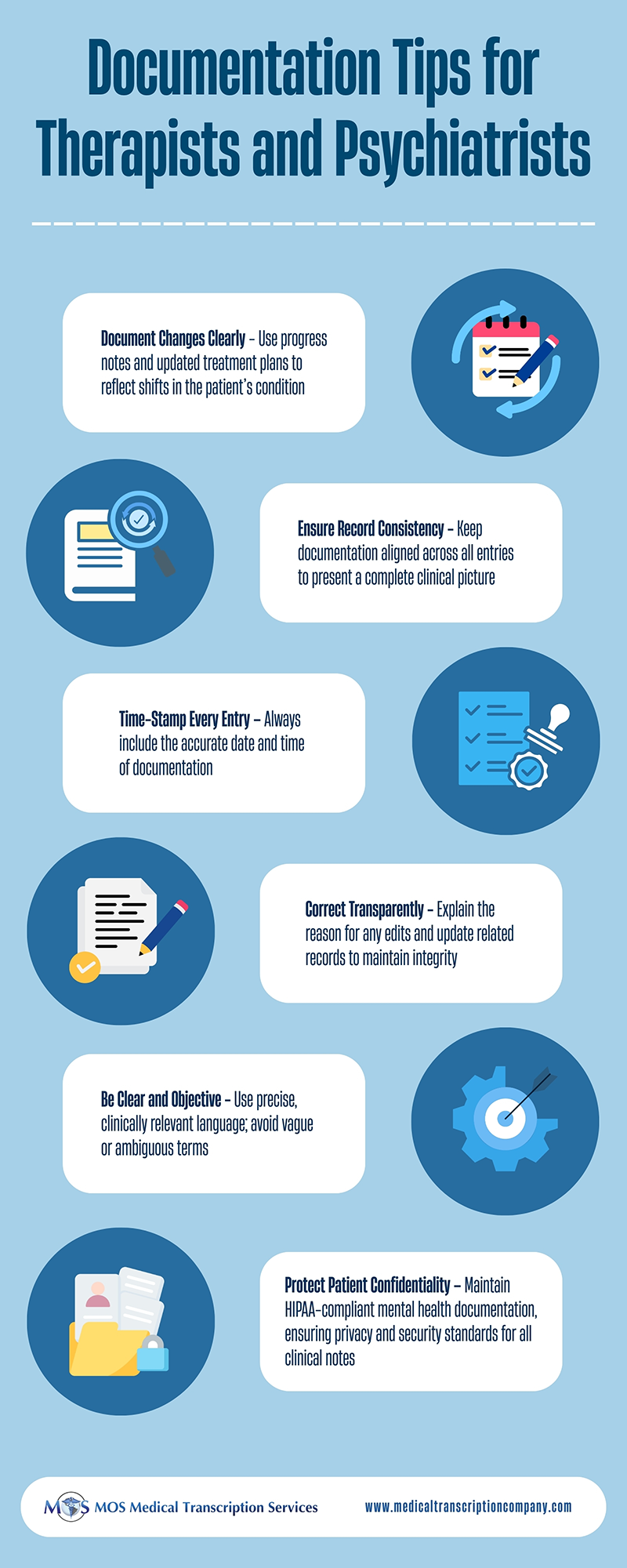
- Clearly document changes in the patient’s condition through detailed progress notes and updated treatment plans.
- Ensure consistency across all records to present a cohesive and comprehensive clinical narrative.
- Record the precise date and time for every clinical entry to maintain documentation accuracy and accountability.
- When making corrections, document the reason for the change and revise any related records to preserve record integrity.
- Use specific, objective, and clinically relevant language; avoid vague or ambiguous terminology.
- Safeguard patient confidentiality by adhering strictly to HIPAA privacy and security guidelines.
Trends in Mental Health Illness Prevalence and Service Use
The use of behavioral medicine services has increased along with the rising prevalence of “any mental illness” (AMI) and “serious mental illness” (SMI). National surveys indicate that treatment utilization among adults with mental illness has increased modestly in recent years, with both counseling and prescription medication use rising.
Recent data from the National Institute of Mental Health shows that:
- About 23 % of adults or over 60 million people experience a diagnosable mental illness each year
- Young adults (ages 18-25) continue to have the highest prevalence, and females overall report higher rates than males.
- Serious mental illness, which substantially interferes with daily functioning, affects roughly 6 % of U.S. adults
Though service use has generally expanded over time, significant gaps persist. Mental Health America notes that nearly 1 in 4 adults with a mental health condition report unmet treatment needs, and a significant proportion of youth lack adequate preventive care.
Teletherapy and digital platforms are now increasingly used to expand access to, especially for those reluctant to seek traditional services. Research from RAND published in August 2023 showed that mental health service use increased by 22% during the early phase of the pandemic. While in-person visits dropped by 40%, tele-mental health visits increased ten-fold compared to the previous year.
The research covered anxiety disorders, major depressive disorder, bipolar disorder, schizophrenia, and PTSD. As study coauthor Dena Bravata notes, the rising demand highlights the need to integrate behavioral health into primary care. This integration can help improve access, reduce stigma, and support a more comprehensive approach to patient well-being.
Outsourcing Medical Transcription Strengthens Behavioral Health Recordkeeping
Contracting out behavioral medicine transcription tasks is an effective way to strengthen documentation quality. By relying on AI-integrated HIPAA compliant medical transcription services, providers can ensure high-quality behavioral health documentation that meets clinical and legal standards. Trained transcriptionists carefully review automatically generated reports to ensure they are error-free. A professional medical transcription company can deliver organized, legible, and complete SOAP, DAP, EMDR, intake notes in fast turnaround time, enabling behavioral health specialists to focus on patient care while experts their manage documentation.