
The transition from paper-based records to electronic health records (EHRs) has significantly increased clinical documentation requirements. As a result, many clerical tasks, including EHR data entry, have become additional responsibilities for physicians. Medical transcription services provide a vital solution by accurately converting physician dictations into text format, ensuring seamless integration into EHR systems and allowing healthcare professionals to focus more on patient care.
Specialty medical transcription involves the precise and detailed documentation of medical records tailored to specific medical specialties, such as cardiology, neurology, orthopedics, and more. Traditionally, medical transcriptionists would listen to recorded dictations from physicians and manually transcribe them into written reports. However, AI is revolutionizing transcription for specialties by using advanced algorithms to convert physician dictations into accurate written text. AI’s transformative role lies in its ability to maintain contextual accuracy, ensuring that specialized medical terms and clinical nuances are captured correctly, enhancing both efficiency and quality in the transcription process.
This post examines how AI enhances accuracy in specialty medical transcription without losing context.
What is Contextual Accuracy in Specialty Transcription?
Medical specialties such as cardiology, neurology, and orthopedics have unique medical terminology, clinical practices, and nuances.
Contextual accuracy in specialty transcription refers to the ability of human or AI transcription systems to correctly interpret and convert spoken domain-specific language, jargon, acronyms, and terminology into words by considering the surrounding context. It ensures that the documentation is not just word-for-word accurate but also semantically and contextually correct.
Why it matters:
In areas like medical, legal, or technical transcription, words may have multiple meanings depending on context. For example, “discharge” in medicine could mean patient release or fluid secretion.
Misinterpretation can lead to serious errors in patient care, legal documentation, or technical instructions. Accurate contextual transcription reduces the need for manual corrections and improves trust in automated systems.
Other challenges in specialty clinical documentation include:
- Volume and Speed: The growing volume of patient data and the demand for quick turnarounds put immense pressure on transcriptionists to maintain accuracy while meeting deadlines.
- Compliance and Legal Requirements: Transcriptions need to adhere to strict regulatory guidelines such as HIPAA. Accurate transcription is also crucial for audits, patient care, and billing purposes.
AI-assisted medical transcription automation can address these challenges efficiently, enhancing contextual accuracy and rationalization workflows.
How AI Transcription for Specialties achieves Contextual Accuracy
AI in specialty transcription achieves contextual accuracy by moving beyond simple “speech-to-text” and into “speech-to-understanding.” AI-powered transcription tools are trained using custom vocabularies. Adding domain-specific terms, acronyms, and brand names to the systems improves recognition. While a general AI might hear “MI” and think “Michigan,” a medical-grade AI knows that in a cardiology clinic, it almost certainly means “Myocardial Infarction”. Contextual boosting allows AI to use clues from the surrounding words to understand tricky terms correctly. For example, when a doctor says two similar-sounding drug names, the system looks at the other words in the sentence to figure out which drug they mean.
Let’s explore the four primary layers that help AI achieve contextual accuracy: Specialized Language Models (SLMs), Clinical Reasoning Engines, Longitudinal Data Integration, and Multi-speaker Diarization.
- Specialty-Specific Language Models
Unlike general AI models trained on the internet, medical AI is fine-tuned on clinical datasets containing millions of hours of specialty-specific dialogue. This allows the AI to distinguish between “near-homophones”—words that sound identical but have vastly different medical meanings. Here are some examples:
For example, in Cardiology, AI can accurately interpret the term “P-T” as referring to blood thinner monitoring. In physical therapy, “P-T” or “PT” would be recognized as referring to the treatment session itself.
In Orthopedics, it can interpret “ACL” (Anterior Cruciate Ligament) in the context of knee stability. Conversely, in General Computing, ACL would be interpreted as Access Control List, related to security permissions
- Clinical Reasoning & Structure (NLP)
Besides getting the words right, contextual accuracy is also about putting them in the right place. Natural Language Processing (NLP) identifies the intent behind the speech to build structured notes like SOAP (Subjective, Objective, Assessment, Plan).
For example, it can distinguish Symptoms from History – If a patient says, “My father had a heart attack,” cardiology AI transcription tools recognize this as Family History, not the patient’s Chief Complaint.
- Longitudinal Data Integration (EHR Sync)
Advanced AI systems achieve accuracy by “reading the room” before the physician even speaks. They sync with the EHR to know the patient’s history. Here’s an example pertaining to Psychiatry transcription:
If a psychiatrist references “lithium,” the AI checks the patient’s current medication list. If the patient is already on it, the AI documents the conversation as a “medication check” rather than a “new prescription.”
- Multi-speaker Diarization
Context is often lost when AI can’t tell who is talking. Specialized AI uses Diarization to separate the voices of the doctor, the patient, and a nurse. AI multi-speaker diarization in medical transcription keeps conversations organized and medically precise.
Consider a conversation with a patient on their pain. The physician asks the patient to describe the pain and the nurses asks the patient whether any medication was taken for it. The patient replies: “Just over-the-counter ibuprofen, but it hasn’t helped much” and the doctor recommends ordering an MRI to investigate further. In this context, AI multi-speaker diarization:
- Identifies the speaker: Doctor, patient, and nurse are clearly separated.
- Ensures medical accuracy: Terms like ibuprofen and MRI are correctly captured.
- Provides context clarity: Ensures the transcript reflects the clinical dialogue without confusion about who said what.
In summary, AI-driven tools ensure that the transcription is not just word-for-word accurate but also semantically and contextually correct.
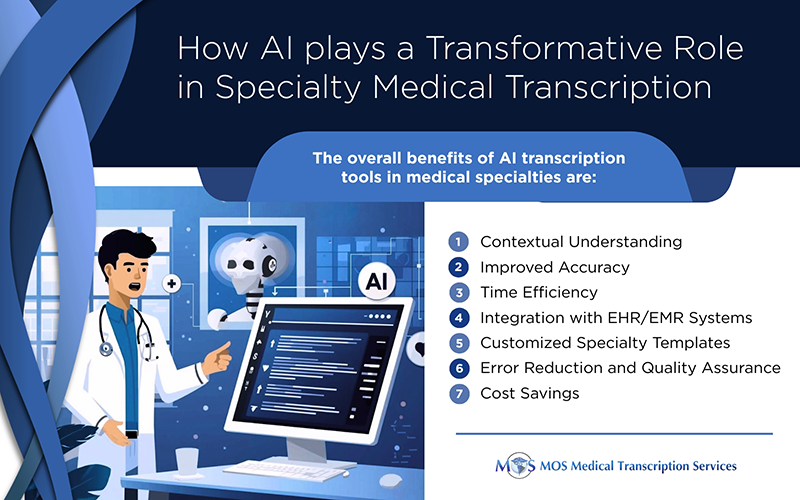
Overcoming Transcription Challenges in Specialty Medicine with AI and Expert Support
As AI technology advances, reports predict that even more specialized applications will make an appearance, such as voice-activated documentation powered by AI assistants, enhanced accuracy in dialects and accents, and AI-driven analytics that track patient trends and recommend treatment improvements.
By leveraging advanced algorithms, AI ensures that complex medical terminology is transcribed correctly while maintaining the nuances of each specialty. Professional medical transcription in the US can play a key role here. By integrating human-in-the-loop validation, a medical transcription company ensures that the final transcriptions meet the highest standards of quality and accuracy. This hybrid approach allow medical specialists to ensure efficient, precise documentation while focusing better on patient care and outcomes.