Why are dermatologists spending more time documenting complex skin conditions in EHRs than engaging with patients?
From tracking lesion variations to documenting detailed treatment plans, clinical documentation in dermatology can be time-consuming and complex. This is where dermatology transcription services make a significant difference.
They convert spoken observations into structured, accurate medical records—reducing manual effort and improving workflow efficiency.
Modern solutions combine AI-powered transcription with human expertise, ensuring:
- Accurate documentation
- Seamless EHR integration
- Reduced administrative burden
This enables dermatologists to focus more on patient care while maintaining high-quality documentation.
Why Dermatologists Need EHR Software
Dermatology involves a mix of clinical, cosmetic, and procedural workflows, making documentation more complex than in many specialties.
Dermatology EHR systems help:
- Capture detailed skin assessments
- Track lesion progression over time
- Manage high-quality clinical images
At the same time, electronic health records for dermatology:
- Accelerate documentation
- Reduce manual errors
- Improve billing accuracy
- Minimize claim denials
A well-designed EHR system enhances workflow efficiency, improves financial outcomes, and supports better patient care.
Best EHR Systems for Dermatology Practices
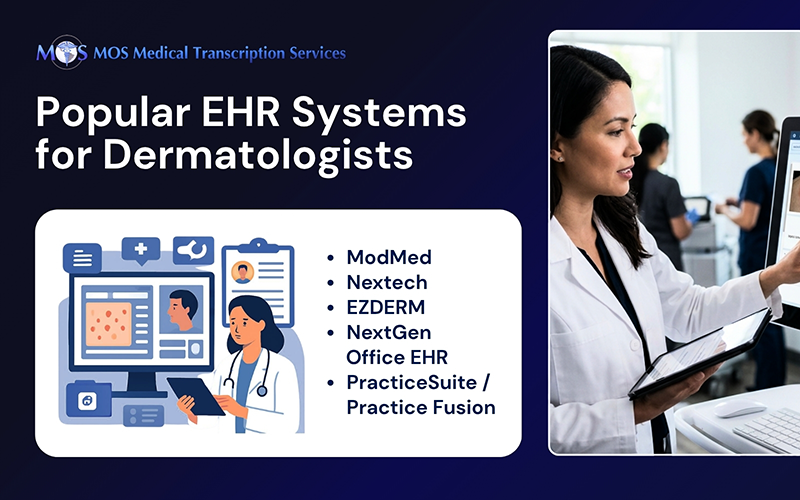
Choosing the right EHR system is critical for dermatology practices, where image-heavy documentation, detailed charting, and fast-paced consultations demand specialized tools. The best EHR systems are designed to streamline workflows, improve diagnostic accuracy, and support efficient patient management. Here are 5 of the best EHR systems for dermatologists.
- ModMed
ModMed’s EMA is a dermatology-focused EHR software designed to simplify clinical documentation and align with real-world dermatology workflows. Built specifically for medical and surgical dermatology, it uses structured documentation that mirrors common clinical scenarios, helping dermatologists record patient encounters more efficiently. The system is particularly suited for mid-sized to large practices that prefer a standardized, specialty-driven approach over highly customizable systems.Key Features:
- Dermatology-specific templates
- Intelligent touch-based documentation
- Integrated practice management and billing
- ePrescribing functionality
- MIPS reporting support
- Advanced imaging tools
ModMed reduces the time spent on documentation by offering ready-to-use templates and intuitive workflows. It improves accuracy in clinical notes, streamlines billing processes, and enables easy management of patient images—helping dermatologists enhance efficiency while maintaining high-quality patient records.
- Nextech
Nextech provides specialized EHR software tailored for dermatology and aesthetics practices, supporting both clinical and procedural workflows. The platform is designed to handle high patient volumes and complex operational needs.
Key Features:
- Dermatology EHR system
- Practice management tools
- Revenue cycle management
- Patient engagement solutions
- Inventory tracking
- Imaging integrations
Nextech improves billing accuracy, supports better patient communication, and helps track treatments through imaging tools. This results in smoother workflows, improved financial performance, and better overall patient management.
- EZDERM
EZDERM is a dermatology-focused EMR software designed to support the specific clinical and operational needs of skin care practices. The platform streamlines dermatology workflows by enabling accurate documentation of skin conditions, procedures, and patient histories.
Key Features:
- Dermatology-specific EMR system
- Body mapping for precise lesion tracking
- Image capture for visual documentation
- Practice management tools
- Billing integration
- Pathology tracking
EZDERM helps dermatologists monitor skin conditions over time and improve diagnostic accuracy. Its integrated billing and pathology tracking also simplify administrative tasks, enabling practices to maintain organized records while enhancing overall workflow efficiency.
- NextGen Office EHR
NextGen Office EHR is a scalable, cloud-based EHR and practice management solution designed to support dermatology practices. It combines clinical documentation, administrative workflows, and e-prescribing within a single platform. The system is particularly beneficial for practices planning long-term expansion, as it can seamlessly adapt from solo providers to multi-location or multi-provider setus.
Key Features:
- Scalable architecture for growing practices
- Integrated e-prescribing within clinical workflows
- Comprehensive reporting and analytics
- Practice management integration
- Multi-provider and multi-location support
- PracticeSuite / Practice Fusion
PracticeSuite and Practice Fusion are cloud-based EHR and practice management solutions designed to offer simplicity, accessibility, and affordability for dermatology practices. These platforms combine essential clinical and administrative functions into a single system, making them ideal for small or solo practices that need efficient workflows without the complexity of large enterprise software. With easy setup and user-friendly interfaces, they help dermatologists manage everyday operations while maintaining accurate and compliant patient records.
Key Features:
- All-in-one EHR and practice management (charting, scheduling, billing)
- Integrated e-prescribing
- Cloud-based access
- Patient record management
- Appointment scheduling
- Billing and claims management
It simplifies prescribing common dermatologic medications, streamlines follow-ups and refills, and ensures regulatory compliance. Dermatologists can save time, improve workflow efficiency, and focus more on patient care, especially in small to mid-sized practices
Role of Transcription Services in Dermatology Documentation
Accurate documentation is important in dermatology, where even minor variations in skin conditions must be recorded precisely.
The role of transcription services in dermatology documentation includes:
- Converting dictation into structured reports
- Ensuring clarity and completeness
- Supporting accurate clinical records
Modern transcription services go beyond basic documentation by enabling seamless EHR integration. While implementing EHR systems can come with certain challenges, advanced medical transcription services make the process much easier.
They:
- Format reports for direct EHR upload
- Reduce manual data entry
- Minimize documentation errors
Importantly, they combine:
- AI-driven automation for speed
- Human expertise for accuracy and compliance
This ensures reliable clinical documentation in dermatology while improving workflow efficiency.
FAQs
How do medical transcription services reduce documentation time?
They convert dictated notes into structured reports quickly, reducing manual typing.
Do medical transcription services support EHR integration?
Yes, they integrate seamlessly with EHR systems for real-time updates.
Can transcription services handle complex dermatology terminology?
Yes, trained experts ensure accurate capture of specialized terms.
How do medical transcription services improve patient care?
By reducing administrative workload, enabling dermatologists to focus more on patients.